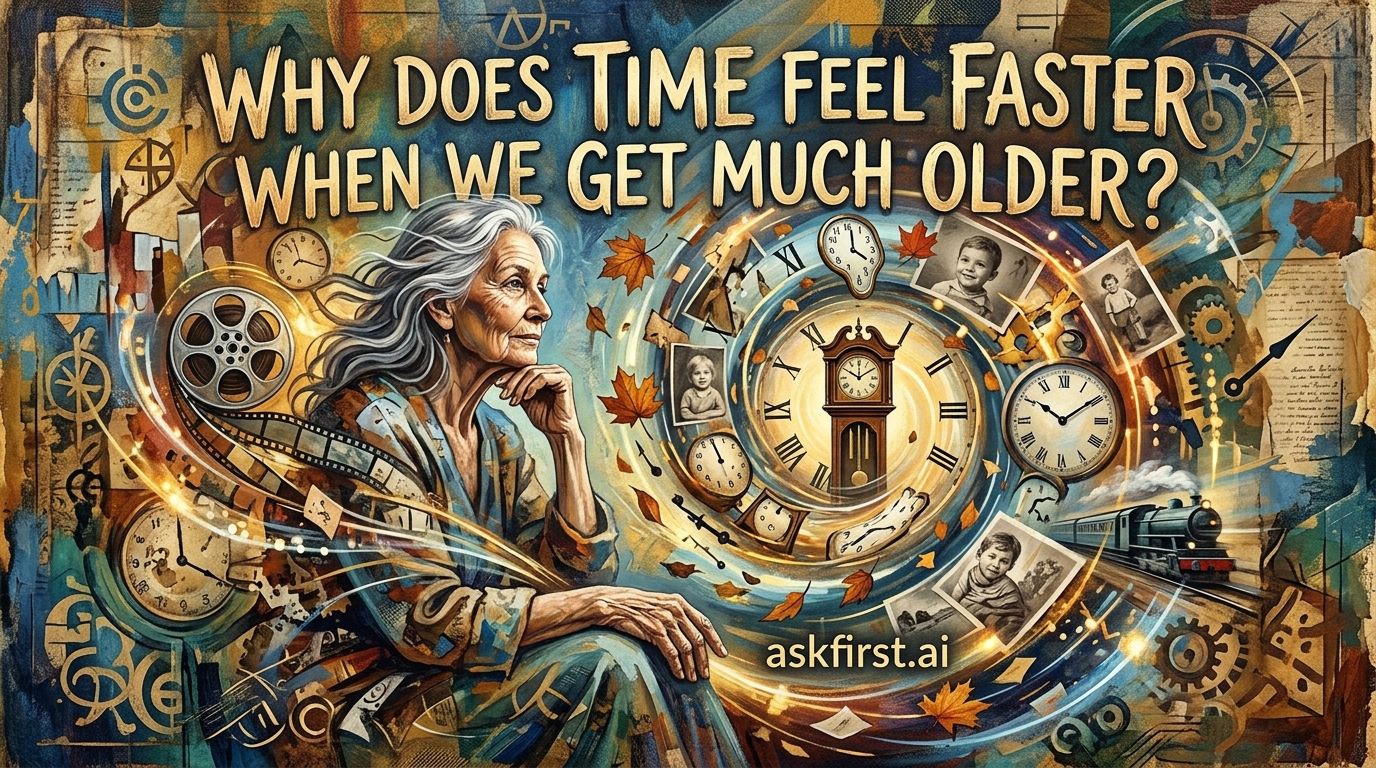
The Phenomenon of Compressed Perception
Human perception of time is far from a fixed, mechanical constant. While clocks tick in precise, metronomic seconds, the subjective experience of time is fluid, malleable, and deeply dependent on neurobiology and cognitive processing. As individuals age, a common observation is that the years seem to accelerate, with summers feeling shorter and decades passing in the blink of an eye. This is not merely a metaphor; it is a scientifically documented shift in how the brain encodes memory and processes the flow of reality.
The Proportional Theory
One of the most persistent explanations is the Proportional Theory, often attributed to the philosopher Paul Janet in 1877. This hypothesis suggests that our perception of time is relative to the total length of the life we have already lived. For a five-year-old, a single year represents 20% of their entire existence. The magnitude of that period feels massive because it constitutes a significant chunk of their memory bank. By the time someone reaches fifty, a year is merely 2% of their life. Because the interval represents a smaller fraction of the totality, the brain categorizes it as a less significant, faster-moving unit of time.
The Novelty and Memory Encoding Hypothesis
Neuroscience offers a more compelling explanation known as the "Novelty Effect" or "Memory Storage Theory." Our brains use new, unfamiliar experiences as markers to measure time. When a person is young, the world is a gallery of constant discoveries. Every "first"—the first day of school, the first bike ride, the first time visiting a new city—creates rich, detailed neuro-networks in the brain. Because the brain spends more energy and synaptic processing on novel experiences, the passage of time is encoded with greater density. When we look back at our youth, these dense memory markers make those periods feel significantly longer.
As we enter adulthood and settle into routines, our environments become predictable. This is the phenomenon of cognitive automation. When the brain performs repetitive tasks—commuting, working the same job, following consistent daily schedules—it does not need to record these moments with high resolution. It treats them as 'background noise' to preserve mental energy. Without vivid, new memory markers to define the passage of days, the mind perceives these stretches of time as a blur. Thus, years spent in the same repetitive cycle feel as though they have evaporated instantly.
Neurochemical Modulation
Emerging research also points to the role of dopamine, a neurotransmitter that helps regulate the internal clock. Research suggests that as people age, the production of dopamine in the brain often stabilizes or decreases. Dopamine is essential for gauging the duration of events. If the neurological clock speed varies based on these chemical concentrations, it might affect how fast or slow we perceive the external flow of time. Additionally, the deterioration of certain sensory inputs—the way the eyes capture information or the way the brain processes auditory signals—may contribute to a lower frequency of sampling the world, creating the subjective sense that reality is skipping frames.
Strategies to Expand Subjective Time
Understanding this mechanism provides a powerful tool for self-improvement and life management. If the perception of time is linked to the density of new information, then one can technically 'lengthen' their life experience by resisting automation. Here are several scientifically backed strategies to combat the sensation of 'fast' time:
- Prioritize Novelty: Actively seek out new hobbies, travel to unfamiliar locations, or learn a challenging skill. Novelty forces the brain to pay attention and increases the density of memories recorded.
- Practice Mindfulness: Being present forces the brain to process the immediate, sensory reality in detail. Meditation and deep-focus activities prevent the brain from slipping into the autopilot mode that causes days to vanish.
- Break the Routine: Even small deviations in your daily life, such as taking a different route to work or engaging with new people, can act as 'temporal anchors' that make a month feel longer.
- Document Experiences: The act of writing, photographing, or reflecting on one's day forces the brain to review the events, effectively reinforcing the memory tracks that define how long we feel our lives have lasted.
Conclusion
In essence, time does not accelerate because of a glitch in physics, but because of a change in cognitive processing. By shifting from a state of 'automatic living' to 'active experiencing,' one can reclaim the feeling of a long, rich, and well-defined existence. The years may move at the same speed on the wall clock, but the internal clock is entirely under the influence of how much life we decide to pack into every passing second.