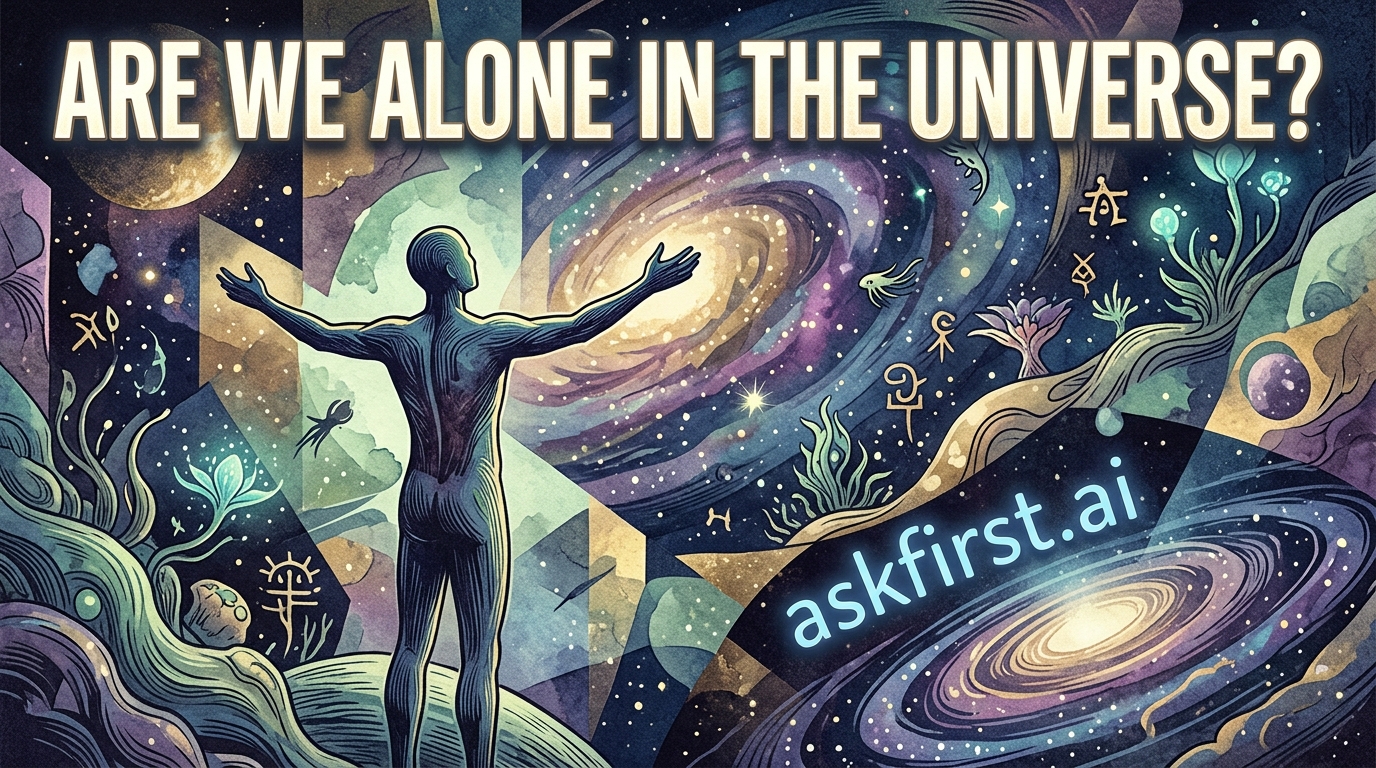
The question of whether we are alone in the universe is perhaps the most profound inquiry humanity has ever dared to pose. It sits at the intersection of astrobiology, cosmology, and philosophy, challenging our understanding of our place in the cosmic tapestry. While we have yet to secure definitive, empirical evidence of extraterrestrial life, the scientific consensus has shifted dramatically over the past few decades from skepticism to a cautious, data-driven optimism.
The Statistical Argument: The Drake Equation
To begin an objective analysis, one must look at the sheer scale of the cosmos. The Drake Equation, formulated by astronomer Frank Drake in 1961 at the Green Bank Observatory in West Virginia, serves as a probabilistic framework for estimating the number of active, communicative extraterrestrial civilizations in the Milky Way galaxy.
The equation accounts for variables such as the rate of star formation, the fraction of those stars with planets, the number of planets that could support life, and the longevity of civilizations. Even with conservative estimates, the sheer volume of the observable universe—containing an estimated two trillion galaxies—suggests that life should be a cosmic imperative rather than a miraculous accident. As Carl Sagan famously noted in his seminal work Cosmos (1980), "The universe is a pretty big place. If it's just us, seems like an awful waste of space."
The Goldilocks Zone and Exoplanetary Research
For decades, we searched for life by looking at our own solar system, but the focus has shifted toward exoplanets—planets orbiting stars beyond our sun. Thanks to the Kepler Space Telescope and the more recent James Webb Space Telescope (JWST), we now know that planets are not rare; they are ubiquitous.
A critical concept here is the "Habitable Zone" or "Goldilocks Zone," the region around a star where conditions are just right for liquid water to exist on a planet's surface. According to data published by NASA’s Exoplanet Archive, we have confirmed thousands of exoplanets, many of which reside in these habitable regions. For example, the TRAPPIST-1 system, located about 40 light-years away, contains seven Earth-sized planets, several of which orbit within the habitable zone. This discovery, detailed extensively by Michaël Gillon and his team in the journal Nature, provides a concrete template for where we should be focusing our search for biosignatures, such as methane or oxygen in planetary atmospheres.
The Fermi Paradox and the Great Filter
If the universe is teeming with potential, why have we not encountered any evidence of intelligent life? This contradiction is known as the Fermi Paradox, named after physicist Enrico Fermi. During a lunch conversation at Los Alamos National Laboratory in 1950, Fermi famously asked, "Where is everybody?"
Several hypotheses attempt to resolve this. One compelling theory is the "Great Filter," proposed by economist Robin Hanson. This theory suggests that at some point in the evolution of life—from the formation of simple cells to the rise of space-faring civilizations—there is an insurmountable hurdle that prevents life from becoming interstellar. If the filter is behind us (for instance, the transition from prokaryotic to eukaryotic cells), we may be rare. If the filter is ahead of us (such as the tendency for civilizations to destroy themselves via nuclear war or climate collapse), then we are likely in a precarious position.
The Search for Technosignatures
Modern SETI (Search for Extraterrestrial Intelligence) programs have evolved beyond simply listening for radio signals. Researchers like Jill Tarter, the former director of the Center for SETI Research, have emphasized the need to look for "technosignatures"—deliberate modifications of the environment that indicate advanced technology. This could include Dyson spheres (massive structures built around stars to harness their energy), laser pulses, or industrial pollutants in the atmospheres of distant exoplanets. The Breakthrough Listen project, funded by Yuri Milner, represents the most comprehensive search for such signals to date, utilizing the Green Bank Telescope and the Parkes Observatory to scan the skies with unprecedented sensitivity.
Conclusion: A Shift in Perspective
While we currently lack a "smoking gun" that confirms we share the universe with others, the scientific trajectory points toward a cosmos that is likely abundant with biological potential. We are living in a golden age of astronomy where the tools to detect life are finally catching up to the scale of our questions. Whether life is common or incredibly rare, the search itself forces us to re-examine our own civilization, our fragility, and our responsibilities as a species that has only just begun to look upward. We may not have found them yet, but we are no longer merely guessing; we are systematically investigating the possibility that the silence of the night sky is not an absence of life, but a reflection of the vast, unconquered distances between us.