The Evolutionary Mechanism of Negativity Bias
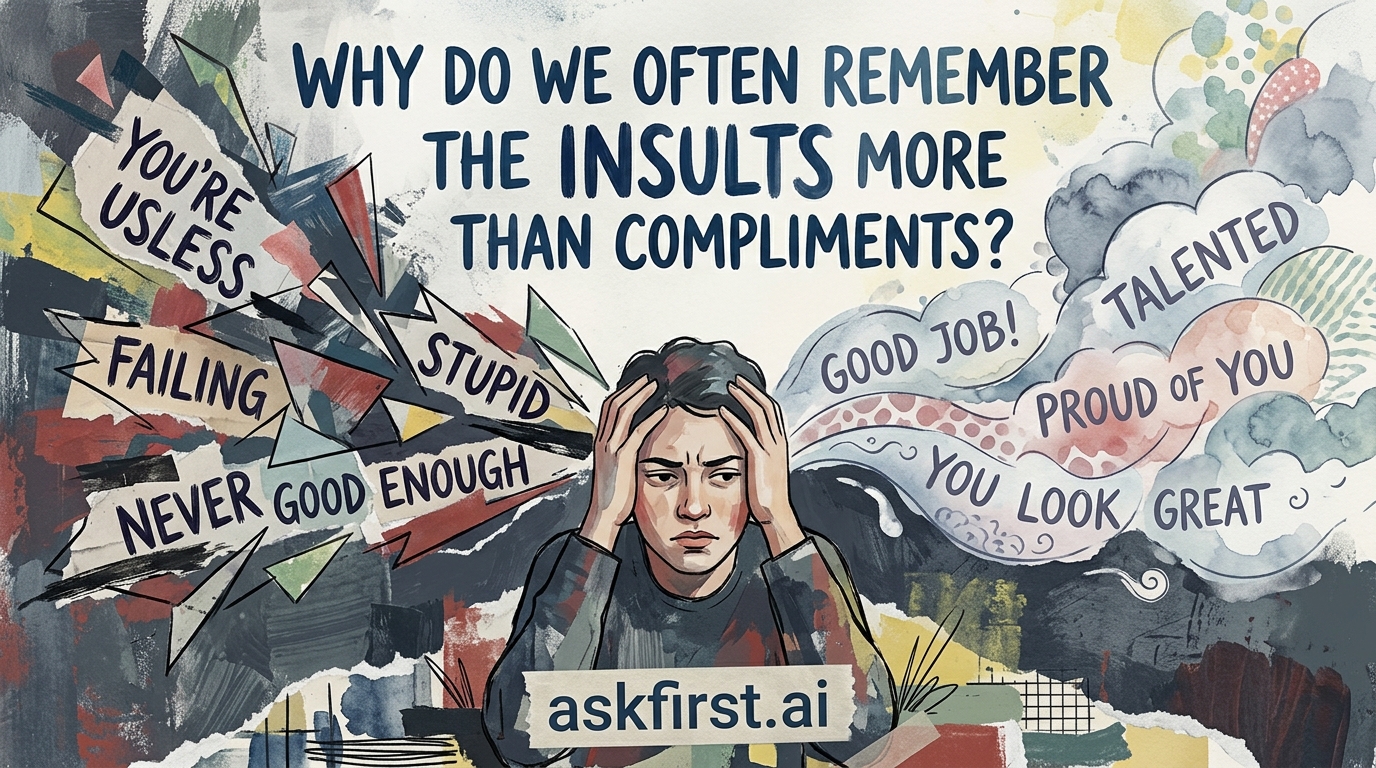
Human memory is not a neutral recorder of events; it is a survival-oriented filter. The psychological phenomenon where individuals recall negative experiences—such as insults—with greater clarity and intensity than positive interactions—such as compliments—is known as the Negativity Bias. From an evolutionary standpoint, this is not a personal failure of character, but a highly efficient survival strategy honed over millions of years. For early humans, failing to notice a predator or a dangerous social slight could mean death or expulsion from a group, whereas missing a positive social cue was rarely life-threatening. Consequently, the brain evolved to prioritize threats.
The Neurobiology of the Brain's Warning System
Neuroscience provides concrete evidence for why insults leave deeper marks. When a human experiences an insult, the amygdala—the brain’s alarm system—is triggered almost instantaneously. This activation releases stress hormones such as cortisol and adrenaline, which sharpen attention and prioritize the storage of the event in long-term memory.
- Increased Neural Activity: Functional MRI studies demonstrate that the brain shows significantly more electrical activity when processing negative stimuli compared to positive ones.
- Encoding Depth: Because negative feedback is perceived as a potential social threat, the brain dedicates more cognitive resources to encoding the information, ensuring it is readily available for future 'threat avoidance.'
Social Survival and the Cost of Ostracism
Beyond mere biology, the sociological component of human existence plays a major role. Humans are inherently tribal creatures; survival for ancestors depended entirely on maintaining a status within a collective. Being insulted often signals social disapproval or a decline in rank within the social hierarchy. To be ignored or ostracized by the group meant a lower probability of survival.
- The Hierarchy Factor: Insults act as signals of social risk. The brain registers the disapproval of others as a threat to belonging.
- The Contrast Effect: Compliments, while rewarding, often feel like 'maintenance' of a positive state, whereas insults feel like an 'interruption' that demands an immediate, remedial response.
The Asymmetry of Emotional Processing
Psychologists have identified a fascinating mathematical asymmetry in human relationships: the 'Gottman Ratio.' Research by Dr. John Gottman suggests that it takes approximately five positive interactions to counteract the emotional weight of a single negative one in a stable relationship. This '5:1 ratio' exists because insults carry an inherent emotional 'weight' that is heavier than the buoyant effect of a compliment. The human psyche is essentially loss-averse; people feel the pain of a loss (or insult) much more intensely than they feel the joy of an equivalent gain (or compliment).
Cognitive Reframing and Memory Management
Understanding that this bias is a 'default setting' of the human brain allows individuals to consciously mitigate its effects. While it is impossible to 'turn off' the amygdala’s reaction, cognitive reappraisal can change how one integrates these memories:
- The 24-Hour Rule: By delaying reaction to an insult, individuals allow the initial physiological 'spike' to dissipate, shifting processing from the emotional amygdala to the rational prefrontal cortex.
- Intentional Savoring: Because compliments are processed quickly and filed away as background data, individuals must practice 'savoring'—spending extra mental time focusing on the positive feedback to force the brain to treat it with the same level of importance as a threat.
Why This Is Actually a Strength
While the lingering sting of an insult is frustrating, it is an essential component of self-improvement and adaptability. If humans were not bothered by negative feedback, there would be no impetus to adjust behaviors, improve social skills, or rectify errors in performance. The 'memory of the insult' acts as a cautionary blueprint. It prevents the repetition of social mistakes and drives the desire for growth.
In conclusion, the tendency to remember insults over compliments is a testament to the sophistication of the human mind. It is a biological legacy designed to keep the individual safe, aware, and socially integrated. By recognizing this pattern as a natural part of being human rather than a personal deficiency, individuals can better manage their emotional responses, ensuring that constructive criticism is utilized for growth while baseless insults are relegated to their proper place as outdated evolutionary noise.