The Psychological Illusion of Accelerated Time
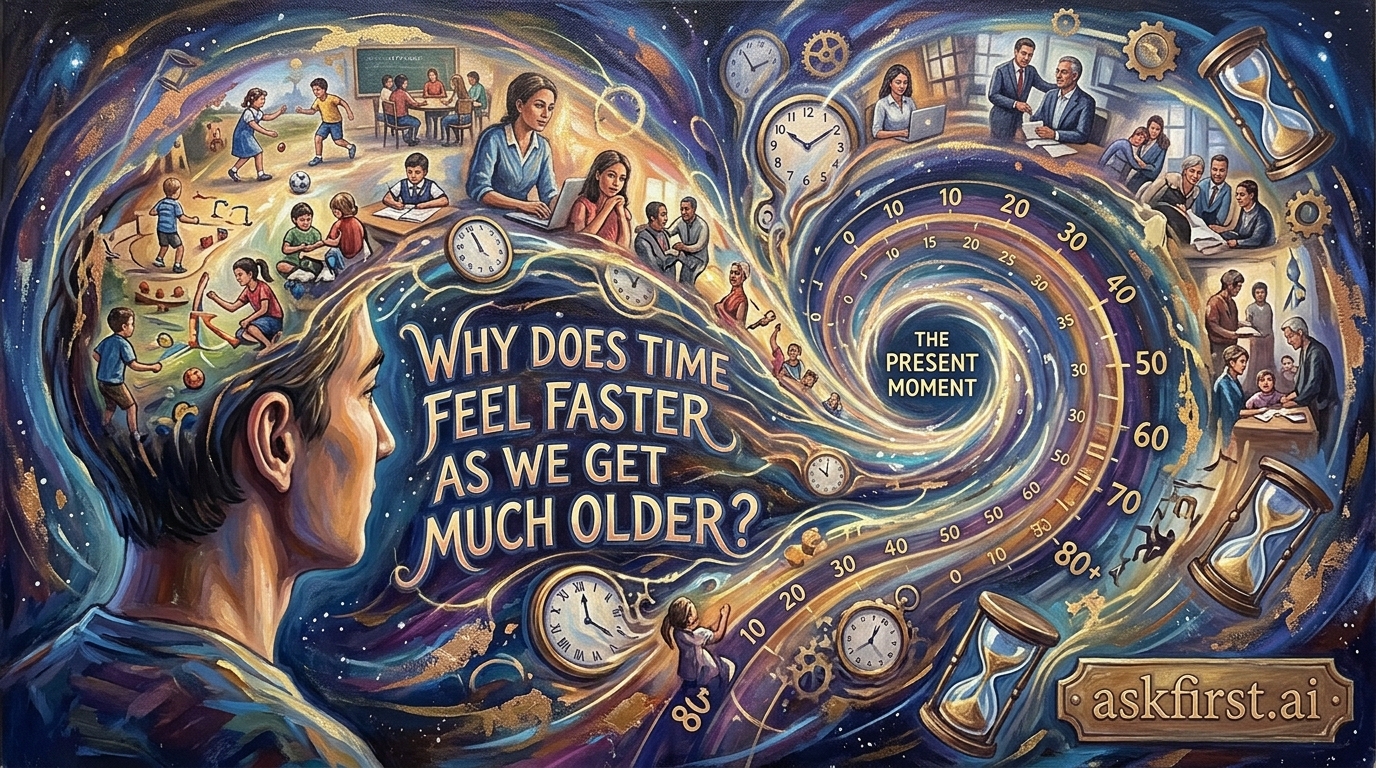
Many individuals report a pervasive sensation that time moves more rapidly as the calendar pages turn. This phenomenon, while seemingly subjective, is supported by a robust framework of neurological and psychological theories. The perception of time is not a linear measurement like the ticking of a clock; rather, it is a constructive process managed by the brain, highly influenced by memory density, novelty, and physiological processing speeds.
The Proportional Theory
One of the most mathematically intuitive explanations is the Proportional Theory, first proposed by French philosopher Paul Janet in 1877. This theory posits that our perception of time is relative to the total duration of our life. When a person is five years old, one year represents twenty percent of their entire lived experience. By contrast, when that same individual reaches age fifty, one year represents only two percent of their life. Because each unit of time constitutes a smaller slice of one’s cumulative memory, the brain perceives the interval as proportionally shorter, creating the illusion of speed.
The Novelty and Memory Density Hypothesis
Neuroscientist David Eagleman and psychologist Claudia Hammond have extensively researched the link between novelty and time perception. When humans encounter new, stimulating environments or learn complex new skills, the brain engages in intensive data recording. Because the experience is rich with unfamiliar details, the brain creates more robust and detailed memories. When looking back on these periods, the abundance of stored information makes the time seem to have "lasted longer."
Conversely, as humans age, daily life often becomes routinized. The brain thrives on efficiency; it begins to filter out repetitive information, effectively "onboarding" routine actions to the subconscious. When we walk the same route to work or perform the same daily tasks, the brain does not expend the energy to create detailed neural maps of every moment. Because there are fewer "memory landmarks" to anchor our past, these periods appear to compress when reviewed in hindsight, leading to the sensation that the years have vanished in a blur.
The Physiological Processing Rate
Biological factors also play a critical role. Research suggests that as the human body ages, the internal processing rate of the brain may slow down slightly. Our perception of time relies on the frequency of neural signals. When the brain processes visual and sensory information at a lower rate, it effectively "sees" fewer frames of reality per second. Since our perception of time is essentially a sequence of these mental frames, a reduction in processing speed results in a subjective feeling that time is passing by more quickly. Think of it as a low-frame-rate video appearing to skip over portions of a journey.
Strategies to Expand Subjective Time
Understanding these mechanisms offers a unique opportunity to reclaim the sense of time. If the perception of time is linked to novelty and memory, then living a life of routine is the primary cause of time contraction. To counteract this, consider the following evidence-based strategies:
- Cultivate Novelty: Actively seek out new experiences, even if they are minor. Learn a new language, take a different path to your destination, or study an unfamiliar hobby. Novelty forces the brain to pay closer attention, thereby slowing the subjective passage of time.
- Break the Routine: Repetition is the enemy of time perception. Varying daily rituals prevents the brain from entering "autopilot mode," which helps in creating distinct memory markers.
- Practice Mindfulness: Being present reduces the tendency to live in a future-oriented loop. Mindfulness allows for a deeper processing of each passing moment, ensuring that the present is felt in full rather than merely observed in passing.
- Document Experiences: The act of journaling or taking notes on one's daily life forces the brain to consciously encode memories. By actively reflecting on the details of the day, you enrich the memory density of your life.
Conclusion
The perception that time accelerates as we age is not a trick of the world, but a feature of the human mind. By understanding that time is essentially a reflection of how much information we store, we gain the agency to "expand" our years. By prioritizing newness and mindfulness, it is possible to make time feel fuller, richer, and significantly more expansive throughout the stages of life.