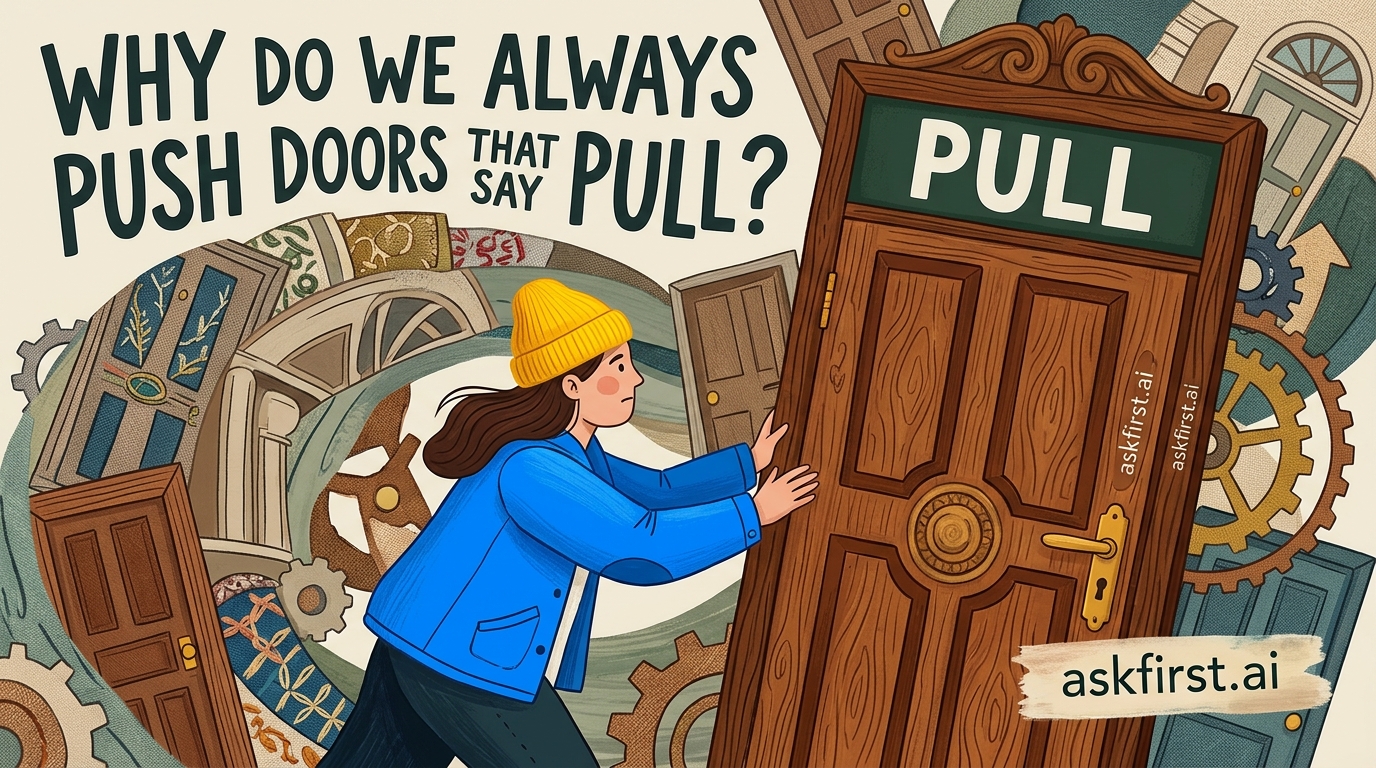
The phenomenon of pushing a door labeled 'pull' is a classic example of a 'Norman Door,' a concept popularized by cognitive scientist and usability engineer Don Norman. This interaction failure reveals profound insights into human psychology, environmental design, and the cognitive heuristics that govern our daily existence. When an object’s physical design contradicts its signage, human instinct almost always defaults to the physical affordance of the object rather than the semantic instruction.
The Architecture of Affordances
At the heart of this mystery lies the concept of 'affordance.' An affordance is a relationship between an object and a person. A handle that is designed to be gripped strongly suggests a 'pulling' motion, while a flat metal plate suggests a 'pushing' motion. When a door is designed with a vertical handle on the side that requires a pull, but is then installed as a push-door, the physical signal of the handle overrides the linguistic message of the sign. The human brain processes visual and tactile information significantly faster than it processes complex written language. We perceive the 'push-ability' or 'pull-ability' of a door handle within milliseconds, creating a cognitive expectation that the brain defends even when contradicted by a printed sticker.
Cognitive Heuristics and Automaticity
Human behavior is largely driven by heuristics—mental shortcuts that allow for rapid decision-making. We navigate the world through automaticity, performing repetitive actions like opening doors without conscious thought. This 'autopilot' state is highly efficient, conserving metabolic energy for more complex tasks. When a person approaches a door, the brain anticipates the required action based on previous experiences. If the door handle presents itself in a way that suggests a push, the brain initiates the motor program for pushing. By the time the eyes register the word 'pull,' the motor system has already engaged, leading to a brief moment of cognitive dissonance known as the 'action-perception gap.'
The Failure of Signage as a Solution
Many architects and facility managers believe that a sign is a universal solution for design flaws. However, cognitive research indicates that people frequently suffer from 'inattentional blindness.' This occurs when individuals are so focused on their immediate goal—entering or exiting a building—that they fail to perceive signs, even if those signs are directly in their field of vision. Relying on signs to correct bad design is an admission of failure in the user interface. A well-designed door should be self-explanatory. If a door must be pulled, the design should offer a surface that is difficult to push, such as a cup-style handle or a design that physically blocks a pushing motion.
Behavioral Psychology and Social Conditioning
There is also a social component to this behavior. We live in a society filled with standard glass-fronted buildings where the 'push' motion is the statistical norm for exit doors due to safety requirements and ease of movement in crowds. We develop a 'mental model' of door behavior based on these thousands of successful interactions. When we encounter an outlier—a door that violates our learned mental model—we experience a mismatch between expectation and reality. This isn't a sign of lack of intelligence; rather, it is a testament to how effectively our brains learn the rules of our environment.
Designing for Human Success
To bridge this gap, modern design principles focus on the 'Principle of Visibility.' Designers are encouraged to create products where the function is clearly articulated through the shape and placement of the mechanism. If a door must be pushed, it should feature a flat surface with no handle. If a door must be pulled, it should feature a handle that is easy to grasp but impossible to push. By aligning physical cues with expected outcomes, we can minimize the frustration and minor embarrassment associated with the 'Norman Door' experience. Understanding this phenomenon highlights a critical lesson: when technology or design fails to function as expected, look to the psychology of the user, not the failure of the individual. Our propensity to push pull-doors is simply the brain doing exactly what it was designed to do: navigating the world through efficient, pattern-based interaction.