The Proportionality Theory
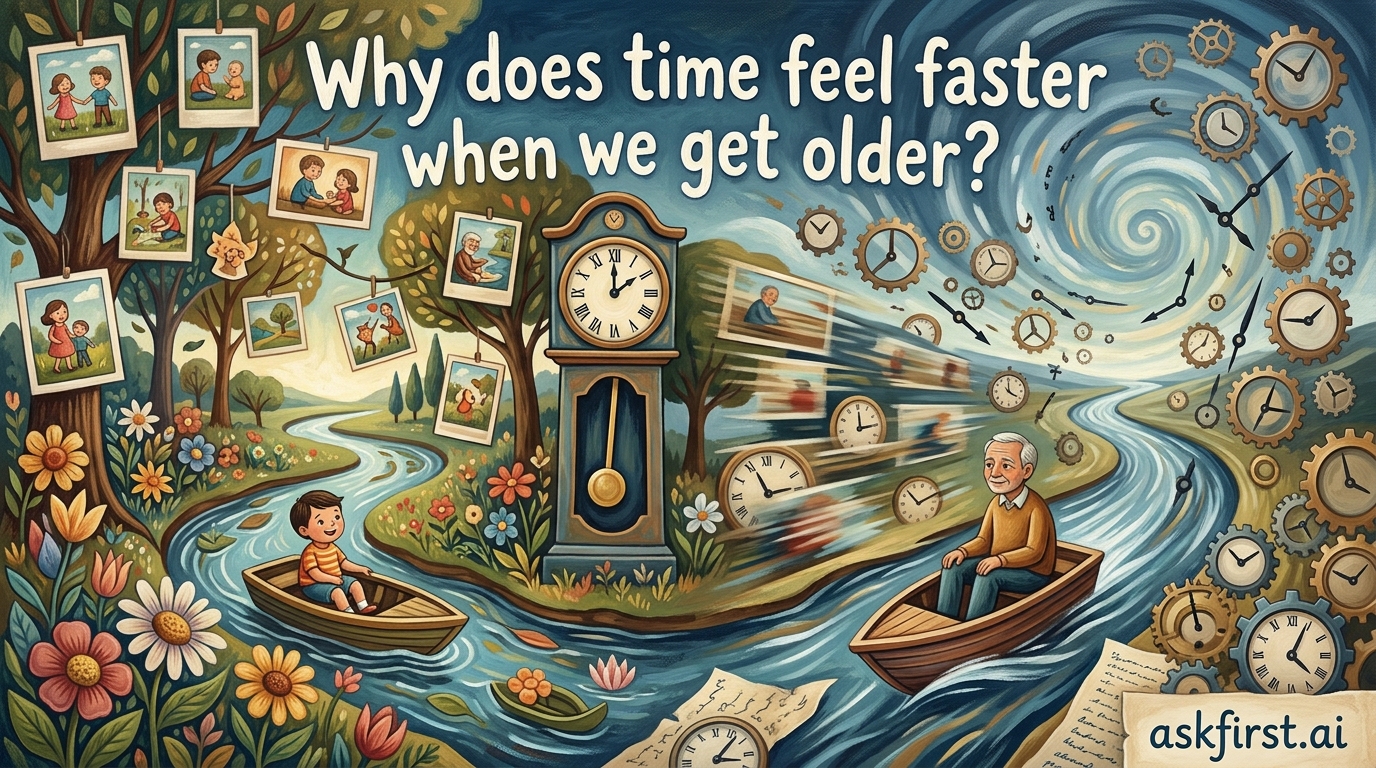
One of the most prominent explanations for the acceleration of perceived time is the Proportionality Theory, first proposed by Paul Janet in 1877. This theory suggests that as individuals age, each unit of time represents a smaller fraction of the total life lived. For a five-year-old, one year represents 20 percent of their entire existence—an eternity characterized by massive developmental leaps. Conversely, for a fifty-year-old, one year constitutes only 2 percent of their life. Because the mind calibrates time based on past experience, the brain perceives the passage of a year as shrinking in relative significance as the database of years already lived grows larger.
The Neural Encoding Hypothesis
Neurologists propose that time perception is linked to how the brain encodes new memories. During youth, the world is a repository of novelty; every experience—from the first day of school to learning to ride a bike—requires deep neural processing. The brain consumes massive amounts of energy to categorize these 'first-time' events. According to neuroscientist David Eagleman, the brain processes novel stimuli with higher granularity. When we encounter something new, we dedicate more neural resources to recording that event, leading to a richer, more detailed memory. Because the brain spends more 'bandwidth' recording these experiences, the resulting memory feels longer in retrospect. As people age, life becomes more routine. The brain, seeking efficiency, stops recording mundane, repetitive daily activities with the same level of detail. Consequently, when looking back at a year filled with routine, the brain finds fewer distinct 'anchor points,' making the duration feel significantly shorter.
The Role of Dopamine and Biological Clocks
Biological clocks, primarily governed by the suprachiasmatic nucleus, interact with neurotransmitters like dopamine to modulate how we experience temporal flow. Research indicates that dopamine levels, which influence our perception of speed and time, tend to fluctuate throughout the lifespan. High levels of arousal or dopamine can make the brain perceive that time is passing more slowly, while lower levels or a steady-state environment can make it seem as though time is slipping away. As the metabolism and neural processing speeds undergo changes with age, the subjective 'ticks' of the internal clock may slow down relative to physical time, leading to the sensation that the external world is rushing forward faster than our internal clock can track.
How to Slow Down Subjective Time
Understanding the mechanics of temporal perception provides a unique opportunity to reclaim the 'length' of our lives. If the secret to a 'long' life is novelty and memory density, then the remedy for a fast-passing life is to disrupt the routine. Here are key strategies based on psychological research:
- Prioritize Novelty: Engage in new hobbies, travel to unfamiliar places, or learn a new skill. Novel experiences force the brain to pay attention and create new, distinct memory structures.
- Cultivate Mindfulness: The practice of focused attention keeps the brain engaged in the 'now' rather than shifting into autopilot. Mindfulness meditation has been shown to alter the brain's processing of temporal flow, forcing a more deliberate observation of the present.
- Change the Environment: Breaking physical routines—such as taking a different route to work or rearranging a workspace—prevents the brain from entering the 'habit loop' that compresses time perception.
- Document Experiences: The act of writing a journal or recording memories forces the brain to synthesize and reflect on the day's events, which helps create a more robust mental archive, ultimately making a year feel more substantial and lengthy in memory.
Conclusion
Time itself remains a constant physical dimension, but the human experience of it is entirely subjective. It is a biological construct synthesized by the brain, contingent upon the density of our memories and the frequency of our encounters with the new. By shifting away from the comfort of the familiar and leaning into the challenge of constant discovery, individuals can effectively expand their sense of time, turning years that might have been a blur of repetition into a vibrant, extended tapestry of distinct and meaningful moments. The perception of speed is not a symptom of age itself, but rather a symptom of how we have allowed our daily lives to become predictable.