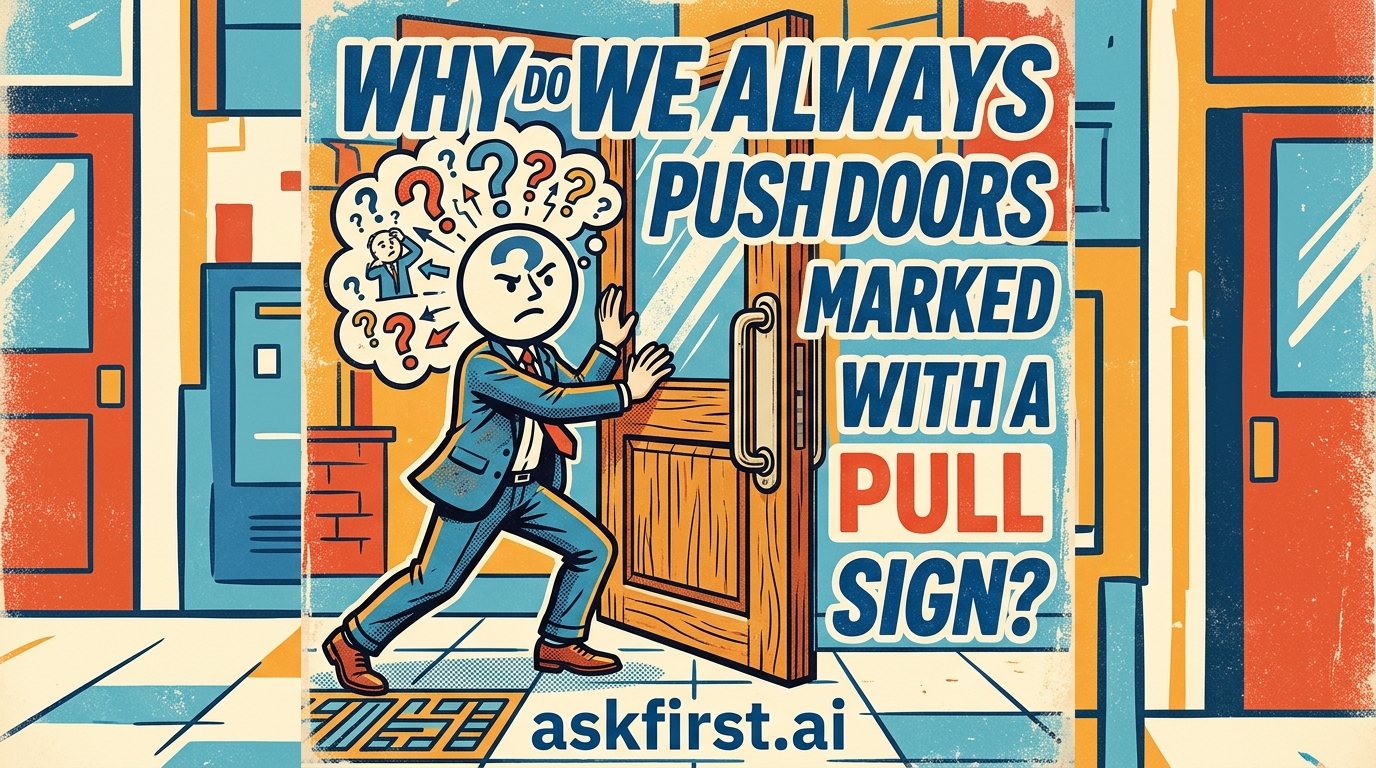
The Psychology of the 'Norman Door' Phenomenon
The mystery of why individuals instinctively push doors that are clearly labeled 'pull' is a classic case study in behavioral psychology and industrial design. This phenomenon is often attributed to the 'Norman Door,' a term coined by design expert Don Norman in his seminal work, The Design of Everyday Things. When a door lacks visible cues that suggest how it should be operated, the human brain reverts to heuristic shortcuts based on environmental perception rather than reading instruction.
The Role of Affordances
At the heart of this issue lies the concept of affordances. An affordance is a property of an object that suggests how it can be used. A flat metal plate on a door acts as a strong visual affordance for pushing, because it provides a place for the palm of the hand to press against. Conversely, a vertical handle or a U-shaped bar provides an affordance for pulling. When the visual affordances of a door contradict the instructional text, the brain's rapid, intuitive processing system (System 1) often overrides the analytical, reading-based system (System 2). If a person approaches a flat, featureless door surface, their biology screams 'push,' effectively rendering the sign invisible.
Cognitive Heuristics and Environment
Humans rely on cognitive heuristics—mental shortcuts—to navigate the world without constant, exhaustive deliberation. When someone is in a rush or distracted, they are even more prone to ignoring signage. Research indicates that approximately 80% of our daily movements are automated. If a person has spent their life pushing through doors that have flat plates, they develop a 'pushed-by-default' mental schema. When they encounter a door that requires a pull, the conflict between their pre-existing schema and the new instruction leads to a moment of cognitive dissonance, often resolved by continuing the physical motion they already initiated.
Design as Communication
Designers argue that a door should be a self-evident object. If a sign is necessary to explain how to operate a simple mechanism like a door, the design has fundamentally failed. A well-designed door intuitively communicates its function. For instance:
- The Pull Door: Features a handle or grip that invites the hand to grasp and pull.
- The Push Door: Features a flat plate or a kick plate that invites the hand or foot to push.
When a door has a handle but needs to be pushed, or a plate but needs to be pulled, it creates a 'usability gap.' Humans do not read signs on doors because they treat doors as non-reading environments. We expect the physical form of the handle to tell us everything we need to know. When the design lies to us, we fail to notice the truth because our brains prioritize physical geometry over linguistic information.
Strategies to Prevent Error
To bridge this gap, architects and engineers are shifting toward human-centric design principles. By utilizing high-contrast visuals, ergonomic handle positioning, and standardized hardware, businesses can reduce the frequency of 'push-pull' errors. A change as simple as installing a vertical bar for pulling and removing plates from push-side doors eliminates the need for signs altogether. This is not just a matter of convenience; it is a vital aspect of universal design, which aims to make spaces accessible and intuitive for everyone, including those with visual impairments or mobility challenges.
Conclusion: The Triumph of Instinct over Text
Ultimately, pushing a 'pull' door is not a sign of ignorance, but rather a testament to how human cognition is hardwired. Our brains are evolutionary machines optimized for reading environments and physical patterns rather than deciphering conflicting instructions in high-pressure scenarios. Next time you find yourself pushing a pull door, remember that it is not your fault—the object is simply failing to speak the language of your instincts. As design becomes more sophisticated, we can hope to see a world where doors communicate clearly, allowing our hands to move with purpose and grace, no longer requiring a sign to tell us which way to go.