The Phenomenon of Relative Time Perception
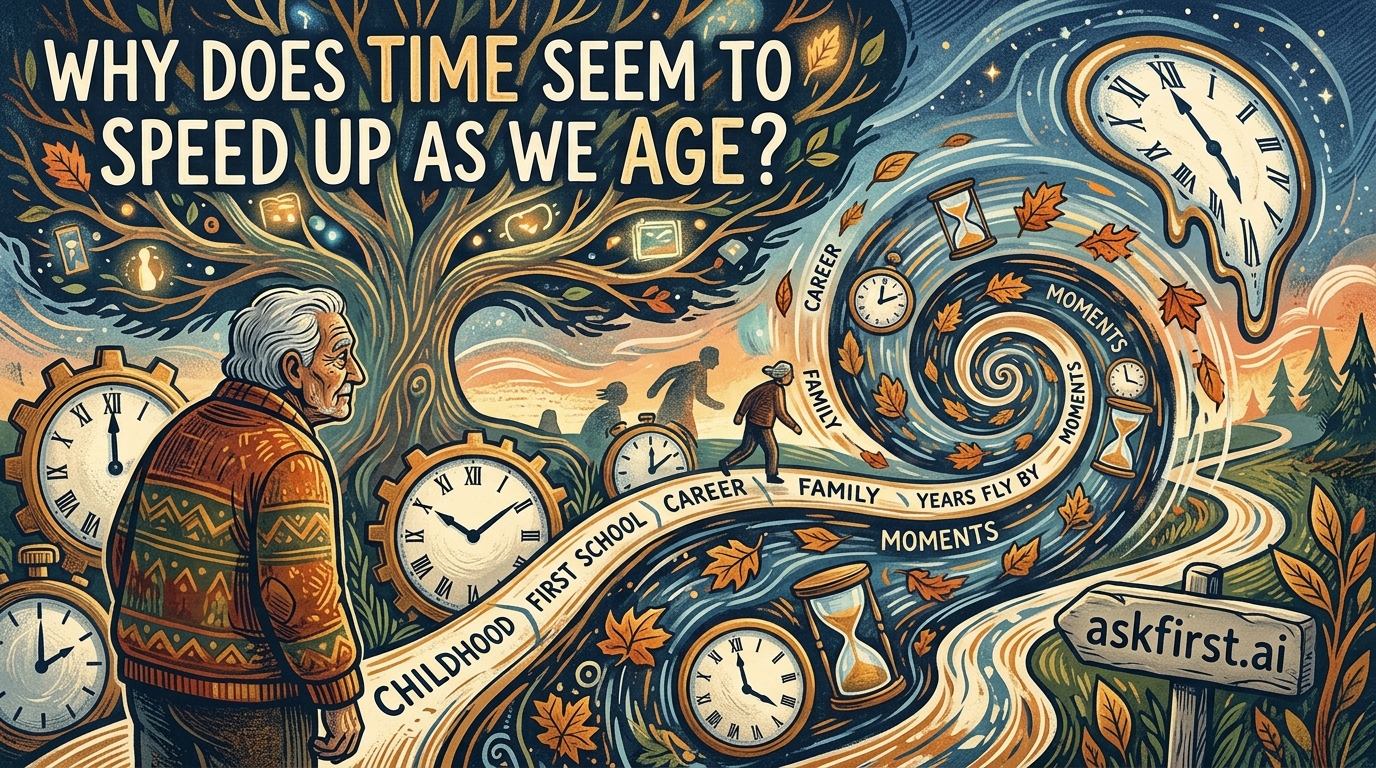
Many individuals notice a peculiar shift in their perception of duration as they move through the stages of life. Childhood summers often feel like endless expanses of discovery, whereas years in adulthood seem to blur into a rapid succession of weeks. This is not merely a nostalgic sentiment but a well-documented phenomenon in cognitive neuroscience and psychological research known as the 'proportional theory' or 'relative time perception.'
The Proportional Theory: A Mathematical Perspective
One of the most compelling explanations for why time feels faster as we age is the proportional theory, first proposed by French philosopher Paul Janet in 1877. According to this concept, the subjective experience of a period of time is proportional to the total amount of time one has already lived. For a five-year-old, a single year represents 20% of their entire existence—a massive chunk of their lived reality. Consequently, that year is experienced as incredibly long and significant. Conversely, for a fifty-year-old, one year represents only 2% of their life. This mathematical reduction creates the sensation that time is passing with increasing acceleration as the denominator of one's total life experience grows larger.
The Role of Novelty and Memory Encoding
Beyond simple mathematics, the way the brain encodes memories plays a critical role in the perception of time. Dr. David Eagleman, a renowned neuroscientist, suggests that time perception is heavily influenced by the novelty of experiences.
- High Novelty: When the brain encounters new environments, faces, or skills, it records these experiences with high density. Because there is so much new information to process, the brain pays more attention, and we later perceive that period as having lasted longer.
- Low Novelty: In adulthood, daily routines often become deeply entrenched. Commuting, office work, and repetitive chores become 'automatized.' The brain stops recording these redundant moments in high detail. When we look back on a routine-filled year, the mind finds fewer unique markers, leading to the subjective feeling that the time 'evaporated' or passed quickly.
The 'Holiday Paradox'
This principle is best observed in the 'Holiday Paradox.' If one goes on an exciting vacation, the time spent there often feels fast while it is happening because of the high levels of engagement. However, upon returning home, the trip feels like it lasted a long time because the brain has stored a rich library of new, vivid memories. Conversely, a boring work week feels slow while it is happening, but vanishes into a blur of indistinguishable days in the memory, giving the illusion of having passed in an instant.
The Neurochemical Aspect
Neurotransmitters like dopamine also modulate our internal clock. Dopamine is associated with the brain's reward system and its ability to process information. Research suggests that as humans age, levels of dopamine may fluctuate in ways that affect the estimation of intervals. When dopamine signaling is high, such as during periods of excitement or new learning, the internal clock may speed up, causing external time to feel as if it is passing more slowly. As these levels stabilize or change with maturity, the perception of flow shifts.
Can We Slow Down Time?
While we cannot alter the physical passage of seconds or hours, we can influence our subjective perception of time by actively managing our cognitive engagement. To counteract the feeling of rapid acceleration, experts recommend the following strategies:
- Embrace Newness: Regularly seeking out new hobbies, traveling to unfamiliar locations, or learning a challenging language forces the brain to move out of 'autopilot' mode and encode more vivid memories.
- Practice Mindfulness: Being fully present in the current moment forces the brain to process details that are usually ignored, thereby extending the perceived duration of the present.
- Change Your Routine: Breaking the monotony of a daily commute or altering the structure of the weekend can provide the mind with the 'anchor points' it needs to distinguish one period of time from another.
Conclusion
The acceleration of time as we age is largely a byproduct of our brain's efficiency. As we collect more experiences and lean into the comfort of routines, our minds compress time to save energy. Understanding this mechanism provides a fascinating opportunity to reclaim our perception of life. By consciously injecting novelty and intentionality into our days, we can effectively expand our internal experience of time, ensuring that our years feel as rich, dense, and meaningful as they did in childhood.