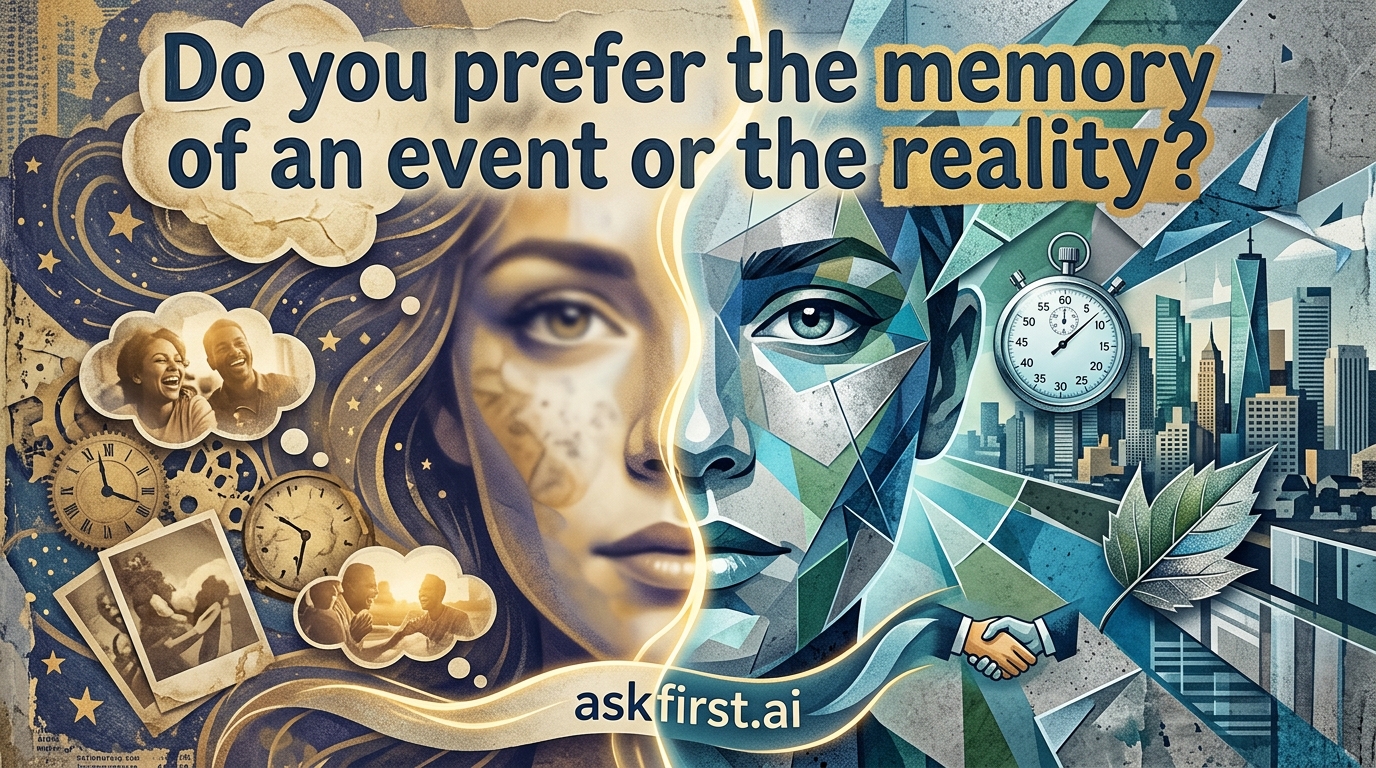
The Dichotomy of Human Perception: Memory Versus Reality
The human experience is perpetually balanced between the immediate sensory input of reality and the malleable, often idealized, construct of memory. Deciding which holds greater value requires a deep dive into the neurobiology of cognition and the philosophy of perception. While reality provides the raw material of existence, memory serves as the canvas upon which personal identity is painted.
The Mechanics of Memory Reconstruction
Cognitive psychology posits that memory is not a static archival process, but rather a dynamic, reconstructive act. Every time a person recalls an event, the brain reintegrates the information, often filtering it through current emotional states and beliefs. According to Elizabeth Loftus’s groundbreaking research on the malleability of human memory, subtle alterations in context can fundamentally change the content of a memory. Consequently, the 'memory' of an event is often an improved or polished version of the original experience, stripped of tedious downtime and buffered by cognitive bias.
- The Peak-End Rule: Popularized by Daniel Kahneman, this heuristic suggests that people judge an experience largely based on how they felt at its peak (the most intense point) and at its end, rather than the total sum of the experience. This explains why memories often feel more impactful than the reality of a long, occasionally monotonous event.
- Selective Editing: The brain is a master editor, shedding irrelevant details over time. This process, known as 'fading affect bias,' allows individuals to feel more positively about their past than their present, as negative emotions associated with specific events tend to dissipate faster than positive ones.
The Purity of Reality
Reality, by contrast, is unfiltered, chaotic, and often demanding. It requires presence. Philosophers of the Stoic tradition emphasize that reality, no matter how mundane or difficult, is the only place where true agency exists. Reality demands engagement, accountability, and adaptive response. Unlike memory, which allows for passive consumption, reality forces the participant to interact with the world as it is, rather than as it is wished to be.
- Engagement vs. Observation: Reality necessitates active participation. While memory is a retrospective observation, reality is the arena of creation.
- The Grounding Factor: Without the anchor of reality, the human psyche risks becoming untethered from objective truth. Chronic preference for the 'idealized memory' can lead to nostalgic paralysis, where the past is perpetually polished to a degree that makes the present feel inherently inadequate.
The Synthesis: Why We Need Both
To view this as a binary choice—one being superior to the other—is to miss the fundamental utility of both cognitive functions. The preference for memory often stems from a desire for meaning. Humans are narrative-driven creatures; they require coherent stories to organize their lives. Memory provides the structure for this narrative.
- Memory as a Source of Resilience: Research in positive psychology indicates that reflecting on positive memories can improve current mental well-being and provide the motivation necessary to navigate challenging realities. By distilling an event into a memory, an individual extracts its 'lesson' or its 'joy,' making the experience usable.
- Reality as the Engine of Growth: It is only through the friction of reality that growth occurs. If one were to live purely within the construct of memory, there would be no new data, no new relationships, and no evolution of the self.
Bridging the Gap
In contemporary life, technology further complicates this dynamic. Digital archives—photos, videos, and social media posts—act as 'external memories' that preserve reality in a fixed state, theoretically reducing the reconstructive bias of the human brain. However, even these artifacts are curated, turning reality into a permanent, frozen memory that can be revisited ad infinitum.
Ultimately, the value lies in the balance. The preference for memory is essentially a preference for the meaning of an event, while the preference for reality is a preference for the potential of the present. To flourish, one must be able to anchor oneself in the raw, messy reality of the now while using the beautifully crafted, edited memories of the past as a compass to guide future intentions. Reality is the teacher, but memory is the library where the lessons are stored, cataloged, and rendered useful for the future.