The Evolutionary Edge of Regret
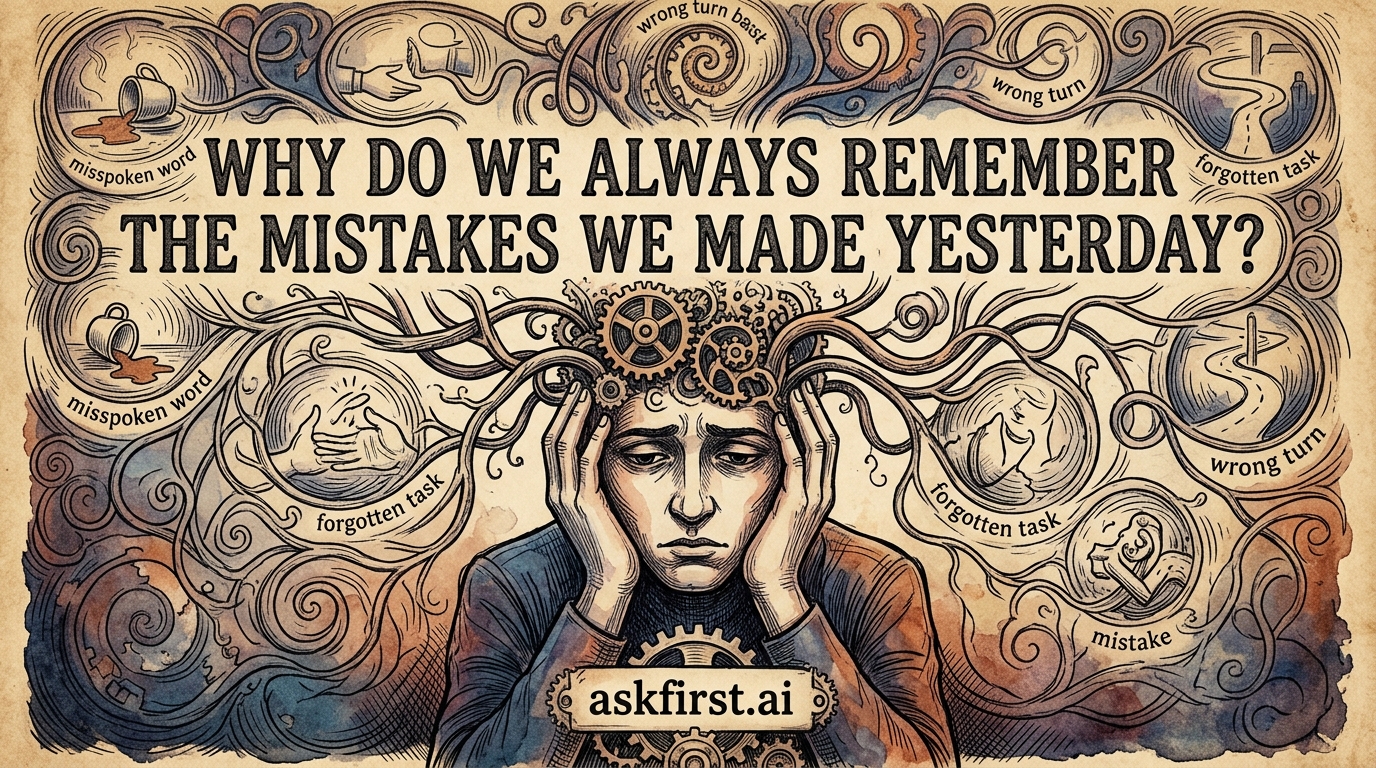
Human cognition is remarkably biased toward the negative, a phenomenon scientifically referred to as the Negativity Bias. This is not a design flaw but rather an evolutionary feature that helped ancestors survive in unpredictable environments. From an early age, the human brain is primed to pay more attention to threats, errors, and social faux pas than to neutral or positive experiences. By fixating on mistakes made yesterday, the brain is performing a persistent, background simulation designed to ensure that the same error does not result in a greater threat to survival tomorrow.
The Neuroscience of Hindsight
When a mistake occurs, the brain’s anterior cingulate cortex (ACC)—a region involved in error detection and performance monitoring—becomes highly active. This region acts as a high-speed alert system, signaling a discrepancy between expected outcomes and reality. Research indicates that when this neural alert is triggered, it prompts a release of norepinephrine, which narrows the focus of attention. Consequently, the mind replays the scenario of the mistake repeatedly, a process known as rumination, to effectively 'encode' the lesson into long-term memory. This neural replaying serves as an internal practice session, allowing for the rehearsal of improved responses for future scenarios.
Psychological Factors and the Zeigarnik Effect
Beyond mere biology, specific psychological principles explain the persistence of these memories. The Zeigarnik Effect states that people remember uncompleted or interrupted tasks better than completed ones. A mistake, by its very nature, represents an unresolved goal—the desire for success or social approval remains unfulfilled. Because the brain perceives the mistake as an 'unfinished business' in terms of social standing or task performance, it keeps the memory in a heightened state of accessibility. The mind is essentially waiting for a 'correction' or 'closure' that only a successful redo can provide.
The Social Mirror: Reputation and Self-Perception
Humans are fundamentally social creatures, and mistakes made in a social context often trigger a deep sense of social anxiety or embarrassment. This occurs because the brain associates social rejection with a risk of group expulsion, which, historically, was a catastrophic threat to survival. Remembering a blunder made yesterday serves as a self-correction mechanism to protect social capital. This phenomenon is supported by the Spotlight Effect, where individuals overestimate how much others notice their flaws. Because the individual believes they are the center of others' attention, the memory of the mistake is amplified by the perceived judgment of peers.
Strategies for Cognitive Reappraisal
While the brain’s focus on mistakes is useful, it can lead to unnecessary distress. To manage this natural tendency, experts suggest several evidence-based techniques:
- Cognitive Reappraisal: Instead of viewing a mistake as a personal character flaw, reframe it as a data point for growth. Ask: 'What specific mechanism failed here?' rather than 'Why am I like this?'
- The 10-10-10 Rule: Evaluate the mistake by asking if it will matter in 10 minutes, 10 months, or 10 years. This perspective helps in de-escalating the emotional urgency of the memory.
- Self-Compassion Practices: Research shows that treating oneself with the same kindness one would offer a friend actually improves motivation. It reduces the fear of failure, which in turn leads to better performance on future tasks.
Conclusion
Ultimately, the persistent recollection of yesterday’s mistakes is the brain’s way of ensuring the future is navigated more skillfully. While uncomfortable, this mental function is a testament to the cognitive complexity that drives human progress. By understanding that this rumination is a hardwired tool rather than a personal enemy, one can harness these memories to foster resilience and refined decision-making. The goal is not to eradicate the memory of failure, but to transform it into the architect of future competence.