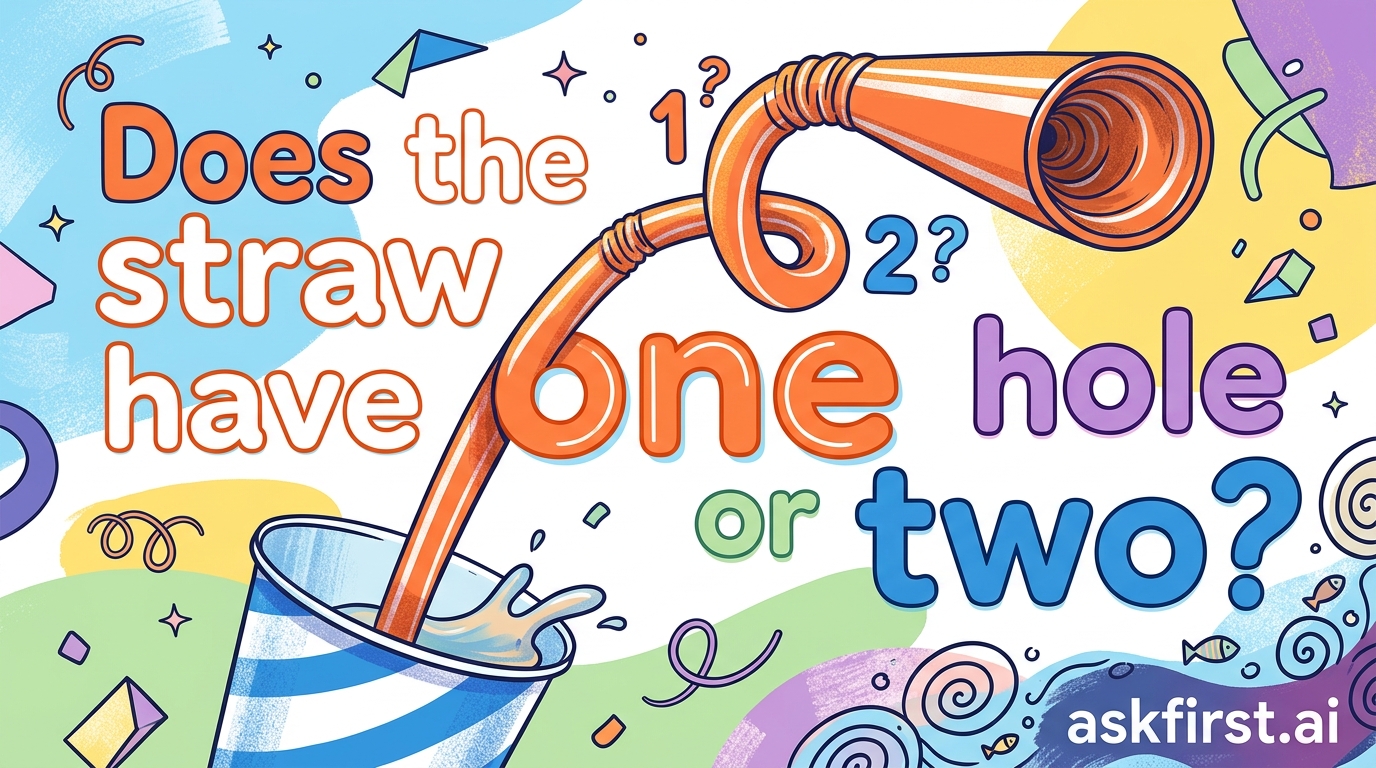
The question of whether a straw possesses one hole or two is a classic topological riddle that has sparked intense debate among mathematicians, engineers, and philosophers alike. To arrive at a definitive answer, one must move beyond colloquial definitions and examine the object through the lenses of topology, geometry, and linguistic semantics.
The Topological Perspective: The Genus of a Torus
In the field of topology—a branch of mathematics concerned with the properties of space that are preserved under continuous deformations—an object’s "number of holes" is defined by its genus. The genus of a surface is essentially the number of handles or holes that pass through it.
If we treat a standard drinking straw as a mathematical object, it is topologically equivalent to a torus (the shape of a donut). A torus is a surface with exactly one hole. When you stretch or compress a straw, you are performing a homeomorphism—a continuous transformation that does not tear or glue the material. Because a straw can be deformed into a perfect donut shape without creating or destroying any connectivity, it is classified as having a genus of one.
From this rigorous scientific standpoint, the straw has one hole. The "two ends" that we perceive are simply the boundaries of that single, continuous tunnel. If you were to imagine a straw as a path, the path does not have two holes; it has one singular aperture that runs through the entirety of its length.
The Geometric and Functional Perspective: The "Tunnel" Argument
When we move away from abstract mathematics and into the realm of three-dimensional geometry and common utility, the definition of a "hole" becomes more nuanced. In everyday language, a hole is often defined as an opening that penetrates a solid object.
If you take a solid block of wood and drill a hole through it, you have created one hole. If you drill a second hole, you have two. Applying this logic to a straw, one might argue that the straw is simply a cylindrical shell surrounding a void. From this viewpoint, the "hole" is not the material itself, but the empty space inside. Because that empty space connects two distinct points in space (the top opening and the bottom opening), some argue that the straw possesses two holes—one at each end.
However, this perspective is functionally flawed. If you have a tunnel that connects two sides of a mountain, you do not refer to the tunnel as "two tunnels"; you refer to it as one tunnel with two entrances. Similarly, the straw is a single, continuous conduit. If you were to block one end, you would still have a "hole," but it would no longer be a straw; it would be a cup or a tube. The definition of a straw is predicated on the continuity of the passage. Therefore, the "two holes" argument is essentially a confusion between entrances and apertures.
Linguistic and Semantics: Defining the Hole
The ambiguity often stems from the fact that the English language does not have a precise, universally agreed-upon definition for what constitutes a "hole" in a non-flat object.
- The "Void" Definition: A hole is any absence of matter within a solid. Under this definition, if the straw is a solid cylinder with a hollow core, the core is the hole. Since the core is one continuous volume, it is one hole.
- The "Surface" Definition: A hole is a topological puncture in a surface. As established by the genus of the object, this is one hole.
- The "Entrance" Definition: A hole is any point of entry into an interior space. Under this definition, a straw has two holes because there are two distinct points where a liquid can enter or exit.
Most linguists and object-oriented ontologists lean toward the topological definition. We generally agree that a tunnel has one hole, even if it has two ends. We agree that a ring has one hole. Because a straw is effectively a long, thin ring, it follows the same logical constraints.
Conclusion
When we synthesize these perspectives, the most authoritative answer is that a straw has one hole.
The confusion arises because humans naturally perceive the two ends of the straw as distinct locations. However, these are merely the boundaries of a single, unified topological feature. If you were to take a piece of clay and poke a finger through it to create a tunnel, you would intuitively say you made "a hole," not "two holes." The straw is simply a manufactured version of that same action. The two ends are the entry and exit points of one single, continuous void. To claim a straw has two holes is to mistake the ends of a tunnel for the tunnel itself. Thus, in both mathematical rigor and common-sense geometry, the straw stands as a singular entity with a single, continuous aperture.