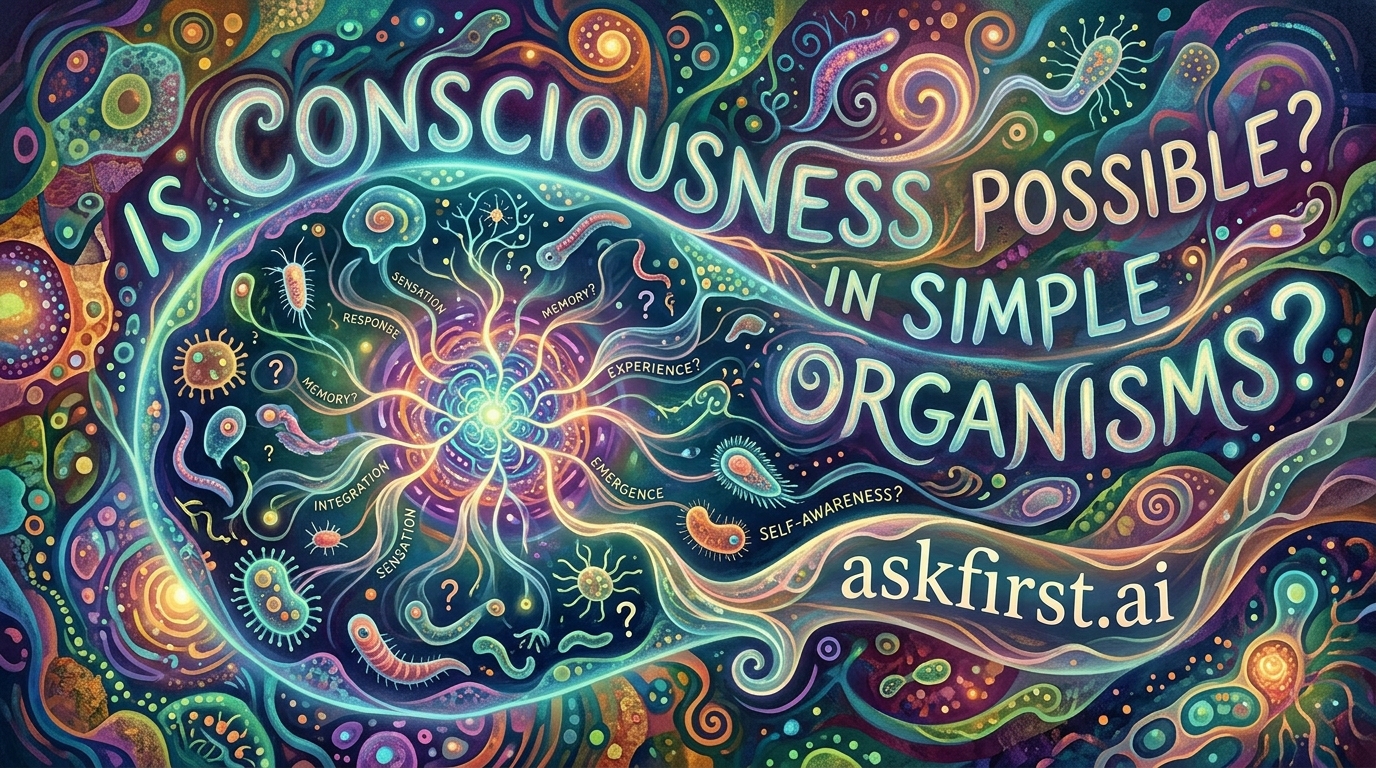
The question of whether consciousness exists in simple organisms is a central debate in biopsychology and philosophy of mind. Scientific consensus remains divided, largely because there is no universally accepted definition of consciousness that can be empirically measured in non-human subjects.
The Spectrum of Consciousness
Researchers often distinguish between two primary forms of awareness:
- Phenomenal Consciousness (Sentience): The subjective, qualitative experience of "what it is like" to be an organism (e.g., feeling pain, sensing light).
- Access Consciousness: The ability to process information, react to stimuli, and integrate data for behavioral control.
Arguments for Simple Consciousness
Proponents of panpsychism or biopsychism argue that consciousness may be a fundamental property of life rather than an emergent property of complex brains. Key arguments include:
- Adaptive Behavior: Simple organisms like E. coli or Physarum polycephalum (slime mold) demonstrate complex decision-making, memory-like behavior, and navigation without a nervous system.
- Evolutionary Continuity: If consciousness provides an evolutionary advantage, it likely evolved gradually from basic forms of sensation rather than appearing suddenly in higher mammals.
- Cellular Signaling: Single-celled organisms exhibit sophisticated intracellular signaling pathways that mirror the functional logic of neural networks.
Arguments Against Simple Consciousness
Critics maintain that consciousness is an emergent property requiring a high degree of integrated information and neural architecture.
- The Global Workspace Theory (GWT): This theory posits that consciousness requires a "global workspace" where information is broadcast across a complex network of neurons. Simple organisms lack this specialized architecture.
- Lack of Subjectivity: Many biologists argue that the behaviors of simple organisms are purely reflexive or algorithmic. Without a centralized nervous system to synthesize these inputs into a unified "self," there is no internal observer to experience the world.
- Complexity Thresholds: The Integrated Information Theory (IIT) suggests that consciousness correlates with the degree of interdependence within a system. While simple organisms possess some integration, it may fall significantly below the threshold required for subjective experience.
Current Scientific Status
Modern research is shifting away from binary "yes or no" answers toward a gradient model of consciousness. This perspective suggests that consciousness is not a single switch, but a spectrum where different organisms possess different "depths" of experience.
While there is currently no evidence that a bacterium possesses a sense of self or complex emotional states, the presence of nociception (the ability to detect harmful stimuli) and goal-oriented movement in simple organisms suggests they possess a primitive form of "proto-consciousness" that allows them to navigate their environment effectively.