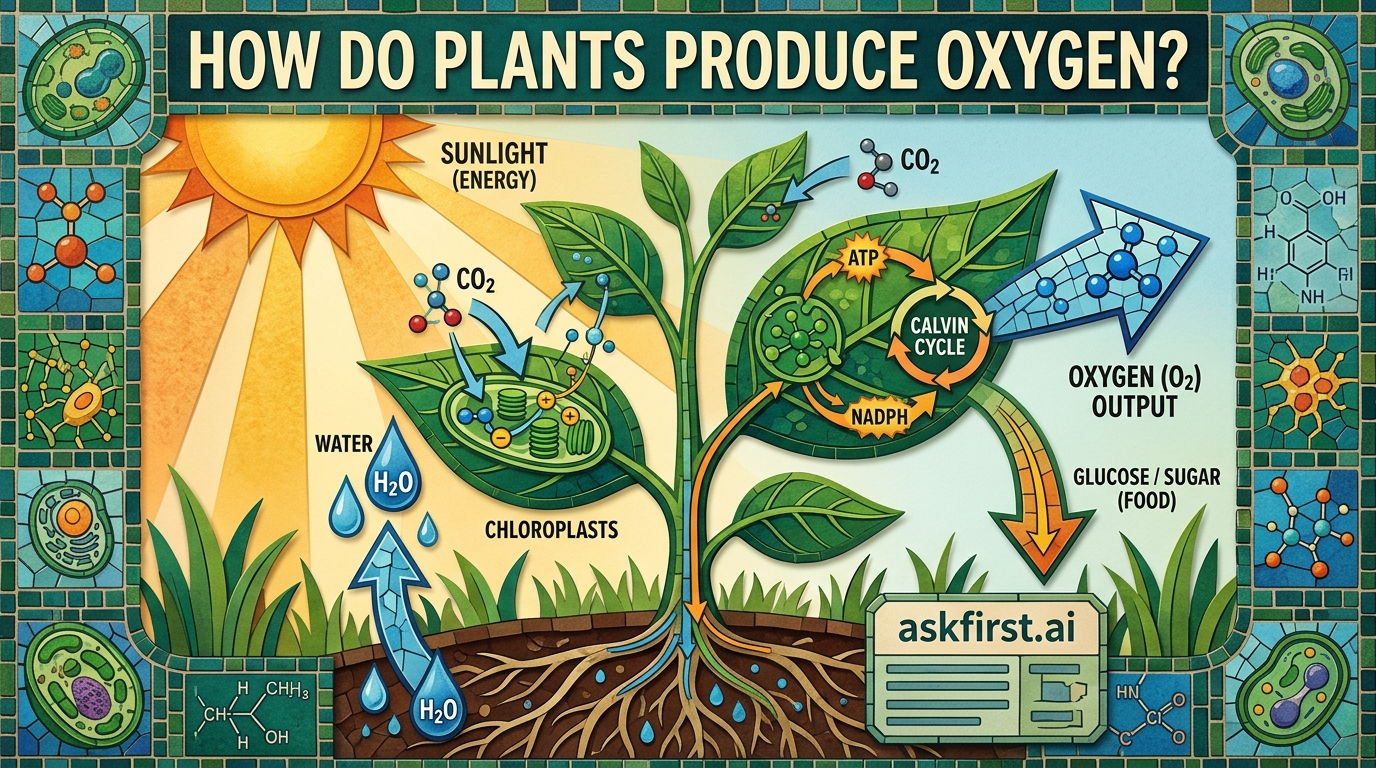
Plants produce oxygen through a biological process known as photosynthesis. This occurs primarily within the leaves, inside specialized cellular structures called chloroplasts.
The Mechanism of Photosynthesis
The production of oxygen is a byproduct of the light-dependent reactions of photosynthesis. The process can be broken down into these key stages:
- Absorption of Light: Chlorophyll, the green pigment located within the chloroplasts, captures energy from sunlight.
- Photolysis (Water Splitting): The captured solar energy is used to split water molecules ($H_2O$) into three components: hydrogen ions, electrons, and oxygen atoms.
- Oxygen Release: The oxygen atoms released during photolysis pair up to form diatomic oxygen gas ($O_2$). This gas is then released into the atmosphere through microscopic pores on the surface of the leaves called stomata.
- Energy Conversion: While the oxygen is expelled, the hydrogen ions and electrons are utilized in the second phase of photosynthesis (the Calvin Cycle) to convert carbon dioxide ($CO_2$) into glucose (sugar), which serves as the plant's primary energy source.
The Chemical Equation
The overall chemical reaction for photosynthesis is expressed as:
$6CO_2 + 6H_2O + \text{light energy} \rightarrow C_6H_{12}O_6 + 6O_2$
In this equation:
- $6CO_2$ (Carbon Dioxide) and $6H_2O$ (Water) are the inputs.
- $C_6H_{12}O_6$ (Glucose) is the stored chemical energy.
- $6O_2$ (Oxygen) is the vital byproduct released into the environment.
Biological Significance
This process is the foundation of aerobic life on Earth. By converting solar energy into chemical energy and releasing oxygen, plants maintain the atmospheric balance necessary for the respiration of humans, animals, and other aerobic organisms. Without this constant replenishment of oxygen, the Earth's atmosphere would eventually lose its ability to support current life forms.