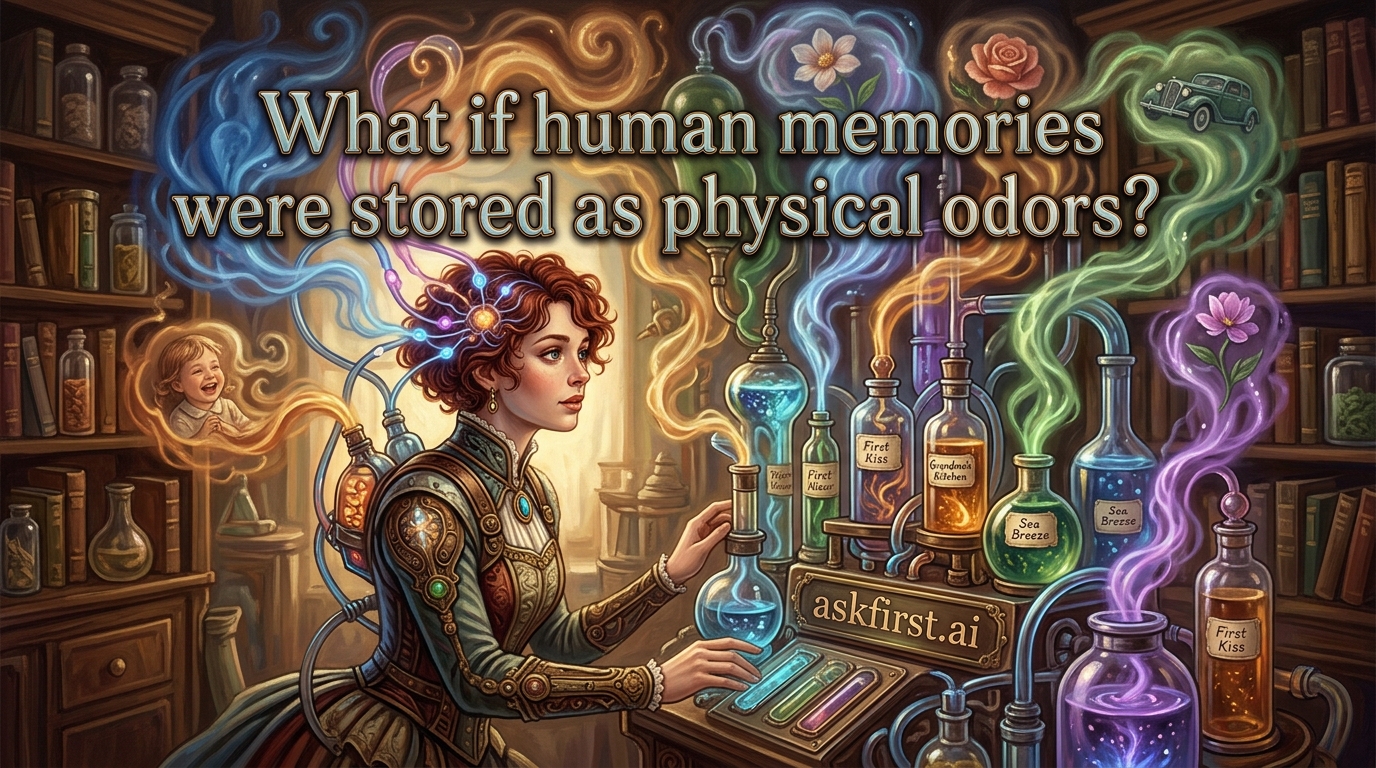
If human memories were stored as physical odors, the nature of human cognition, social interaction, and architecture would undergo a radical transformation. This biological shift would fundamentally alter how we perceive time, intimacy, and the preservation of history.
1. The Olfactory Architecture of the Mind
Unlike electrical signals in the brain, odors are chemical compounds. If memory functioned this way, the brain would likely operate as a biological scent-distillation center.
- Volatile Recall: Memories would be subject to atmospheric conditions. Humidity, temperature, and airflow could dictate the intensity and clarity of a memory. A "forgotten" memory might simply be one that has dissipated or been masked by a stronger, more recent scent.
- Physical Decay: Memories would have a half-life. The brain would require constant "re-scenting" or consolidation to prevent the chemical compounds from evaporating, essentially making memory a process of constant chemical maintenance.
2. Social and Interpersonal Dynamics
In this paradigm, the "private" sphere of the mind would become public property.
- Olfactory Transparency: Thoughts and recollections would be detectable by those in close proximity. Secrets would be nearly impossible to keep, as the "scent" of a traumatic or joyful event would linger in the air around an individual.
- The Scent of Truth: Deception would be hindered by the physical emission of sensory data. If lying produces a specific chemical signature—a "stink" of anxiety or fabrication—social trust would be governed by the ability to detect and interpret these olfactory cues.
- Intimacy: Relationships would be defined by the blending of personal scents. "Shared memories" would be literal, involving the physical exchange or mingling of odor molecules between individuals.
3. Societal and Environmental Impact
The physical world would be designed to accommodate, preserve, or mask these memory clouds.
- Memory Museums: Instead of digital servers or books, archives would consist of hermetically sealed vaults containing the solidified scents of significant historical events. One could "inhale" the history of a civilization.
- Atmospheric Filtering: Urban planning would prioritize ventilation systems to prevent the "pollution" of collective memory. Public spaces would require sophisticated scrubbers to clear the air of the overwhelming olfactory residue of large crowds or traumatic events.
- The Criminal Justice System: Forensic science would shift from DNA analysis to Olfactory Forensics. Investigators would analyze the lingering scent-trails at crime scenes to reconstruct the specific memories and intentions of those present.
4. Biological Constraints
- Sensory Overload: Humans would require an exponentially more complex olfactory bulb to process the nuanced chemical differences between millions of distinct memories.
- Memory Blending: Cross-contamination would be a significant risk. If one spent too much time in a high-density environment, their own memory-scents might become muddied by the "aroma" of others, leading to potential identity confusion or the unintentional adoption of foreign memories.
Ultimately, a world of olfactory memory would be one of total sensory immersion, where the boundary between the internal self and the external environment is permanently dissolved by the air we breathe.