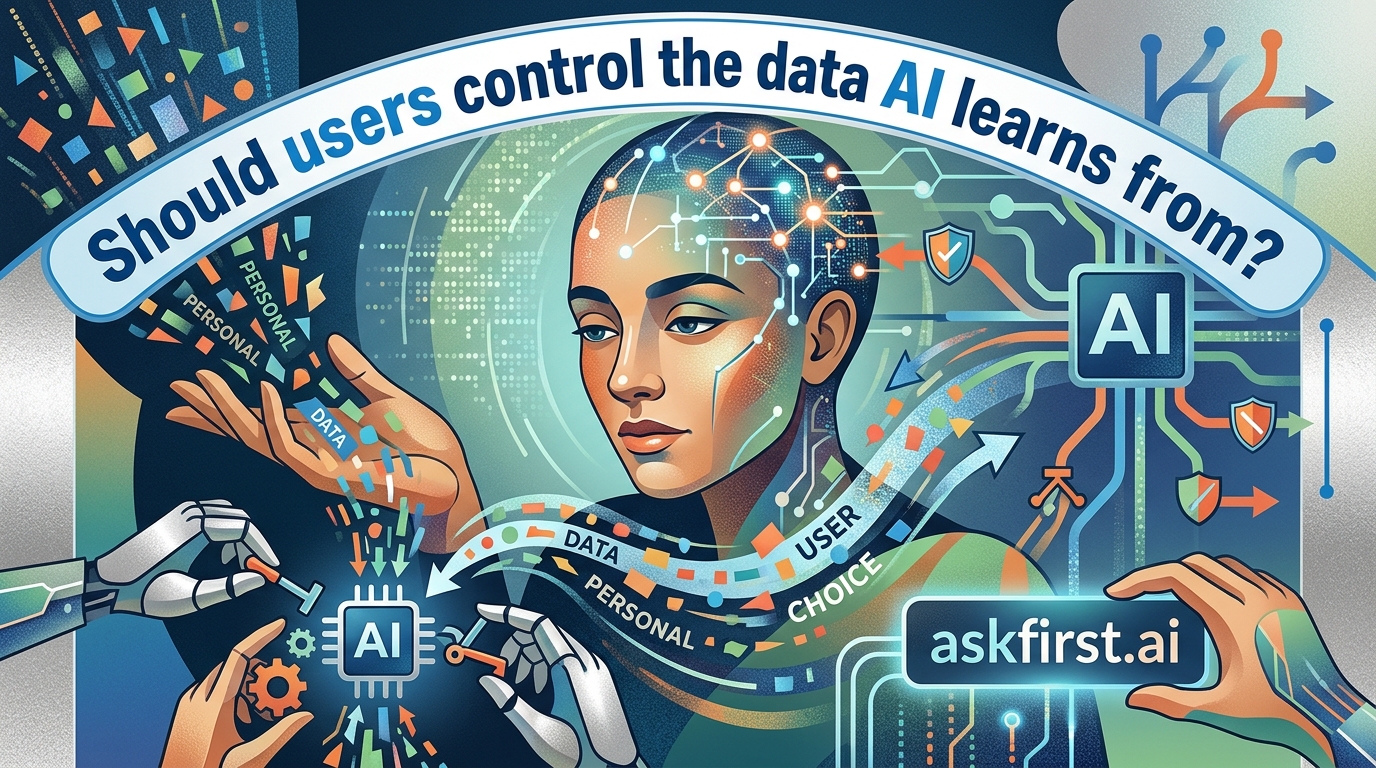
The question of whether users should control the data AI learns from is one of the most significant ethical and technical debates in modern technology. There are several compelling arguments both for and against this level of user sovereignty.
Arguments for User Control
- Data Sovereignty and Privacy: Users own their personal information. Allowing individuals to opt-out or "forget" their data ensures that AI models do not inadvertently leak sensitive information or perpetuate privacy violations.
- Mitigating Bias: If users can curate or filter the data used for training, they can help developers remove biased, harmful, or inaccurate information, leading to more equitable AI systems.
- Intellectual Property Rights: Many creators, artists, and writers argue that their work is being used to train AI models without consent or compensation. Giving users control would allow creators to protect their copyrights.
- Building Trust: Transparency and control are essential for user adoption. If people feel they have agency over how their digital footprint is utilized, they are more likely to trust and engage with AI tools.
Challenges to Universal Control
- Model Performance: AI models require massive, diverse datasets to function effectively. If every user opts out, the quality, accuracy, and generalizability of these models could degrade significantly.
- Technical Complexity: Implementing a "delete" command for a neural network is not as simple as deleting a file from a database. Once a model has "learned" a pattern, extracting that specific influence without retraining the entire model is a massive engineering hurdle.
- The "Black Box" Problem: Modern deep learning models are incredibly complex. It is often difficult for developers to pinpoint exactly which piece of data contributed to a specific output, making granular control difficult to guarantee.
The Middle Ground: Potential Solutions
- Federated Learning: This technique allows AI models to learn from data located on user devices without the data ever being uploaded to a central server. This keeps the data private while still allowing the model to improve.
- Opt-in vs. Opt-out Frameworks: Regulations like the GDPR and CCPA are moving toward stricter requirements, forcing companies to provide clear opt-out mechanisms.
- Data Provenance and Attribution: Developing systems that track where data came from can help companies compensate creators and allow for better auditing of training sets.
Conclusion:
The consensus is shifting toward increased user agency. While total control poses technical difficulties, the current paradigm of "data harvesting" is becoming unsustainable due to legal pressures and public demand. Moving forward, the industry will likely adopt a hybrid approach that prioritizes privacy-preserving technologies alongside clearer legal frameworks for consent.