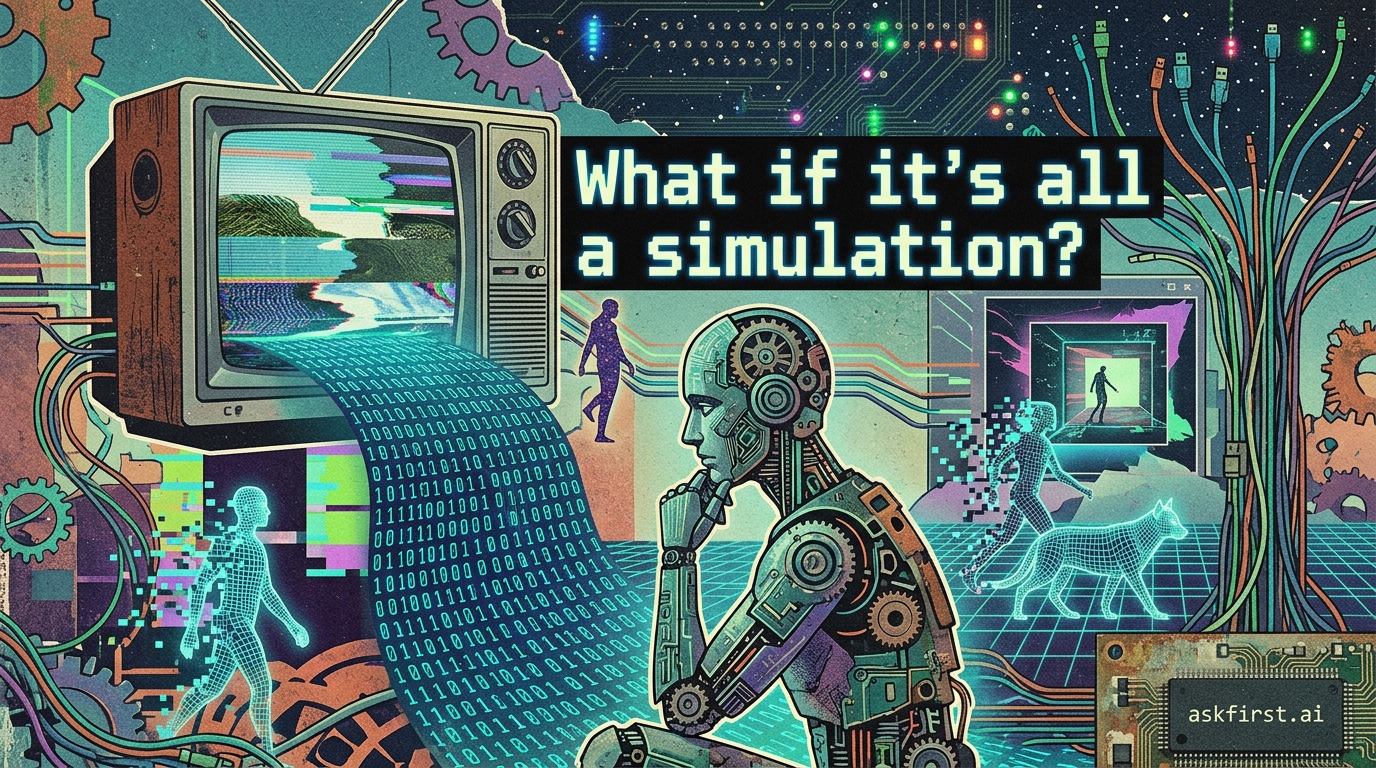
The hypothesis that our reality is a computer simulation—often called the Simulation Hypothesis—is a fascinating subject that bridges philosophy, physics, and computer science. If we are indeed living in a simulation, here are some of the most compelling implications:
The Limits of Computation: If the universe is simulated, it might be subject to the constraints of its host system. Some physicists speculate that the Planck length (the smallest unit of distance) could be the equivalent of a "pixel" in our reality. If space is quantized, it suggests that reality is discrete rather than continuous, much like a digital grid.
The "Fine-Tuning" Problem: Proponents of the theory point to the fact that the fundamental constants of physics (like the strength of gravity or the speed of light) seem perfectly "tuned" to allow for the existence of life. In a simulation, these constants could simply be pre-set parameters determined by the architects of the program.
The Observer Effect: In quantum mechanics, particles behave differently when they are being observed. Some theorists suggest this is an optimization technique—similar to "frustum culling" in video games—where the computer only renders the details of a scene when a player (or observer) is looking at it, saving processing power.
The Statistical Argument: Philosopher Nick Bostrom famously argued that if a civilization ever reaches the point where they have the computing power to simulate consciousness, they would likely run billions of such simulations. Statistically, if that happens, there would be millions of simulated worlds but only one "base" reality, making it mathematically more likely that we are in one of the many simulations.
What does this change?
If it were proven to be true, it would fundamentally shift our understanding of existence:
- Purpose: Does the simulation have an end goal? Are we being studied, or are we just a background process in a much larger experiment?
- Ethics: If we create our own simulations (like AIs or digital avatars), do we have the same moral obligations to them that we hope our "creators" have toward us?
- The Nature of Reality: Ultimately, even if our world is "simulated" using binary or quantum bits, the experiences, emotions, and consciousness we feel are still real to us. A simulated pain is still painful; a simulated joy is still joyful.
While we currently have no way to prove or disprove this, the question serves as a powerful tool for questioning the nature of consciousness and the limits of our scientific knowledge. Are you looking for the scientific arguments for this, or are you more interested in the philosophical implications?