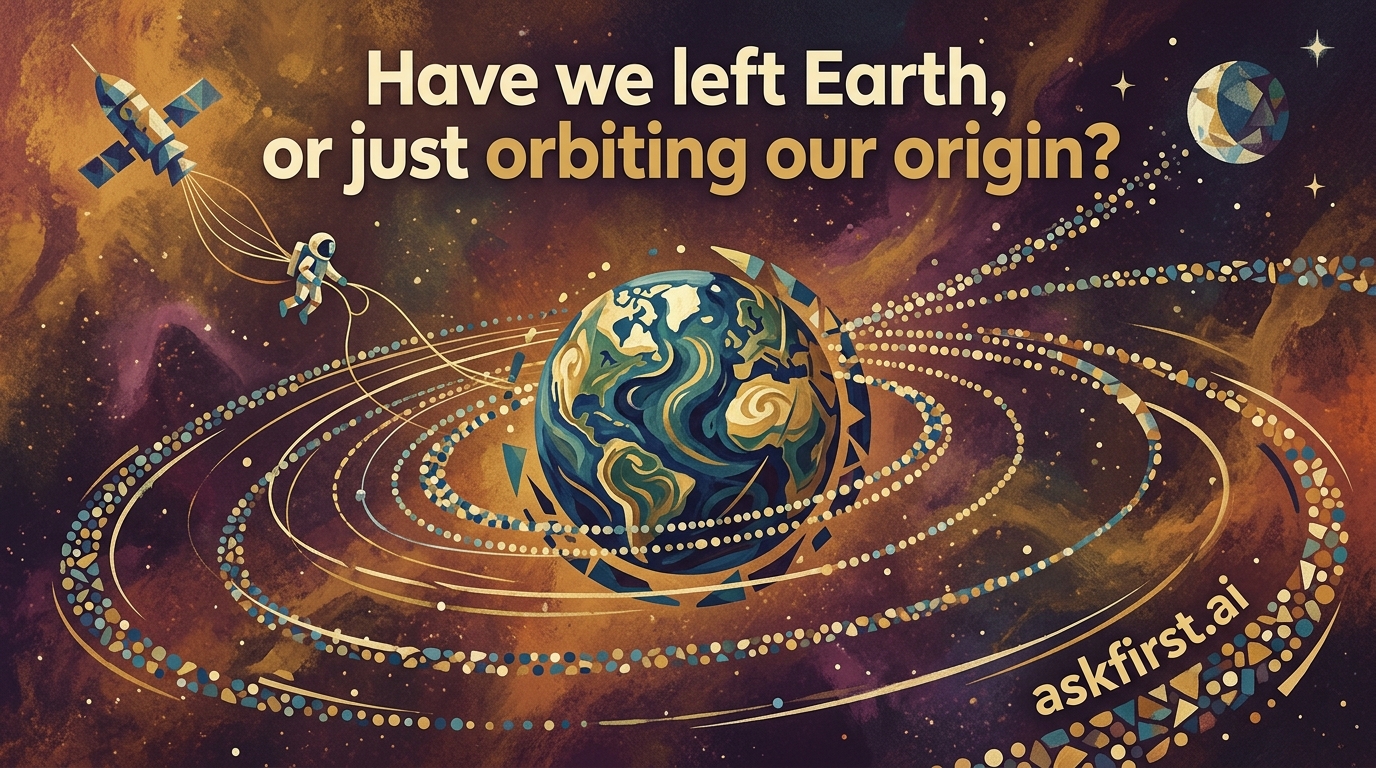
To answer your question, we must distinguish between Earth orbit and deep space exploration. The reality is a mix of both:
We are primarily orbiting our origin: The vast majority of human space activity—including the International Space Station (ISS), the Tiangong Space Station, and thousands of satellites—takes place in Low Earth Orbit (LEO). This is a region only a few hundred kilometers above the surface. We have not "left" Earth in a permanent sense; we are essentially hovering just above our home planet's atmosphere.
We have visited the Moon: Between 1969 and 1972, the Apollo missions successfully sent humans beyond Earth's immediate influence. Twelve people walked on the lunar surface, marking the only time humans have set foot on another celestial body. However, we have not returned there since 1972, though current initiatives like NASA’s Artemis program aim to establish a sustainable presence there soon.
Robotic exploration has left: While humans have stayed relatively close, our robotic emissaries have truly left the nest. Probes like Voyager 1 and 2 have crossed the heliopause and are now traveling through interstellar space, far beyond the reach of our Sun's primary influence. Additionally, we have landed rovers on Mars, sent probes to the outer gas giants, and mapped the solar system extensively.
In summary:
- Humanity: Remains tethered to Earth. We are currently an "orbiting" species, limited by the massive energy requirements and biological risks of long-term deep space travel.
- Technology: Has successfully left the cradle. Our machines are effectively our scouts, exploring the vastness of the solar system and beyond while we prepare to take the next physical steps.
We are currently in a transition phase, moving from a species that simply observes space from orbit to one that is beginning to develop the infrastructure for interplanetary travel.