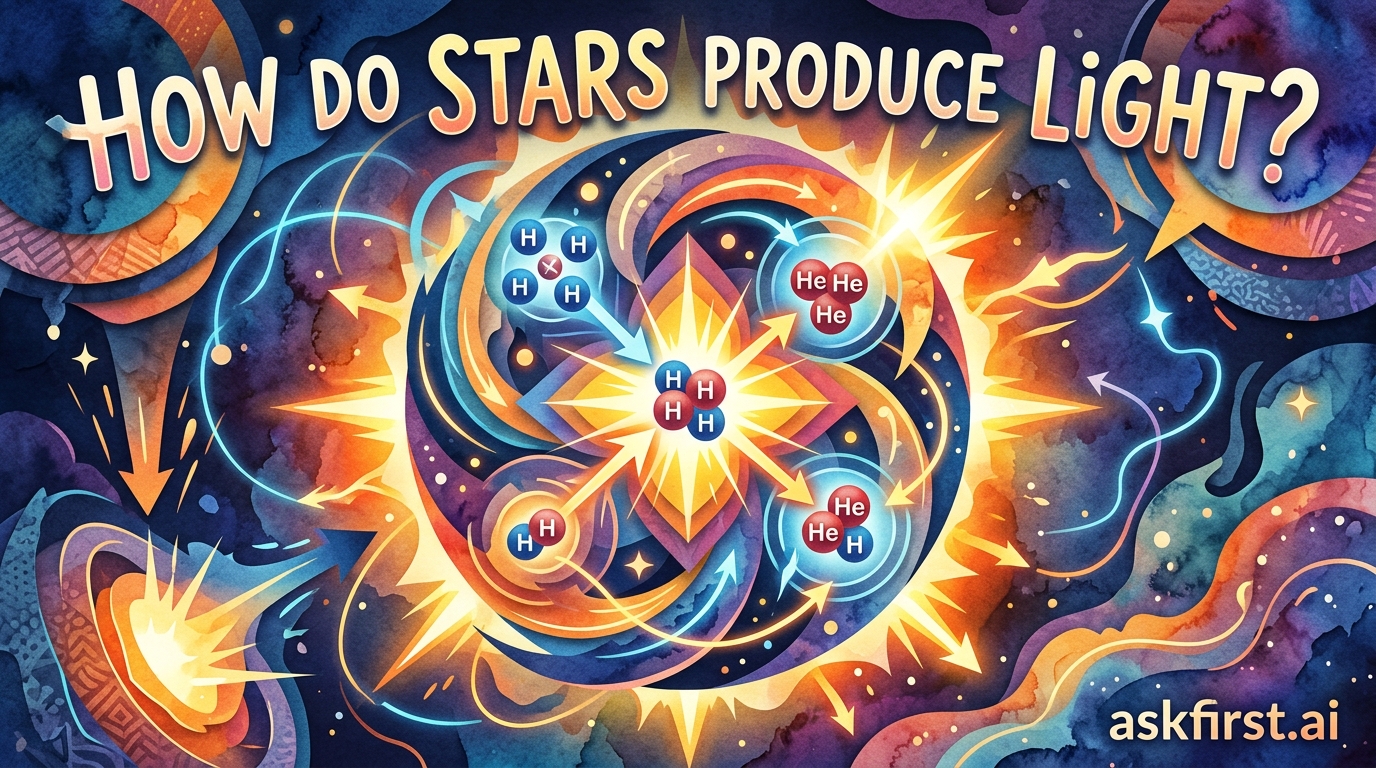
Stars produce light through a process called nuclear fusion, which occurs deep within their cores. Here is the step-by-step breakdown of how this process works:
- Extreme Conditions: The core of a star is under immense gravitational pressure. This pressure compresses hydrogen atoms so tightly and heats them to such extreme temperatures (millions of degrees) that they overcome their natural repulsion.
- Nuclear Fusion: Under these conditions, hydrogen nuclei (protons) collide and fuse together to form helium. This process is known as the proton-proton chain reaction.
- Mass-Energy Conversion: During this fusion, a tiny fraction of the mass of the hydrogen atoms is lost. According to Albert Einstein’s famous equation, $E=mc^2$, this "lost" mass is converted into a massive amount of energy.
- Radiation and Convection: This energy moves outward from the core toward the surface of the star through two main methods:
- Radiative Zone: Energy travels as photons, bouncing around for thousands of years.
- Convective Zone: Hot plasma rises, cools, and sinks, carrying energy to the surface.
- Emission of Light: Once the energy reaches the star's surface (the photosphere), it is released into space as electromagnetic radiation, which we perceive as light and heat.
In essence, a star acts like a giant, self-sustaining nuclear reactor that turns matter into light. This constant release of energy also creates outward pressure that perfectly balances the inward pull of gravity, keeping the star stable for billions of years.