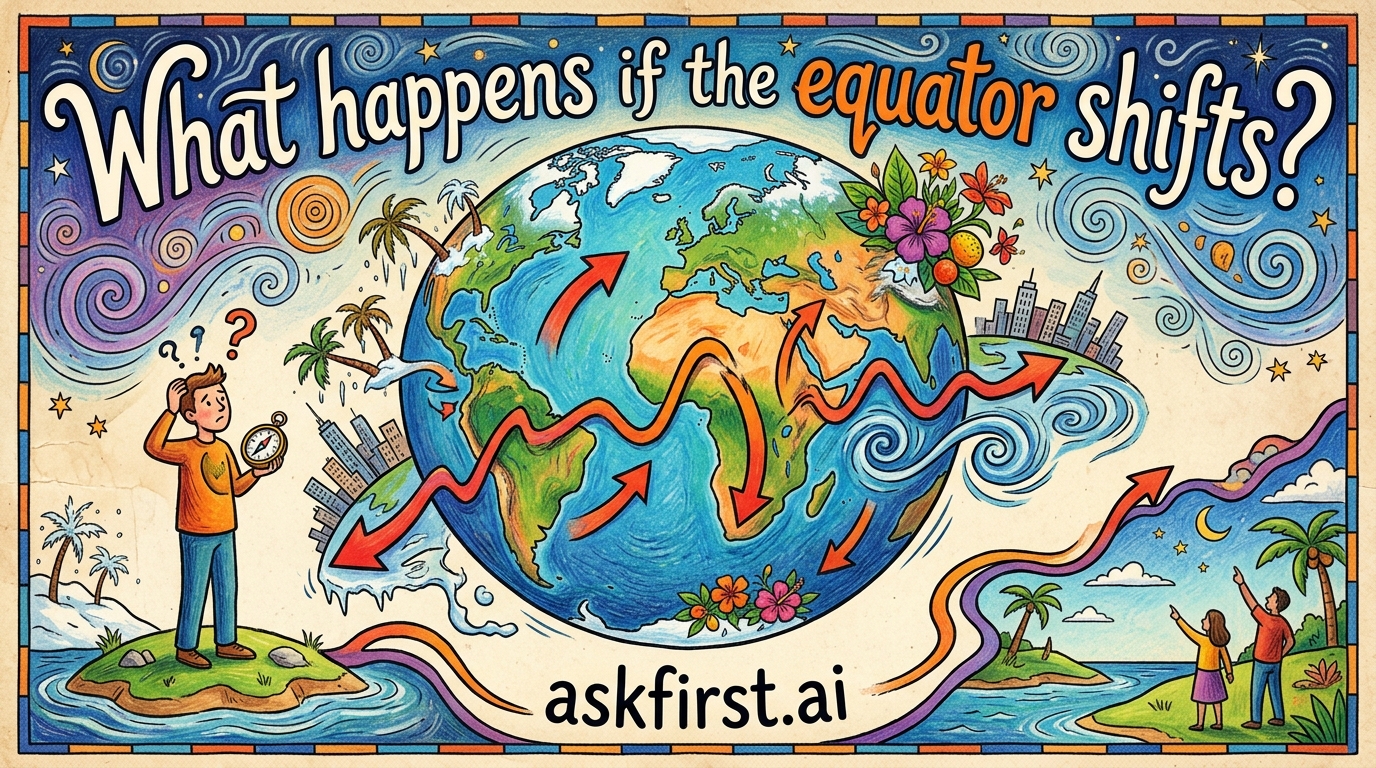
If the Earth's equator were to "shift"—meaning a change in the planet's axis of rotation or a geographical pole shift—the consequences would be catastrophic and global in scale.
It is important to distinguish between magnetic pole shifts (which happen naturally over long periods) and a true polar wander or crustal displacement (which would physically move the planet's axis). Here is what would happen if the physical equator shifted:
1. Global Catastrophic Flooding
The Earth is an oblate spheroid, meaning it bulges at the equator due to its rotation. If the axis were to shift, the oceans would redistribute to match the new bulge.
- Massive Tsunamis: Oceans would surge toward the new equatorial regions, submerging continents and coastal cities that were previously at higher latitudes.
- Sea Level Rise: Global sea levels would fluctuate wildly, permanently altering the shape of the world's coastlines.
2. Extreme Climate Disruption
Climate zones are dictated by the amount of solar radiation received at different latitudes. A shift in the equator would completely scramble these zones.
- Agricultural Collapse: Regions that are currently the "breadbaskets" of the world (like the American Midwest or Ukraine) could suddenly find themselves in arctic or tropical zones, rendering current farming infrastructure useless and leading to global famine.
- Ecosystem Extinction: Species are highly adapted to their specific latitudes. A rapid shift would outpace the ability of plants and animals to migrate or adapt, leading to a mass extinction event.
3. Atmospheric and Oceanic Turbulence
The Earth's rotation drives the Coriolis effect, which dictates weather patterns and ocean currents.
- Superstorms: A change in the axis would trigger massive atmospheric instability. We would see unprecedented hurricanes, typhoons, and wind patterns as the atmosphere struggles to adjust to the new rotational dynamics.
- Ocean Currents: Deep-ocean circulation (the "conveyor belt" that regulates global temperature) would be disrupted, potentially leading to sudden ice ages or rapid global heating depending on the trajectory of the shift.
4. Technological and Navigational Chaos
Our modern world relies on precise positioning.
- Satellite Failure: Satellites in geostationary orbit are locked to the current equator. A shift would render GPS systems, global communications, and weather monitoring satellites obsolete or misaligned.
- Infrastructure Stress: The Earth's crust is under immense pressure. A sudden shift in the rotational axis would trigger global earthquakes and volcanic eruptions as the tectonic plates adjust to the new centrifugal forces.
Is this likely to happen?
According to geological evidence, the Earth does undergo "True Polar Wander," where the solid Earth rotates relative to its spin axis. However, this process typically occurs over millions of years, allowing the planet and its biosphere to adjust gradually. A sudden, rapid shift—the kind depicted in disaster movies—is not supported by any scientific evidence and is not expected to occur.