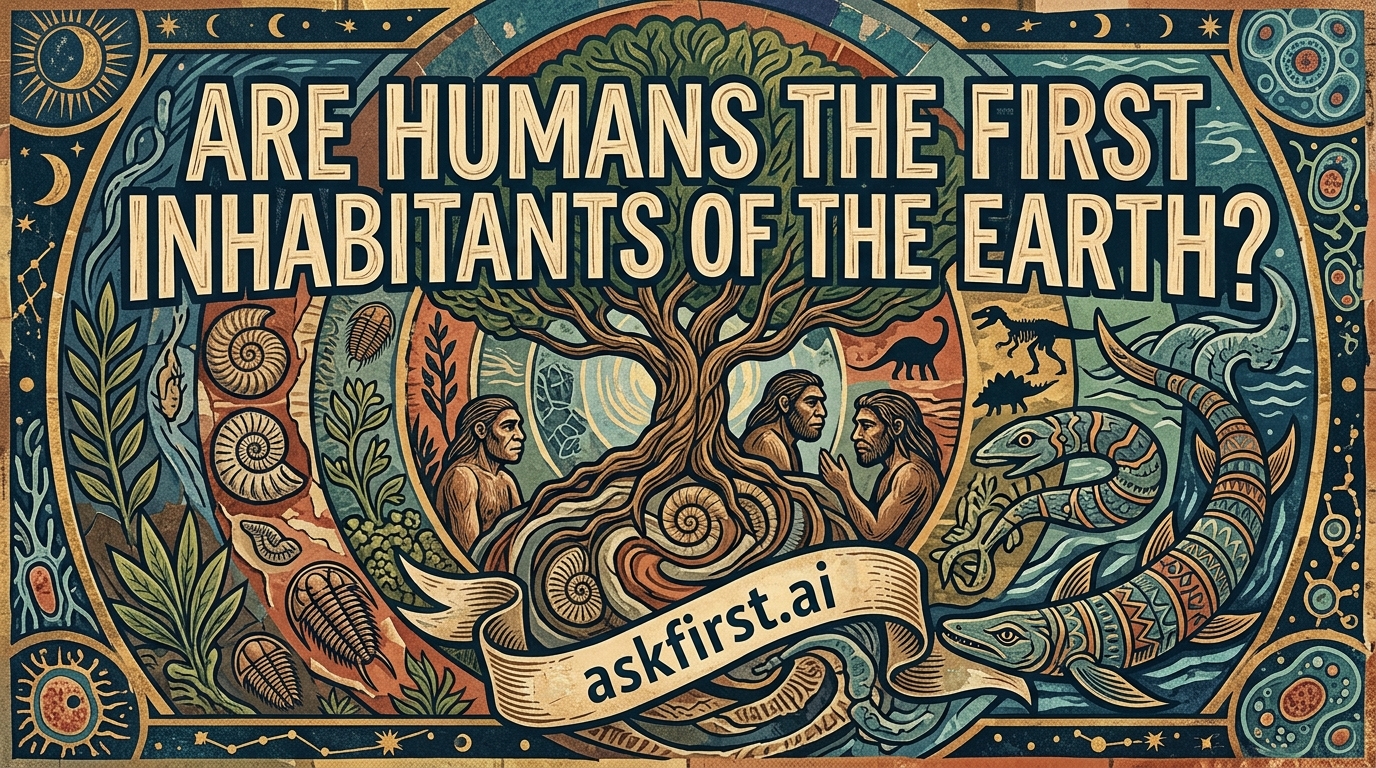
The answer depends on how you define "inhabitants." Based on the scientific consensus regarding the history of our planet, the short answer is no, humans are certainly not the first.
Here is a breakdown of the timeline and context:
- Earth's Age: The Earth is approximately 4.54 billion years old.
- First Life: Evidence suggests that life began on Earth at least 3.5 to 3.8 billion years ago. These early inhabitants were simple, single-celled organisms like bacteria and archaea.
- Multicellular Life: Complex multicellular life did not appear until much later, roughly 600 million years ago, leading to the explosion of biodiversity seen in the fossil record.
Where do humans fit in?
- The Anthropocene Context: Anatomically modern humans (Homo sapiens) appeared only about 300,000 years ago.
- The Ratio: If the entire history of the Earth were compressed into a 24-hour clock, humans would not appear until roughly two seconds before midnight.
Who came before us?
Before humans arrived, the Earth was occupied by a vast succession of life forms, including:
- Prokaryotes: The sole inhabitants for billions of years.
- Marine Life: Various forms of algae, sponges, and trilobites.
- Dinosaurs: These dominant reptiles ruled the Earth for roughly 165 million years before their mass extinction 66 million years ago.
- Mammals: Following the extinction of the dinosaurs, mammals diversified and flourished long before the evolutionary lineage leading to humans emerged.
In summary: Humans are very recent arrivals in the long, complex history of Earth. We are the current tenants of a planet that has been "inhabited" by a diverse array of life for billions of years.