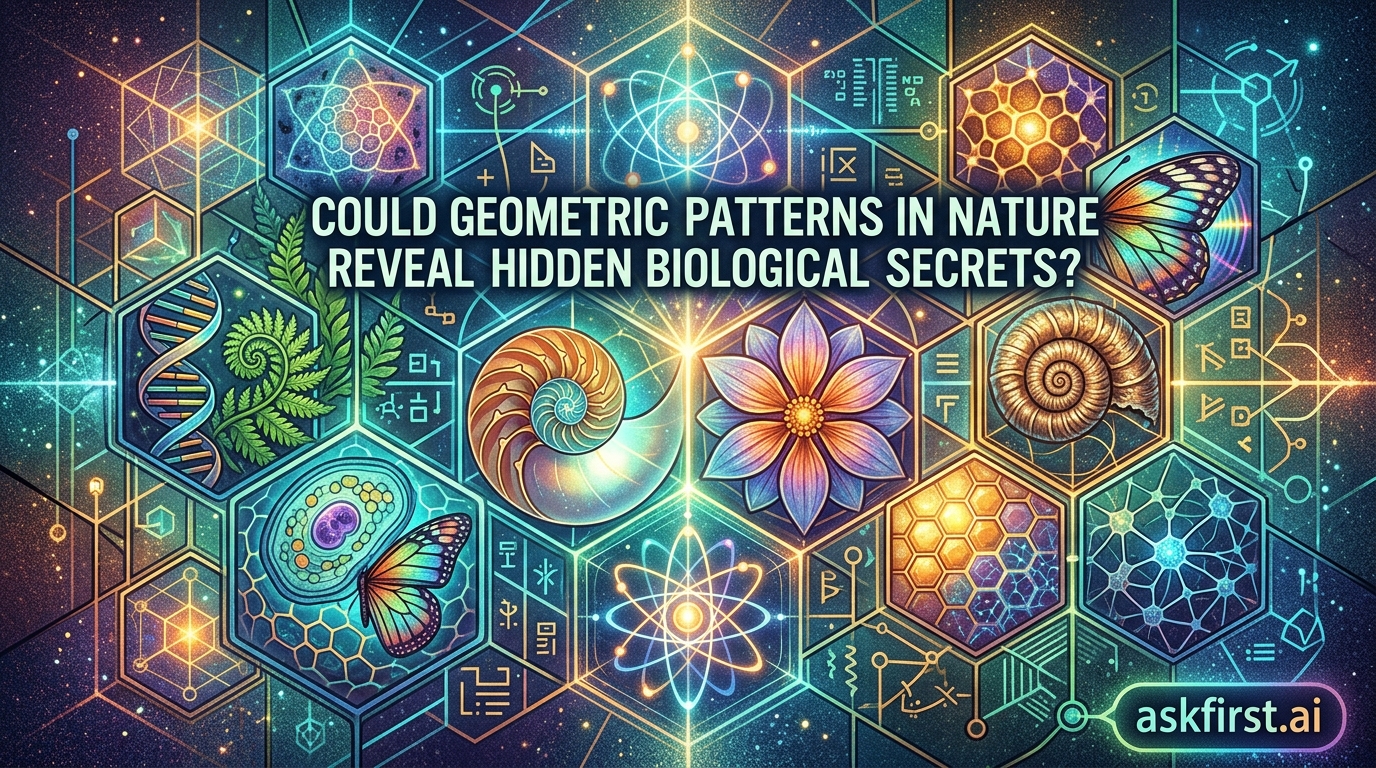
The Hidden Geometry of Life: Unlocking Nature’s Architectural Blueprint
Nature is not random. From the spiral of a nautilus shell to the hexagonal architecture of a honeybee's hive, the living world operates according to a profound, mathematical language. These geometric signatures are not mere aesthetic choices but are fundamental biological strategies for survival, efficiency, and growth.
The Fibonacci Sequence and Phyllotaxis
One of the most pervasive patterns is the Fibonacci sequence, where each number is the sum of the two preceding ones (1, 1, 2, 3, 5, 8, 13, and so on). In biology, this manifests as phyllotaxis, the arrangement of leaves on a stem or seeds in a sunflower. By growing in these specific ratios, plants maximize exposure to sunlight and rainfall, ensuring that no leaf shades the one below it. This optimal packing strategy allows for the most efficient use of physical space and energy, proving that evolution favors mathematical optimization.
The Efficiency of Hexagons
Hexagonal geometry appears repeatedly in structures such as honeycombs and crystalline formations. The hexagon is the most efficient shape for tiling a surface; it covers the maximum area with the minimum perimeter. For a bee, building a hive out of hexagonal wax cells minimizes the amount of energy required to produce wax while maximizing the storage capacity for honey. This architectural brilliance illustrates how natural organisms utilize geometric constraints to thrive in resource-limited environments.
Fractal Complexity in Anatomy
Fractals, or self-similar patterns that repeat at different scales, are the secret architecture of the human body. The branching structures of human lungs, the circulatory system, and the neurons in the brain are all fractal in nature. This design allows for a massive surface area to be packed into a small, finite volume. For instance, the human lung’s surface area is roughly equivalent to the size of a tennis court, which is only possible because of its branching, fractal-based structure. This enables efficient gas exchange, nutrient transport, and rapid neural signaling, which would be impossible if these systems were constructed as simple, flat geometric shapes.
The Biological Implications of Symmetry
Symmetry is another geometric principle that offers deep insight into biological health. Bilateral and radial symmetry often signal genetic fitness. In evolutionary biology, symmetry is a key indicator of developmental stability—an organism's ability to withstand environmental stress during growth. When these patterns are disrupted, it often indicates mutation or environmental degradation, making geometry a vital tool for ecologists monitoring the health of ecosystems.
Conclusion: Decoding the Code
These geometric patterns serve as an underlying framework for life. They demonstrate that nature functions as a complex, self-organizing system governed by physical laws. By studying these hidden geometries, scientists continue to decode the fundamental principles that dictate growth, adaptation, and survival, bridging the gap between abstract mathematics and the physical realities of the natural world.