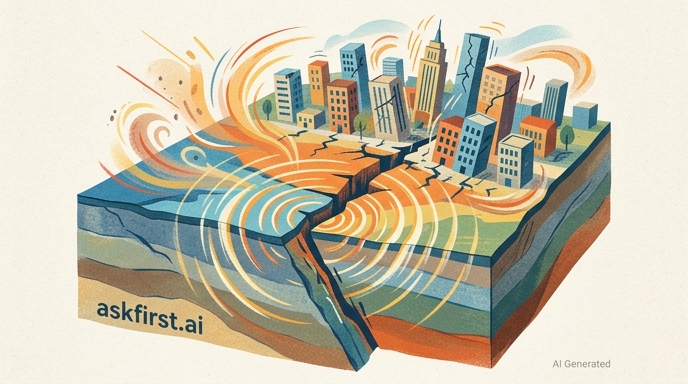
An earthquake is, at its core, the sudden release of energy within the Earth’s crust that creates seismic waves. While we often perceive them as momentary tremors, the physical processes governing these events are complex, involving massive tectonic forces, brittle failure of rock, and the propagation of kinetic energy across the planet’s surface.
The Tectonic Foundation
The Earth’s outer shell, known as the lithosphere, is divided into several massive, rigid plates that float atop the semi-fluid asthenosphere. These plates are in constant, albeit slow, motion—drifting at rates comparable to the growth of human fingernails. When these plates interact at their boundaries—converging, diverging, or sliding past one another—they do not move smoothly.
Because the rock surfaces are jagged and irregular, they become "locked" due to friction. Despite this lock, the tectonic forces continue to push the plates. This creates a state of elastic strain, where the rocks surrounding the fault line act like a stretched rubber band. They store potential energy over years, decades, or even centuries. When the accumulated stress eventually exceeds the frictional strength of the fault, the rock undergoes a brittle failure. The "snap" of this failure is the earthquake.
The Moment of Rupture: Hypocenter and Epicenter
The exact point where the fault first breaks is called the hypocenter (or focus), which can be located anywhere from near the surface to hundreds of kilometers deep. The point on the Earth’s surface directly above the hypocenter is the epicenter.
As the fault ruptures, it does not happen instantaneously across the entire length of the fault. Instead, the rupture propagates outward from the hypocenter at speeds often reaching several kilometers per second. This rupture process releases the stored elastic energy in the form of seismic waves, which radiate outward in all directions, similar to the ripples created when a stone is dropped into a pond.
The Anatomy of Seismic Waves
The energy released by an earthquake travels through the Earth and along its surface in the form of four primary types of waves, categorized into two groups:
Body Waves (Travel through the Earth's interior):
- P-waves (Primary waves): These are compressional waves, similar to sound waves. They are the fastest seismic waves and the first to reach a recording station. They move by compressing and expanding the material they pass through, causing the ground to oscillate back and forth.
- S-waves (Secondary waves): These are shear waves that move material perpendicular to the direction of wave travel. They are slower than P-waves and cannot travel through liquids, which is how scientists determined that the Earth’s outer core is molten.
Surface Waves (Travel along the Earth’s exterior):
- Love waves: These move the ground side-to-side in a horizontal motion. They are particularly destructive to the foundations of structures.
- Rayleigh waves: These move the ground in an elliptical, rolling motion, similar to ocean waves. These waves typically cause the most intense shaking and ground displacement during an event.
The Phenomenon of Ground Motion
What a human experiences as an earthquake is the result of these waves reaching the surface. The intensity of the shaking depends on several factors: the magnitude of the quake, the distance from the epicenter, and the local geology.
In areas with loose, water-saturated sediment (such as reclaimed land or river deltas), a phenomenon known as liquefaction can occur. During intense shaking, the water pressure between soil particles increases until the soil loses its strength and begins to behave like a liquid. This causes buildings to sink, tilt, or collapse entirely, even if the structures themselves are earthquake-resistant.
Furthermore, the shaking can be amplified by "basin effects," where seismic waves become trapped in deep sedimentary basins, causing the shaking to last longer and become more violent than it would be on solid bedrock.
Aftershocks and Secondary Hazards
The earthquake is rarely a single event. The initial rupture often redistributes stress to adjacent sections of the fault, triggering a series of aftershocks. These can range from minor tremors to powerful events that cause further damage to weakened structures.
Beyond the immediate shaking, earthquakes trigger secondary hazards that are often more lethal than the seismic waves themselves:
- Landslides: On steep terrain, the violent shaking can destabilize slopes, burying infrastructure and blocking valleys.
- Tsunamis: If the earthquake occurs under the ocean and causes a vertical displacement of the seafloor, it can displace massive volumes of water, generating waves that travel across entire oceans.
- Fires: The rupture of gas lines and electrical grids often leads to widespread conflagrations that are difficult to extinguish due to broken water mains.
In summary, an earthquake is the Earth’s method of correcting a state of disequilibrium. It is a violent, high-energy transition from a state of stored elastic strain to a state of equilibrium, leaving behind a reshaped landscape and a profound reminder of the planet's dynamic geological activity.