The Linguistic Hegemony of Code: Why English Rules Software
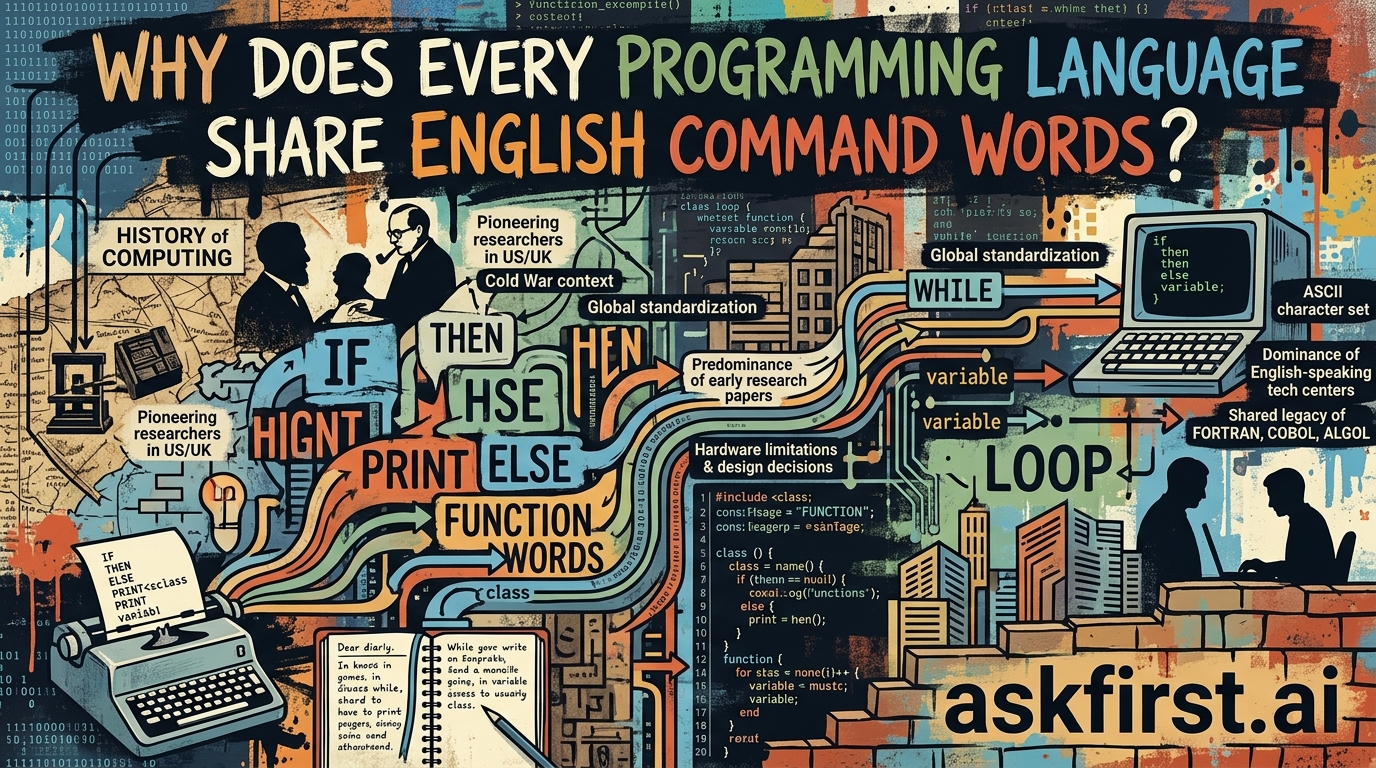
Programming languages are formal systems, yet they consistently rely on English-based vocabularies like 'if', 'else', 'while', 'print', and 'return'. This phenomenon is not an accident of nature but a deliberate artifact of history, logistics, and global standardization.
The Historical Nexus: Early Computing
The genesis of modern computing is rooted in the United States and the United Kingdom during the 1940s and 1950s. Projects like the ENIAC and the development of FORTRAN by IBM led to the establishment of the first standardized programming syntaxes. Grace Hopper, a pivotal figure in computer science, envisioned languages that utilized common language rather than purely mathematical notations. Because the dominant institutions driving innovation were English-speaking, the resulting documentation, compilers, and internal logic structures defaulted to English. By the time computing became a global industry, the "English-first" paradigm was already cemented into the foundational architectures of machine code and high-level language design.
Economic and Educational Standardization
For an industry that relies on collaborative efforts across borders, a common "lingua franca" is essential for maintenance and interoperability. When a software project starts in Bangalore, involves team members in Berlin, and is maintained by developers in San Francisco, the overhead of translating language keywords would be prohibitive. Programming languages are designed to be read more often than they are written. If a developer had to reconcile a compiler that accepted 'si' instead of 'if' or 'tant que' instead of 'while', the cognitive load of shifting between local dialects would skyrocket, creating fragile and inefficient codebases.
Engineering Efficiency and Predictability
Modern programming syntax is heavily influenced by the C language family. The C language, designed by Dennis Ritchie at Bell Labs, adopted English keywords as a way to map mnemonic instructions directly to assembly language operations. For instance, the command 'return' serves as a clear instruction to the processor to conclude a subroutine. Using consistent English keywords allows compilers and integrated development environments (IDEs) to parse, highlight, and debug code with incredible speed. It reduces the chance of semantic ambiguity. If keywords were translated into various languages, the risk of syntax errors would increase significantly, as developers would struggle with non-standardized localized reserved words.
Conclusion: A Global Interface
While non-English programming languages (such as those using Chinese or Russian syntax) have been developed, they remain niche. The global ecosystem relies on English as a standardized set of logical labels. This choice represents a practical compromise: English has become the technical interface for the machine, allowing developers worldwide to share libraries, documentation, and logic structures without linguistic friction. It is the language of the machine, ensuring that software remains a universal tool for human innovation.