The Architecture of the Invisible: How Code Constructs Modern Reality
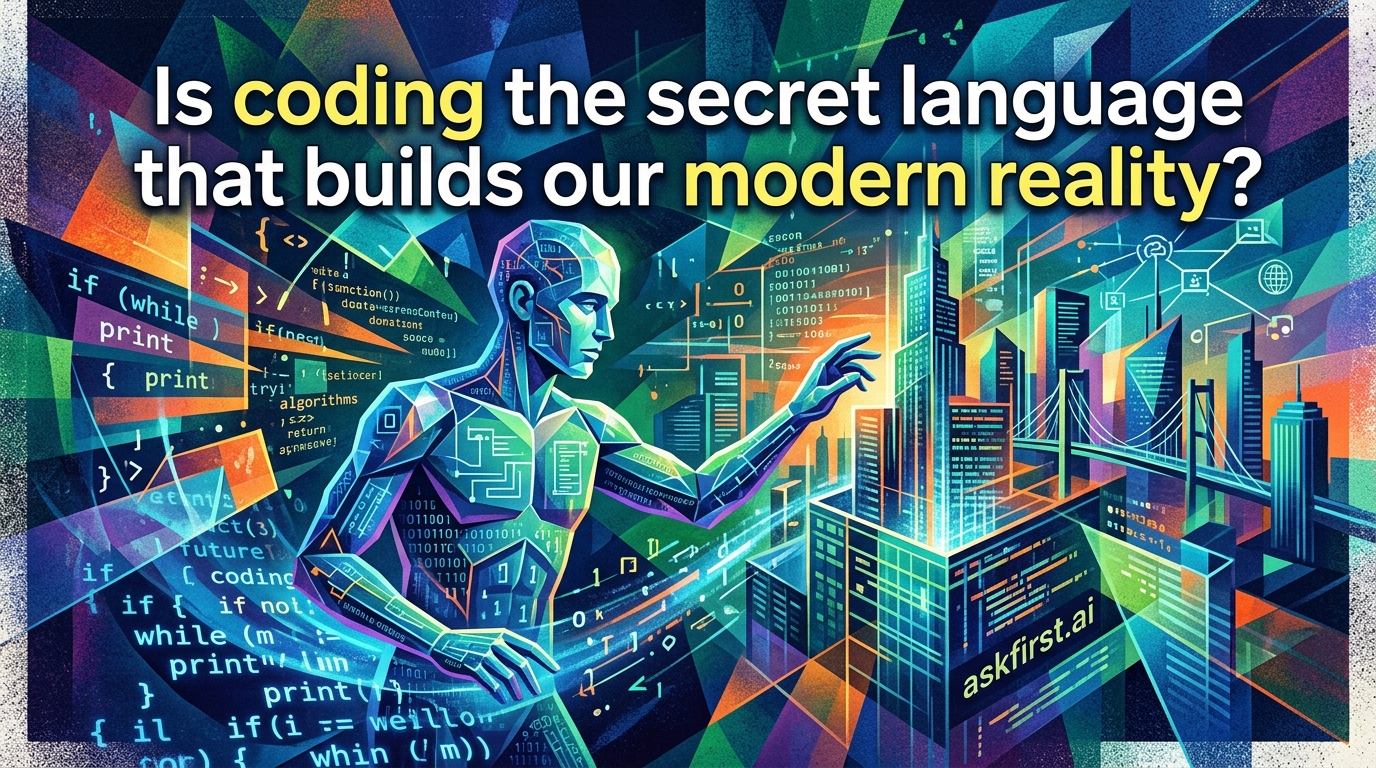
To suggest that coding is the "secret language" of our modern reality is not merely a metaphorical flourish; it is a literal description of how the 21st century operates. We live in a world where the physical environment is increasingly mediated, monitored, and manipulated by layers of logical instructions. From the financial markets that dictate the global economy to the algorithms that curate our social interactions, software has become the fundamental substrate of human civilization. In many ways, code has replaced the steam engine or the printing press as the primary engine of societal transformation.
The Ontological Shift: Reality as Data
In his seminal work The Stack: On Software and Sovereignty (MIT Press, 2016), cultural theorist Benjamin Bratton argues that we are witnessing the emergence of a "planetary-scale computation." This is not just a collection of computers, but a new kind of social and geopolitical infrastructure. Code acts as the "glue" that binds disparate physical objects—cars, thermostats, cameras, and smartphones—into a singular, responsive system.
When we write code, we are not just solving a logic puzzle; we are defining the parameters of what is possible within a given environment. For instance, consider the "Smart City" initiatives being implemented in places like Singapore or Songdo, South Korea. In these environments, traffic flow, energy consumption, and public safety are managed by autonomous systems. The "reality" of a citizen living in such a city is directly influenced by the efficiency and the biases embedded in the code governing these municipal systems. If the code prioritizes traffic throughput over pedestrian safety, the physical reality of the street changes accordingly.
The Logic of Algorithms and Human Behavior
The most profound impact of coding on our reality is found in the behavioral influence of algorithms. In The Age of Surveillance Capitalism (PublicAffairs, 2019), Shoshana Zuboff details how the "secret language" of code is used to predict and modify human behavior for profit. The algorithms powering platforms like X (formerly Twitter) or TikTok are designed to optimize for engagement, which often translates to the amplification of extreme emotions.
This is a concrete example of code shaping human reality:
- Information Filtering: By deciding which news stories or videos appear in your feed, code constructs your perception of world events.
- Economic Incentives: Algorithmic trading, which accounts for the majority of volume on the New York Stock Exchange, means that the "value" of a company is often determined by millisecond-long interactions between competing bots rather than human analysts.
- Social Stratification: Credit scoring systems, which are increasingly reliant on machine learning models, determine who can borrow money, buy a home, or secure a lease, effectively codifying socio-economic standing into software.
Code as Law: The "Code is Law" Doctrine
Legal scholar Lawrence Lessig famously asserted in his book Code and Other Laws of Cyberspace (Basic Books, 1999) that "Code is Law." Lessig argued that software developers possess a form of legislative power. When a programmer decides whether a platform should be encrypted or transparent, they are making a policy decision that carries the weight of law.
If a platform’s code prevents the deletion of data, then "permanence" becomes a law of that digital space. If a platform’s code restricts speech through automated moderation, then "censorship" (or curated discourse) becomes an architectural feature of that space. Unlike legislative law, which can be debated in public forums, the "law" of code is often opaque, proprietary, and inaccessible to the average user. This opacity is what gives code its "secret" quality—it governs our reality from behind a curtain of syntax and logic that most people never see.
The Fragility of a Programmed World
Because our reality is now built upon this digital foundation, we have introduced a new category of vulnerability: systemic fragility. In The Design of Everyday Things (Basic Books, 2013), Don Norman discusses the importance of human-centered design, but today’s reality is often "system-centered." When software fails—as seen in the 2024 global IT outage caused by a faulty update to CrowdStrike’s security software—the impact is instantaneous and physical. Airlines ground planes, hospitals halt surgeries, and media outlets go dark.
This illustrates that we have moved past the era where code was a tool; we are now in the era where code is the environment. We are no longer using the internet; we are living inside it.
Conclusion: The Responsibility of the Architect
The notion that coding is the secret language of modern reality is accurate because code defines the boundaries, rules, and possibilities of our daily lives. It mediates our relationships, our commerce, our governance, and even our perception of truth. As we move deeper into an era defined by artificial intelligence and automated decision-making, the importance of "literacy" in this language cannot be overstated.
To understand the modern world is to understand the logic that underpins it. We must transition from being passive inhabitants of a programmed reality to active participants who interrogate, audit, and demand transparency from the code that shapes our existence. The architects of our reality are no longer just politicians or philosophers; they are the engineers who write the instructions that run the world. Recognizing this is the first step toward reclaiming agency in the digital age.