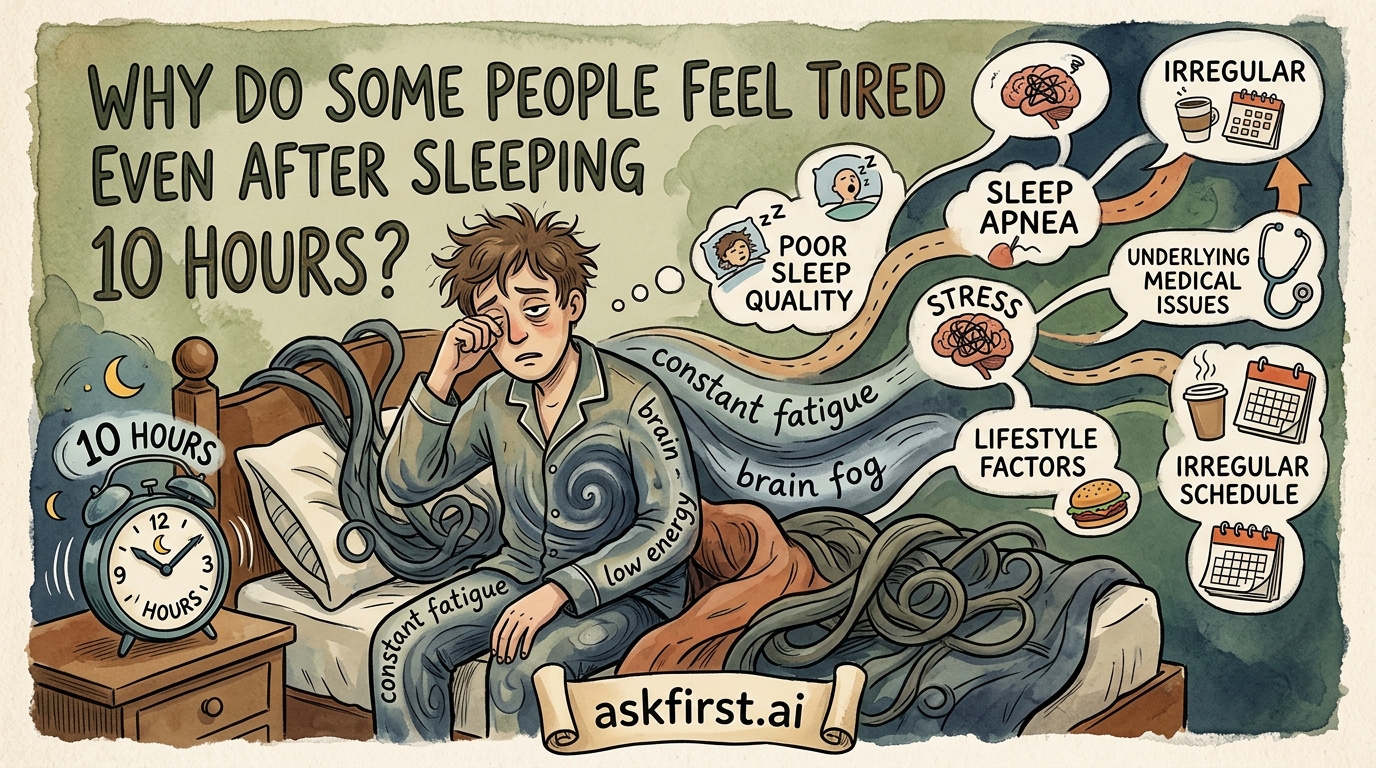
The Paradox of Prolonged Slumber: Understanding Persistent Fatigue
It is a common frustration: you set aside ten hours for sleep, wake up at the designated time, and yet, instead of feeling rejuvenated, you experience a heavy, fog-like exhaustion that lingers throughout the morning. Contrary to the popular belief that "more sleep is always better," the biological reality is far more nuanced. Sleeping for ten hours does not automatically equate to high-quality recovery. In many cases, excessive time in bed can actually be counterproductive, leading to a phenomenon often described as "sleep drunkenness" or sleep inertia.
To understand why this occurs, we must look beyond the clock and examine the architecture of sleep, metabolic health, and the underlying physiological mechanisms that govern our circadian rhythms.
1. The Disruption of Sleep Architecture and Fragmentation
Sleep is not a monolithic state; it is a complex cycle composed of Non-Rapid Eye Movement (NREM) stages and Rapid Eye Movement (REM) sleep. According to Dr. Matthew Walker in his seminal work, Why We Sleep: Unlocking the Power of Sleep and Dreams, the brain requires a specific progression through these cycles to achieve true restoration.
When you sleep for ten hours, you are often forcing your body to remain in a state of "junk sleep." After the first eight hours, the homeostatic sleep drive—the pressure to sleep built up by the accumulation of adenosine in the brain—is largely satisfied. The subsequent two hours are often spent in lighter, fragmented stages of sleep. During this extended period, the body is prone to micro-awakenings that you may not consciously remember, but which effectively shatter the continuity of your sleep architecture. This fragmentation prevents the brain from completing the essential memory consolidation and metabolic cleansing processes that occur during deep, restorative cycles.
2. Circadian Misalignment and Sleep Inertia
Your body operates on an internal master clock located in the suprachiasmatic nucleus (SCN) of the hypothalamus. This clock regulates the release of hormones like melatonin and cortisol. When you oversleep, you are frequently fighting against your body’s natural wake-up signal.
If you wake up at the end of a long, ten-hour bout, you are likely emerging from a sleep cycle at the wrong point. Waking up from deep sleep (Stage 3 NREM) triggers intense sleep inertia—a physiological state of impaired cognitive performance and grogginess. As noted by Dr. Charles Czeisler of Harvard Medical School, the brain requires a transition period to move from sleep to wakefulness. By extending sleep duration, you increase the likelihood that your alarm will sound while you are in the deepest phase of your cycle, making the transition to consciousness feel physically painful and mentally exhausting.
3. Underlying Pathologies: When Sleep Quality is Compromised
Often, the need for ten hours of sleep is a compensatory mechanism for poor quality. If you have an undiagnosed sleep disorder, your body "thinks" it needs more time because the time it has already spent asleep was ineffective.
- Obstructive Sleep Apnea (OSA): This is one of the most common culprits. As described in The Sleep Solution by Dr. W. Chris Winter, OSA causes repeated airway collapses throughout the night, forcing the brain to wake up briefly to resume breathing. You may not remember these awakenings, but they prevent you from reaching the restorative deep sleep stages. Ten hours of "apneic sleep" is essentially ten hours of light, interrupted rest that leaves the body starving for oxygen.
- Restless Leg Syndrome (RLS) and PLMD: Periodic Limb Movement Disorder causes involuntary twitching during sleep. These movements act as a constant physical irritant, preventing the body from achieving the "delta wave" deep sleep necessary for physical repair.
4. Psychological Factors and Metabolic Health
Fatigue is not always a result of a sleep disorder; it is frequently a symptom of systemic health issues. Chronic stress, for instance, elevates cortisol levels, which can lead to "tired but wired" syndrome. Even if you manage to stay in bed for ten hours, your nervous system may remain in a hyper-aroused state, preventing the parasympathetic nervous system from fully engaging in recovery.
Furthermore, imbalances in blood glucose levels can impact energy. If you consume high-glycemic foods before bed, you may experience nocturnal hypoglycemia (low blood sugar), which prompts the body to release adrenaline to stabilize levels, causing you to wake up feeling depleted rather than refreshed.
Conclusion: Quality Over Quantity
The goal of sleep is not to maximize hours spent in bed, but to maximize the efficiency of the time spent asleep. If you are consistently sleeping ten hours and waking up exhausted, the solution is rarely to sleep longer. Instead, focus on sleep hygiene: maintain a consistent wake-up time, optimize your bedroom environment (cool, dark, and silent), and consult a professional to rule out sleep apnea or other physiological conditions.
As the research of Dr. Walker and other sleep scientists suggests, the human body is designed for a rhythmic, efficient cycle, typically between seven and nine hours. When you find yourself needing ten, it is a signal from your biology that something is interfering with the quality of your rest, not that you simply haven't had enough of it. Addressing the underlying fragmentation is the only path to waking up with the clarity and vitality you deserve.