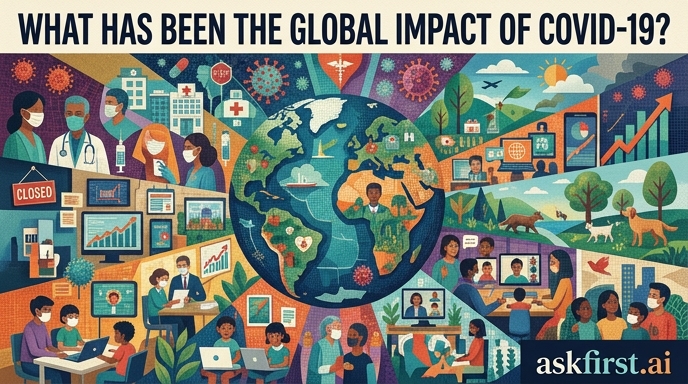
The global impact of the COVID-19 pandemic, which emerged in late 2019 and dominated international affairs through the early 2020s, represents one of the most significant disruptors in modern human history. Its consequences have permeated every facet of society, from public health and global economics to geopolitical relations and individual behavioral psychology. The following analysis explores these multidimensional impacts with the depth required to understand our current global landscape.
1. Public Health and Demographic Shifts
The most immediate impact of COVID-19 was the catastrophic loss of life and the immense strain placed on healthcare infrastructure. Beyond the tragic mortality figures, which reached millions worldwide, the pandemic exposed profound vulnerabilities in global health systems. Hospitals were forced to pivot almost entirely toward emergency respiratory care, leading to a massive backlog in elective surgeries, cancer screenings, and routine vaccinations for other diseases.
Furthermore, the pandemic catalyzed a revolution in medical technology. The rapid development and deployment of mRNA vaccine platforms set a new precedent for pharmaceutical innovation. This shift has opened doors for future treatments regarding HIV, malaria, and various forms of cancer. However, it also highlighted a "vaccine apartheid," where wealthy nations secured early access while the Global South faced significant delays, exacerbating existing health inequities.
2. Economic Restructuring and Global Supply Chains
The global economy underwent a "Great Lockdown" that triggered the deepest recession since the Second World War. Governments responded with unprecedented fiscal stimulus packages, which prevented total systemic collapse but also contributed to inflationary pressures that persisted for years afterward.
Perhaps the most structural change occurred in the supply chain. Before 2020, the global economy relied heavily on "just-in-time" manufacturing, which prioritized efficiency over resilience. The pandemic exposed the fragility of this model; when factory shutdowns in Asia halted production in Europe and North America, the world realized the danger of over-reliance on single-source suppliers. This has led to a major shift toward "near-shoring" and "friend-shoring," where nations are actively moving critical manufacturing back to domestic soil or to politically aligned trade partners to ensure national security.
3. The Digital Transformation of Society
If there is one silver lining to the pandemic, it is the acceleration of digital adoption. What might have taken a decade of corporate and educational evolution occurred in a matter of months. Remote work—or "telecommuting"—moved from a niche perk to a standard operational requirement. This shift permanently altered the urban landscape; commercial real estate markets in major metropolitan hubs have yet to fully recover as employees demand hybrid flexibility.
Education also saw a seismic shift. The transition to remote learning underscored the "digital divide," where students without stable internet access or personal computers fell significantly behind their peers. This has forced governments and international organizations to treat high-speed internet as a fundamental utility rather than a luxury, sparking massive infrastructure investment programs globally.
4. Geopolitical Realignment and Trust
The pandemic acted as an accelerant for existing geopolitical tensions. The initial failure of international cooperation—exemplified by the competition for personal protective equipment (PPE) and the politicization of vaccine origins—weakened faith in multilateral institutions like the World Health Organization (WHO) and the United Nations.
We have witnessed an increase in nationalist rhetoric, as countries prioritized domestic stocks over international commitments. The pandemic also exacerbated the rivalry between the United States and China, with both nations using "vaccine diplomacy" to project soft power in developing regions. Consequently, the world has moved toward a more fragmented, multipolar order where national sovereignty is often prioritized over global integration.
5. Socio-Psychological and Long-Term Behavioral Changes
The human cost of the pandemic extends far beyond physical health. The prolonged periods of social isolation, school closures, and economic instability have triggered a global mental health crisis. Rates of anxiety and depression, particularly among the youth, have seen marked increases.
Behaviorally, the pandemic has left a lasting imprint on how we view public spaces and collective safety. There is a heightened awareness of hygiene, air quality, and biological risks that did not exist in the public consciousness prior to 2020. Furthermore, the "Great Resignation" and the subsequent focus on "quiet quitting" reflect a fundamental change in the social contract between employers and employees. Workers are increasingly prioritizing personal well-being, work-life balance, and purpose-driven employment over traditional corporate loyalty.
Conclusion
The COVID-19 pandemic was not merely a temporary interruption of the status quo; it was a watershed moment that forced humanity to confront its own fragility. While the immediate health threat has transitioned into an endemic phase, the structural changes—in how we work, how we trade, how we govern, and how we view our collective health—are permanent. The global community is now tasked with navigating a new era defined by digital integration, supply chain resilience, and a cautious, perhaps more cynical, approach to international cooperation. The lessons learned during this period continue to inform the policies and personal choices that will shape the remainder of the 21st century.