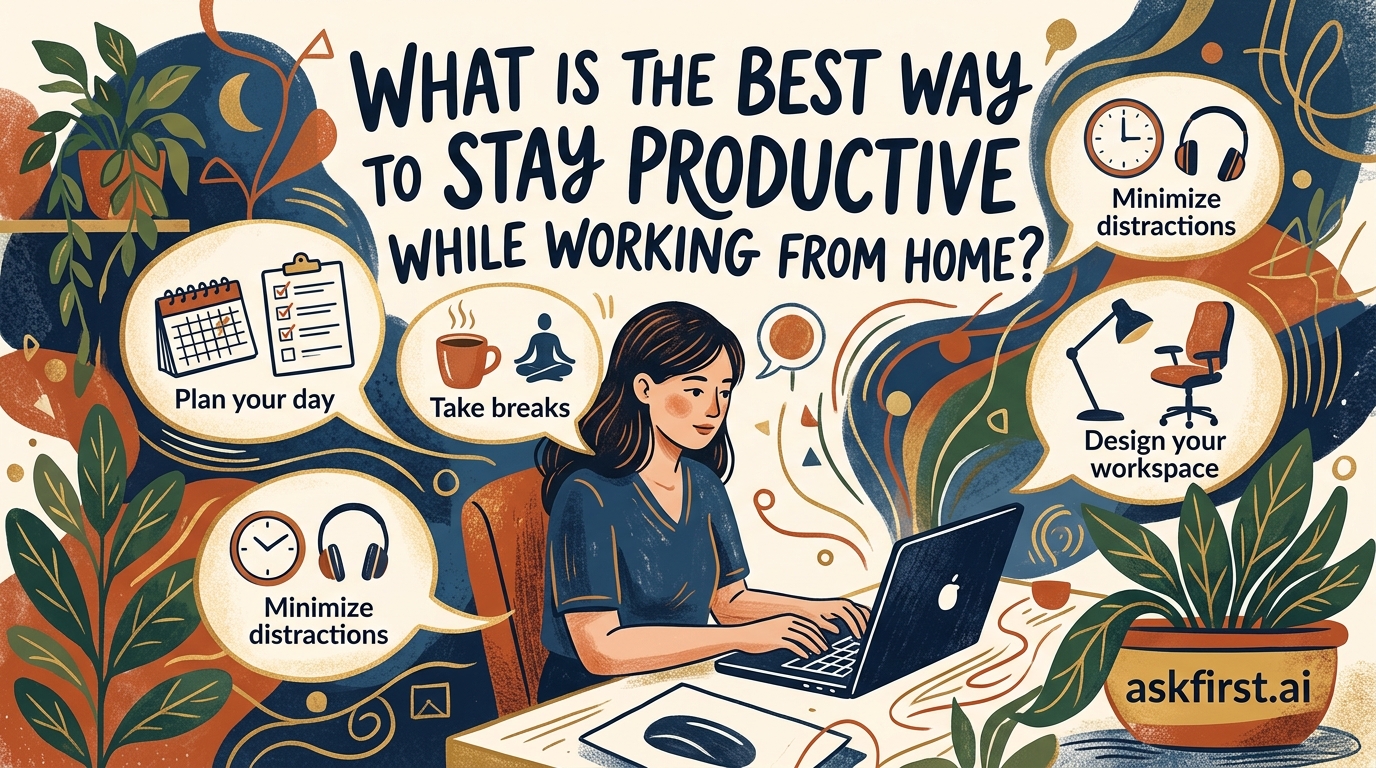
Mastering the Remote Workspace: A Blueprint for Peak Productivity
The transition to remote work has fundamentally altered the professional landscape. While the freedom to work from anywhere offers unparalleled flexibility, it also dissolves the traditional boundaries between professional responsibilities and personal life. Maintaining high output in a home environment requires more than just a laptop and a reliable internet connection; it demands a strategic architecture of your time, space, and psychological state.
1. The Architecture of the Physical Workspace
Productivity is profoundly influenced by environmental cues. When you work from the same space where you relax, your brain struggles to switch between "focused" and "restful" modes.
- Dedicated Zones: Establish a workspace that is used exclusively for professional tasks. According to Cal Newport in his seminal book Deep Work: Rules for Focused Success in a Distracted World, the physical act of entering a specific space can trigger a psychological state of concentration. If you do not have a separate office, use a specific desk or even a specific chair that is associated only with work.
- Ergonomics and Lighting: Physical discomfort is the silent killer of productivity. Ensure your monitor is at eye level and your chair provides lumbar support. In The Productivity Project by Chris Bailey, the author emphasizes that managing your energy is just as important as managing your time. Poor lighting or uncomfortable seating leads to physical fatigue, which prematurely drains your energy reserves.
2. Temporal Structure: Time-Blocking and Deep Work
Without the natural rhythms of an office—such as scheduled meetings or lunch breaks with colleagues—the day can easily become fragmented.
- Time-Blocking: Divide your day into distinct blocks of time dedicated to specific tasks. Instead of a general "to-do" list, assign a start and end time to every objective. This creates a sense of urgency and prevents "Parkinson’s Law," which states that work expands to fill the time available for its completion.
- The Power of Deep Work: Protect your most cognitively demanding tasks by scheduling them during your peak biological hours. For most, this is in the morning. During these blocks, eliminate all notifications. As Newport argues, multitasking is a myth; you are merely "context switching," which incurs a significant "attention residue" cost that lowers your IQ and overall efficiency.
3. Managing the Digital Environment
The home office is rife with digital distractions. From Slack pings to the temptation of social media, the internet is designed to capture your attention.
- The "Zero-Notification" Policy: During deep work sessions, utilize "Do Not Disturb" modes on all devices. If a message is truly urgent, a phone call is usually the standard protocol.
- Batching Communication: Rather than checking email or messaging platforms every five minutes, schedule three specific times during the day to address them. This prevents the "reactive" loop where you spend your entire day responding to others' priorities rather than advancing your own.
4. The Psychological Boundaries of "Clocking Out"
One of the greatest challenges of remote work is the inability to disconnect. When your office is in your living room, the workday never technically ends, leading to burnout.
- The Shutdown Ritual: Develop a formal closing sequence for your day. This might involve clearing your desk, reviewing your accomplishments, and writing down the top three priorities for the next day. This ritual signals to your brain that the professional day has concluded.
- Transition Activities: Create a bridge between work and home life. This could be a 15-minute walk, a change of clothes, or a specific hobby. This transition helps reset your mental state, ensuring that your evening is restorative rather than a continuation of your workday.
5. Prioritization Frameworks
The "Eisenhower Matrix," a concept popularized by Dwight D. Eisenhower and later refined in Stephen Covey’s The 7 Habits of Highly Effective People, remains the gold standard for task management. Categorize your tasks into four quadrants based on urgency and importance:
- Do First: Urgent and important tasks.
- Schedule: Important but not urgent tasks (these are the tasks that drive long-term growth).
- Delegate/Minimize: Urgent but not important tasks (often interruptions).
- Eliminate: Neither urgent nor important.
Focusing on the "Important but not urgent" quadrant is what separates high achievers from those who are perpetually "busy" but unproductive.
Conclusion
Staying productive at home is not about working more hours; it is about working with greater intent. By curating your environment, strictly managing your time through deep work, and establishing clear psychological boundaries between your professional and personal life, you can achieve a level of sustained output that is often impossible in the chaotic, interruption-heavy environment of a traditional office. Productivity is a practice of discipline and self-awareness—by consistently applying these structures, you transform your home into a sanctuary of high-impact work.