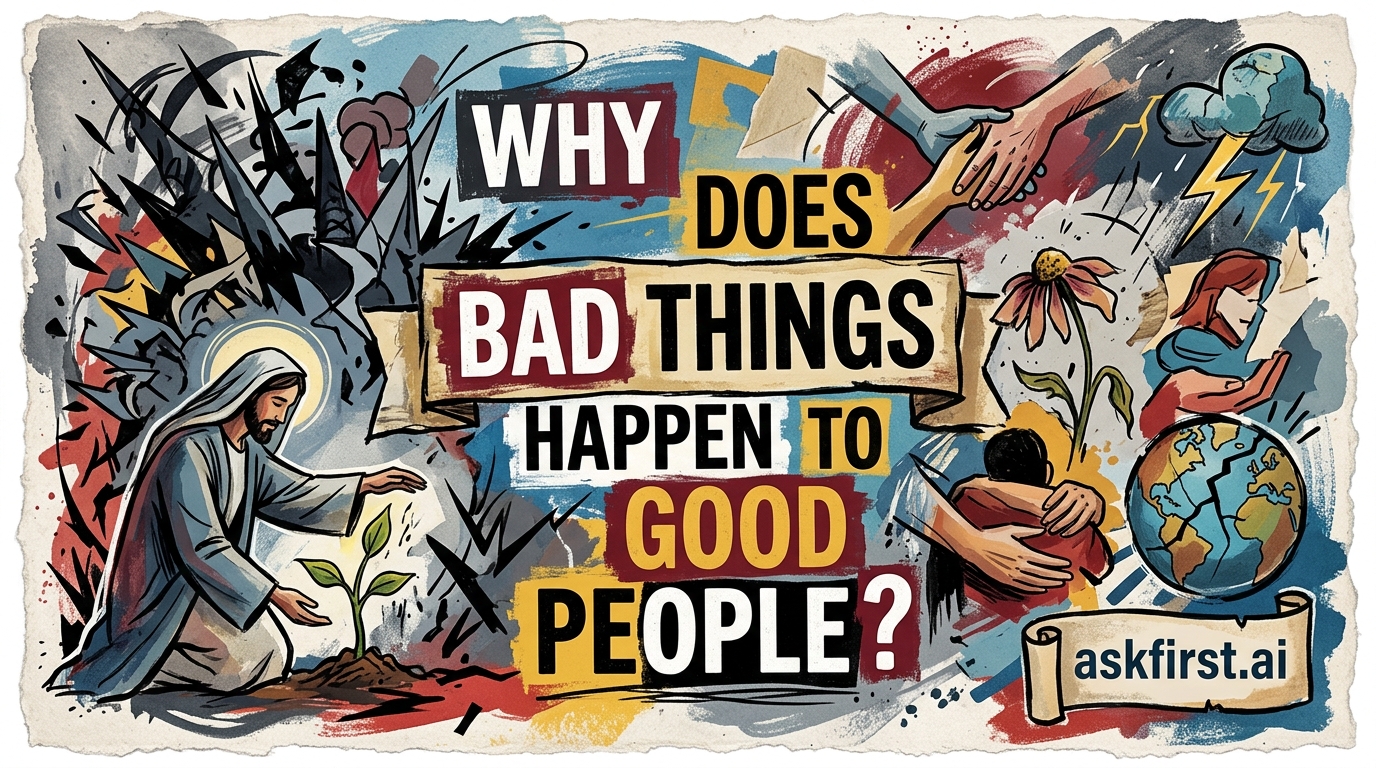
The question of why misfortune befalls those who act with integrity and kindness is perhaps the oldest and most profound inquiry in human history. It is the central conflict of the Book of Job in the Hebrew Bible, the subject of Harold Kushner’s seminal work When Bad Things Happen to Good People, and a persistent challenge to the concept of a moral universe. To understand this phenomenon, we must move beyond simplistic notions of divine retribution or cosmic justice and examine the intersection of probability, human agency, and the inherent nature of physical reality.
The Illusion of a Moral Ledger
Human beings are psychologically hardwired to seek patterns. We possess an innate desire to believe in a "Just World Hypothesis"—a cognitive bias, first proposed by social psychologist Melvin Lerner in his 1980 book The Belief in a Just World: A Fundamental Delusion. Lerner argued that people have a deep-seated need to believe that the world is inherently fair, where good deeds are rewarded and bad deeds are punished.
When we see a virtuous person suffer, it creates "cognitive dissonance." We feel uncomfortable because the event contradicts our belief system. To resolve this, we often subconsciously blame the victim, telling ourselves they must have done something wrong, or we project a future reward to balance the scales. However, the reality, as observed by physicist Leonard Mlodinow in his book The Drunkard's Walk: How Randomness Rules Our Lives, is that the universe is governed by stochastic processes—random events that have no regard for the moral character of the individuals they affect.
The Nature of Physical Reality and Entropy
From a scientific perspective, the universe does not operate on a moral axis. It operates on the laws of physics, chemistry, and biology. Natural disasters—earthquakes, hurricanes, and pandemics—do not select their targets based on the goodness of the human heart. They are the result of tectonic shifts, atmospheric pressure changes, and biological mutation.
In The Demon-Haunted World, Carl Sagan emphasizes that science provides a way to understand the universe as it is, not as we wish it to be. If a "good" person happens to be standing on a fault line when an earthquake occurs, the tectonic plates do not pause to consider the individual's charitable contributions. The entropy of the universe is indifferent. This is not a cruel design; it is simply a neutral one. Recognizing this helps us shift our focus from asking "Why me?" to understanding the mechanics of our environment, which empowers us to build better infrastructure, practice better medicine, and prepare for the unpredictable.
The Role of Human Agency and Complexity
While nature is indifferent, human society is complex, and "bad things" often occur due to the intersecting actions of many people. This is what sociologist Charles Perrow identified in his work Normal Accidents. Perrow argues that in complex systems—like global economies, healthcare networks, or political structures—failures are inevitable, not because of malice, but because of the sheer complexity of interconnected parts.
A virtuous person may suffer because they are caught in the "ripple effect" of someone else’s poor decision or a systemic failure. For instance, a person who manages their finances with total integrity can still be ruined by a global financial crash caused by the greed of others. This is the "interconnectedness problem." We are not isolated moral agents; we are nodes in a massive, complex network. The suffering of a good person is often the collateral damage of a system that is far larger than any single individual’s moral standing.
The Existential Perspective: Meaning in the Midst of Suffering
Since we cannot rely on the universe to be fair, we are forced to grapple with the existential challenge of creating meaning in the face of tragedy. This is the core philosophy of Viktor Frankl, a psychiatrist and Holocaust survivor who wrote Man’s Search for Meaning. Frankl argued that while we cannot always control what happens to us, we have absolute control over our response to those events.
Frankl’s experience in concentration camps led him to the conclusion that suffering is an unavoidable part of the human condition. When we face misfortune, the "why" becomes less important than the "how." How do we integrate this suffering into our life story? How do we use it to cultivate empathy or resilience? In this view, the "good" in a person is not a shield against suffering, but a resource for enduring it. Virtue provides the internal strength to find purpose even when the external world is devoid of justice.
Conclusion: From Retribution to Responsibility
Ultimately, the question "Why do bad things happen to good people?" is based on a misunderstanding of the universe’s architecture. There is no cosmic ledger. The universe is not a courtroom; it is a dynamic, complex, and often chaotic system.
By accepting that misfortune is frequently the result of randomness, systemic complexity, and the basic indifference of physical laws, we stop waiting for a cosmic correction that will never come. Instead, we move toward a more mature stance: radical responsibility. We recognize that while we cannot prevent all suffering, we can mitigate it through community, innovation, and compassion. The "goodness" of a person is not a transaction that buys protection from the world; it is the essential light that allows us to navigate the darkness when the inevitable, random, and tragic events of life occur.