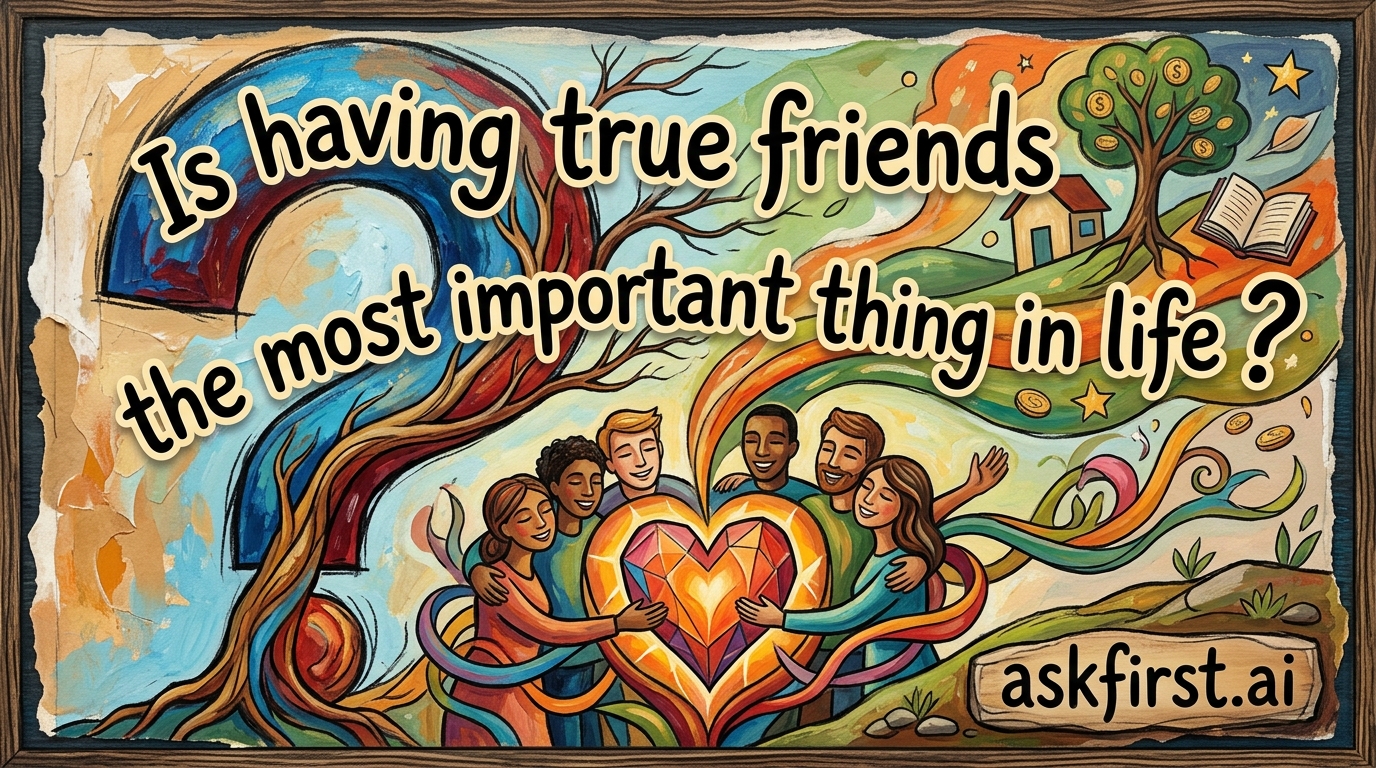
The question of whether true friendship constitutes the most important aspect of human existence is one that has occupied philosophers, theologians, and psychologists for millennia. To declare a single "most important" element of life is inherently subjective, yet the overwhelming consensus across centuries of human inquiry suggests that the quality of our social bonds is the primary determinant of both our longevity and our psychological well-being.
The Biological and Psychological Imperative
From an evolutionary perspective, human beings are obligate gregarious animals. Our survival as a species was never predicated on individual strength, but on our capacity for cooperation, empathy, and collective problem-solving. In his seminal work Social: Why Our Brains Are Wired to Connect, neuroscientist Matthew Lieberman argues that our need for social connection is as fundamental as our need for food and shelter. Lieberman demonstrates through fMRI imaging that the brain processes social rejection in the same regions that register physical pain. This suggests that the presence of true friends is not merely a "nice-to-have" luxury; it is a biological necessity for regulating our nervous systems and maintaining mental homeostasis.
Furthermore, the longest-running study on human happiness, the Harvard Study of Adult Development—led for decades by George Vaillant and currently by Robert Waldinger—has tracked the lives of hundreds of individuals for over 85 years. The recurring conclusion of this study is stark: the single most significant predictor of physical health, cognitive longevity, and overall happiness is not wealth, fame, or career success, but the quality of our close relationships. Those who cultivate deep, reliable friendships experience lower levels of cortisol, stronger immune systems, and a significantly slower decline in memory as they age.
The Philosophical Weight of Friendship
In the Western philosophical tradition, the importance of friendship is perhaps most elegantly articulated by Aristotle in his Nicomachean Ethics. Aristotle categorized friendship into three types: friendships of utility (based on mutual benefit), friendships of pleasure (based on shared enjoyment), and the "perfect" or "virtuous" friendship.
According to Aristotle, true friendship—the virtuous kind—is essential because it allows us to see ourselves through the eyes of another. A true friend acts as a "second self," providing the honest feedback, moral support, and intellectual stimulation required to flourish as a human being. Without this external mirror, we are prone to self-deception and moral stagnation. In this light, friendship is not just a source of comfort; it is a mechanism for self-actualization.
The Counter-Argument: Is it the "Most" Important?
While the evidence for the importance of friendship is robust, one must consider competing priorities. Stoic philosophers, such as Marcus Aurelius in Meditations, argued that the most important thing in life is the cultivation of one's own character and adherence to reason. From the Stoic perspective, if your happiness is entirely dependent on others, you remain a prisoner to fortune. They suggest that while friends are valuable, the "most important" thing must be internal—a foundation of personal integrity that remains unshaken even in isolation.
Similarly, in various spiritual traditions, the most important element of life is often defined as one's relationship with the divine or the pursuit of enlightenment. In these contexts, human friendship is seen as a secondary, albeit helpful, manifestation of a deeper, transcendental goal.
The Reality of Modern Connectivity
In our contemporary era, the definition of "friend" has been diluted by digital platforms. It is vital to distinguish between social networking and the "true friends" described by thinkers like C.S. Lewis in his book The Four Loves. Lewis famously noted that "Friendship is unnecessary, like philosophy, like art... It has no survival value; rather it is one of those things which give value to survival."
A true friend is someone with whom you share a "common vision"—not necessarily a common opinion, but a common respect for the truth and for your development as a person. The modern crisis of loneliness is not a lack of acquaintances or "followers," but a lack of this specific, high-stakes, high-trust bond.
Conclusion
Is having true friends the most important thing in life? If we define "importance" by what provides the most value to our survival, our health, our mental stability, and our moral growth, the answer is a resounding yes. While individual character and personal purpose provide the framework for a life well-lived, friendship provides the substance.
We are not designed to exist in a vacuum. The empirical data from Harvard and the philosophical insights from Aristotle and Lewis converge on a singular truth: we are shaped by those we allow into our inner circle. If you have even one or two individuals who truly know you, challenge you, and stand by you, you possess a wealth that no amount of material success can replicate. Ultimately, friendship is the architecture of a meaningful life, providing the courage to face adversity and the capacity to fully enjoy our triumphs.