The Linguistic Polymath: Defining the Master of Universal Literacy
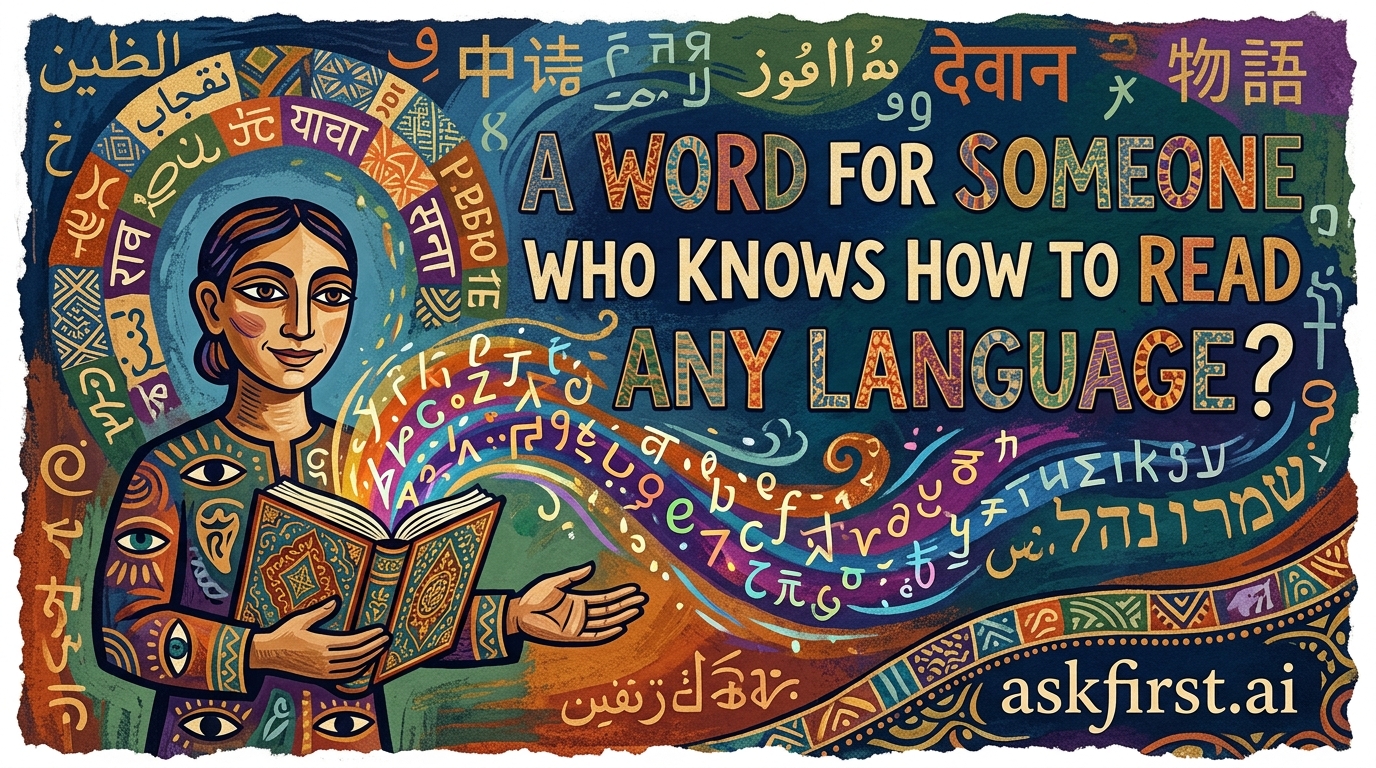
The pursuit of understanding every written language is one of the most ambitious intellectual endeavors in human history. While there is no single, universally recognized dictionary term that perfectly encapsulates "someone who can read every language" without implying a supernatural or mythical status, the concept is often discussed through the lenses of linguistics, philology, and cognitive science. The most accurate term to describe such a person is a pan-polyglot or, more precisely, a universal polyglot or hyperpolyglot.
The Distinction Between Polyglot and Hyperpolyglot
To understand the mastery of global literacy, one must first distinguish between the common labels used in linguistic circles. A polyglot is generally defined as someone who speaks or reads several languages—typically four or more. However, the term hyperpolyglot is reserved for those who have achieved proficiency in a significantly higher number of languages, often twelve or more.
The concept of a "universal" reader—someone capable of deciphering any script or language—is theoretical. As noted by Michael Erard in his seminal book Babel No More: The Search for the World's Most Extraordinary Language Learners, the human brain has cognitive limitations regarding the storage of grammatical structures, vocabulary, and syntactic nuances. While a hyperpolyglot might be able to read dozens of languages, the claim to read all languages is complicated by the existence of undeciphered ancient scripts (such as Linear A) and thousands of endangered or highly localized indigenous dialects that lack standardized writing systems.
The Mechanics of Universal Literacy
How would one theoretically achieve the ability to read any language? It requires a mastery of three distinct pillars:
- Script Decipherment (Paleography and Epigraphy): This is the ability to recognize and translate the characters themselves. An expert in this field would need to master everything from the logographic systems of Ancient Egyptian hieroglyphs to the syllabaries of Cherokee or the complex abjads of Semitic languages like Arabic and Hebrew.
- Comparative Linguistics: This involves understanding the genetic relationship between languages. For instance, a reader who understands the Proto-Indo-European roots can more easily deduce the meaning of written texts in Sanskrit, Latin, Greek, and Germanic languages.
- Syntactic Mapping: This is the cognitive ability to adapt to different word orders (Subject-Verb-Object, Subject-Object-Verb, etc.) and morphological structures.
In the work The Loom of Language by Frederick Bodmer, the author emphasizes that literacy is not merely about memorizing words, but about understanding the "structural architecture" of human communication. A person capable of reading any language would essentially be a master of comparative morphology, allowing them to reverse-engineer the meaning of a text even if they have not encountered that specific dialect before.
Notable Historical Figures and Modern Examples
History has produced individuals who approached the ideal of the universal reader. Cardinal Giuseppe Mezzofanti (1774–1849) is perhaps the most famous historical example. As the Chief Keeper of the Vatican Library, Mezzofanti was reputed to be fluent in dozens of languages and dialects. His biographer, Charles William Russell, in The Life of Cardinal Mezzofanti, notes that he could read and translate texts in languages he had never formally studied by applying his deep knowledge of linguistic families.
In the modern era, individuals like Alexander Arguelles have dedicated their lives to the study of dozens of languages. Arguelles utilizes a technique he calls "shadowing" and focuses heavily on the written traditions of diverse cultures. While these individuals do not read "every" language, they represent the pinnacle of human capacity for reading acquisition.
The Challenge of Undeciphered and Endangered Languages
The primary barrier to becoming a person who can read "any" language is the sheer volatility of human speech. According to the Ethnologue: Languages of the World (published by SIL International), there are over 7,000 living languages. Many of these do not have a written form. Furthermore, there are historical texts written in scripts that remain locked to modern scholarship.
To read "every" language, one would have to be a master of:
- Logographic scripts: Where symbols represent words (e.g., Mandarin Chinese).
- Abjads: Where only consonants are written (e.g., Arabic).
- Alphabets: Where both consonants and vowels are represented (e.g., English, Greek).
- Syllabaries: Where symbols represent syllables (e.g., Japanese Kana).
Conclusion
While the term "universal reader" remains a goal rather than a common reality, the study of language acquisition suggests that the human brain can be trained to recognize patterns across vast linguistic landscapes. Whether we label such a person a hyperpolyglot, a philological savant, or a linguistic polymath, their ability rests on the mastery of comparative structures rather than just rote memorization. The quest to read every language is ultimately a quest to map the entirety of human thought as it has been recorded throughout history. Through the rigorous application of paleography, comparative linguistics, and cognitive discipline, the dream of universal literacy remains one of the most noble intellectual pursuits in the academic world.