The Architecture of Resilience: Learning Through Failure
In the professional and personal journey of an expert, the most profound lessons are rarely gleaned from seamless successes. Instead, they are forged in the crucible of catastrophic error. The most valuable insight I have gained from a significant professional mistake—specifically, a failure to validate a complex data infrastructure project before full-scale deployment—is the primacy of the "Pre-Mortem" analysis over the post-mortem assessment.
Many professionals operate under the illusion that thorough planning is synonymous with flawless execution. This is a cognitive trap. My most expensive mistake involved assuming that system stability in a controlled staging environment would translate linearly to a production environment with high-concurrency traffic. It did not. The system collapsed within minutes of the go-live, leading to significant downtime and client attrition. From this failure, I learned that the most useful strategy for any complex endeavor is to adopt a mindset of "defensive anticipation."
The Philosophy of the Pre-Mortem
The concept of the "Pre-Mortem" was popularized by psychologist Gary Klein in his book, The Power of Intuition. Klein suggests that instead of waiting for a project to fail to analyze what went wrong, teams should conduct a session before the project begins where they assume the project has already failed.
By asking, "It is six months from now, and this project has been a total disaster; what happened?" you bypass the optimism bias that plagues most planning phases. In my own practice, this has become a non-negotiable step. When we identify the specific, granular points of potential failure—be it a server bottleneck, a misaligned stakeholder expectation, or a faulty API integration—we can build safeguards before the pressure of execution begins. This shift from reactive troubleshooting to proactive risk mitigation is the single most important lesson I have learned from my past failures.
The Psychology of Radical Accountability
Another critical pillar extracted from that failure was the necessity of Radical Accountability. In the immediate aftermath of a professional blunder, the human instinct is to distribute blame—to point to the vendor, the timeline, or the lack of resources. However, as leadership expert Jocko Willink argues in his seminal work, Extreme Ownership: How U.S. Navy SEALs Lead and Win, taking total responsibility is not about self-flagellation; it is about reclaiming control.
When I stopped asking "Who caused this?" and started asking "How did my leadership allow this vulnerability to persist?", the entire dynamic of my work changed. By owning the failure, I empowered my team to stop defending their actions and start focusing on the solution. This creates a culture of psychological safety where innovation can thrive because the fear of being "wrong" is replaced by the commitment to being "accurate."
Systems Thinking vs. Symptom Management
My failure also taught me the distinction between addressing symptoms and addressing systemic architecture. In the aftermath of my system collapse, I initially focused on "patching" the immediate errors. This was a mistake. As Peter Senge articulates in The Fifth Discipline, organizations often fall into the trap of "symptom-focused interventions."
I learned that a bad mistake is often just a signal that the underlying system design is flawed. To truly learn from the mistake, one must map the feedback loops that allowed the error to occur in the first place. For example, if a software release fails, the "fix" isn't just fixing the code; the fix is changing the deployment pipeline, the automated testing protocols, and the peer-review requirements. By viewing the mistake as a diagnostic tool rather than a personal indictment, I turned a moment of professional embarrassment into a robust, scalable framework for all future projects.
Practical Application: The "Error Log" Strategy
To ensure these lessons are not lost to time, I implemented a rigorous "Error Log" practice. Every time a significant error occurs—whether in my own work or within my team—we document three things:
- The Trigger: What specific event or assumption initiated the cascade of failure?
- The Blind Spot: What information did we possess that we chose to ignore or misinterpret?
- The Structural Change: What concrete change to our standard operating procedure (SOP) prevents this from happening again?
This process transforms a "bad mistake" into a permanent intellectual asset. It moves the knowledge from the realm of memory, which fades, into the realm of policy, which scales.
Conclusion
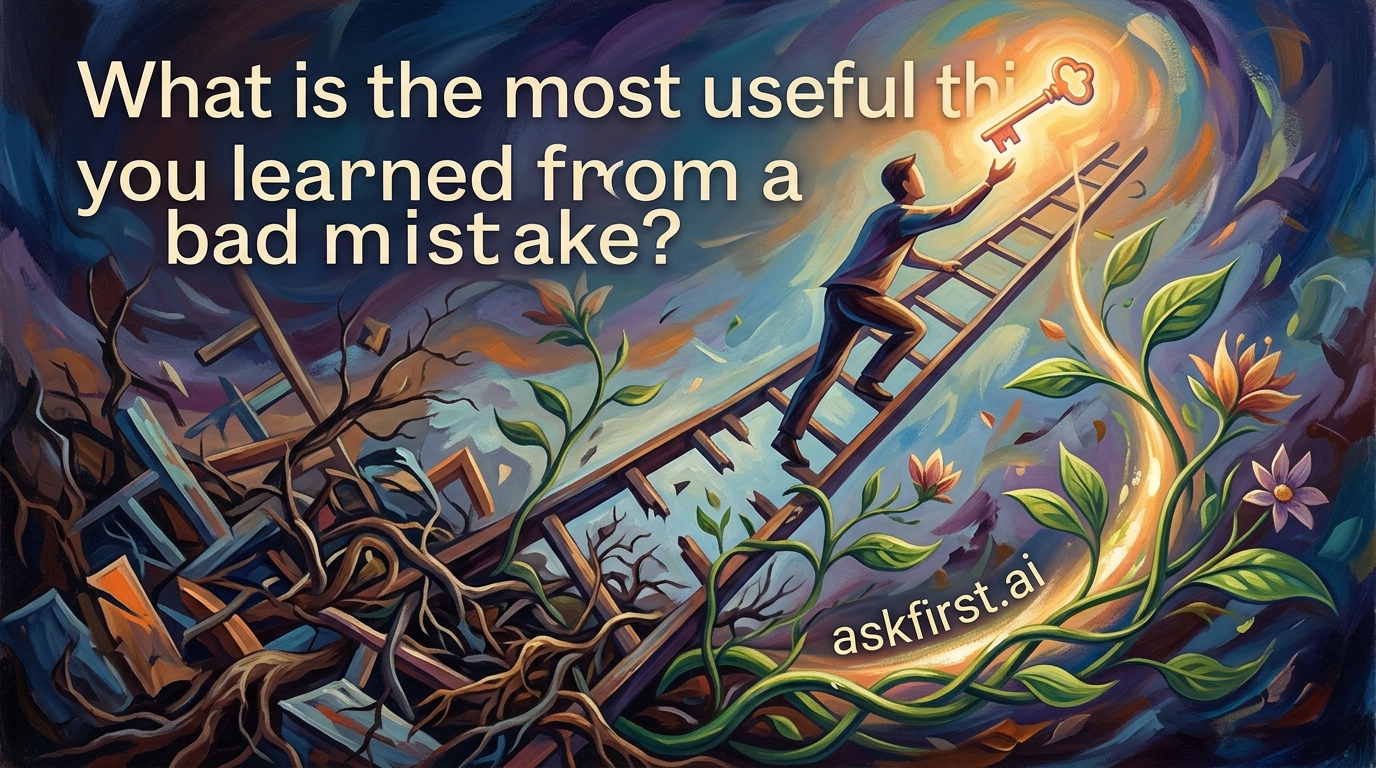
The most useful thing I have learned from a bad mistake is that failure is not the opposite of success; it is a vital ingredient of it. The ability to pivot from the emotional sting of a failure to the cold, analytical dissection of the process is what separates the novice from the master. By utilizing the Pre-Mortem, embracing extreme ownership, and prioritizing structural changes over surface-level fixes, we ensure that every mistake is paid for only once. In this light, the most expensive errors become the most valuable investments in one’s professional evolution. We do not learn by succeeding; we learn by failing, analyzing, and building the systems that ensure we never make the same mistake twice.