The Hardest Truths: Navigating Life’s Most Difficult Lessons
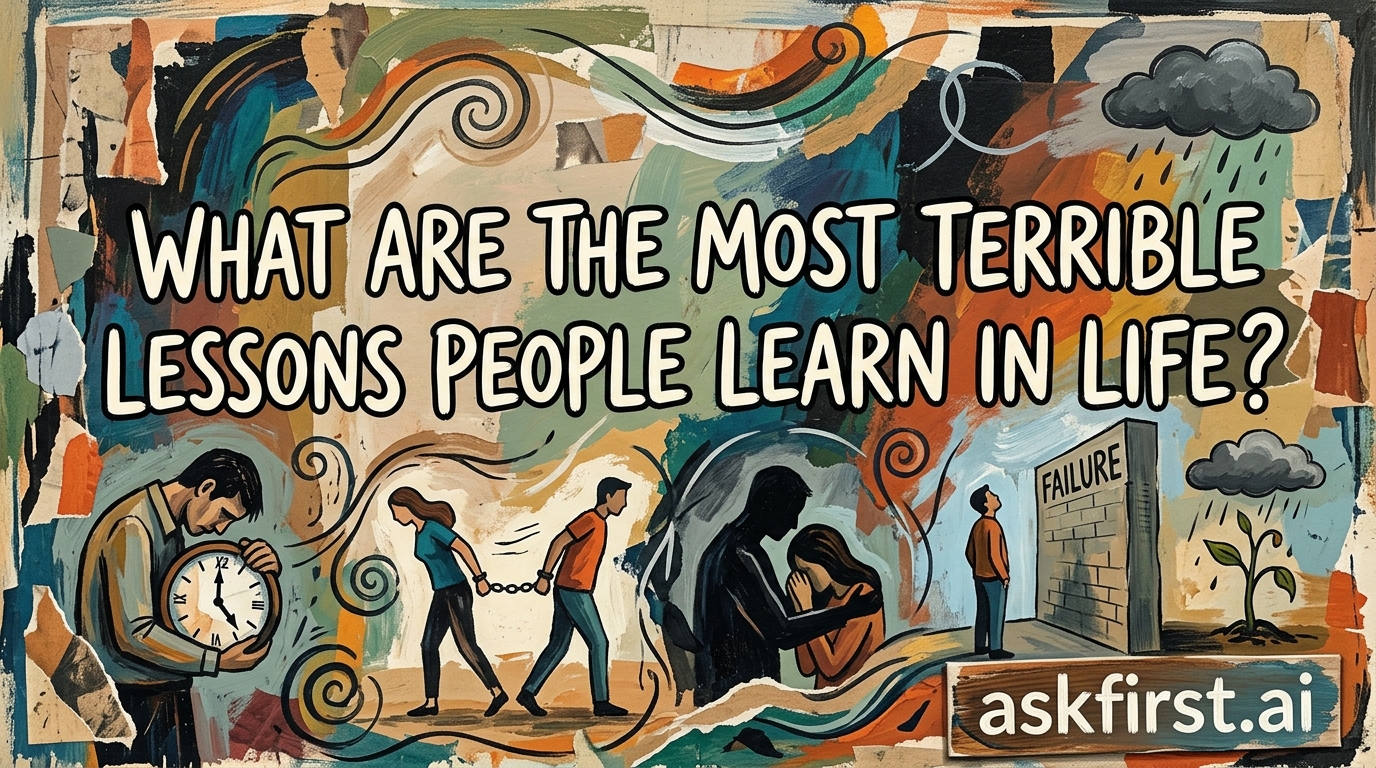
Life is often described as a masterclass in resilience, but the curriculum is rarely gentle. While we are raised on stories of meritocracy and the inherent fairness of the universe, the reality of adult existence frequently collides with these idealistic notions. The most "terrible" lessons are not necessarily those that cause immediate trauma, but rather those that dismantle our fundamental assumptions about how the world operates. These realizations are painful because they force a permanent shift in perspective, stripping away the protective illusions of childhood.
1. The Myth of Meritocratic Justice
One of the most jarring realizations is the understanding that hard work does not guarantee success, and being a "good person" does not exempt one from suffering. In his seminal work Man’s Search for Meaning, psychiatrist Viktor Frankl, who survived the horrors of Nazi concentration camps, posits that while we cannot always control our circumstances, we are responsible for our attitude toward them. However, society often teaches us a distorted version of this: that if you suffer, it is because you failed, and if you succeed, it is because you earned it.
The reality is that luck, timing, and systemic accidents play a far larger role in human outcomes than we care to admit. Accepting that life is inherently "unfair"—that bad things happen to good people and mediocre people often rise to the top—is a bitter pill. It forces individuals to abandon the "Just-World Hypothesis," a cognitive bias studied extensively by psychologist Melvin Lerner. When you accept that the universe is indifferent to your virtue, you stop waiting for a cosmic reward and begin to focus on internal integrity rather than external validation.
2. The Transience of All Attachments
Perhaps the most harrowing lesson is the absolute impermanence of everything we love. Whether it is the loss of a parent, the dissolution of a long-term marriage, or the slow fading of a career identity, we spend much of our lives building "houses" on shifting sands. In the Buddhist tradition, specifically within the Pali Canon, this concept is known as Anicca. It teaches that suffering arises not from the events themselves, but from our desperate attempts to make permanent that which is inherently fleeting.
This lesson is terrible because it creates a constant background hum of anxiety. To love deeply is to accept the certainty of future grief. Yet, those who learn to sit with this discomfort often develop a profound appreciation for the present. By acknowledging that a relationship or a state of health is on a "loan" rather than a permanent possession, one tends to treat these things with a much higher level of care and intentionality.
3. The Limits of Influence and Changing Others
Many people spend decades attempting to "fix" partners, parents, or friends, operating under the delusion that if they just provide enough logic, love, or pressure, the other person will transform. This is a recipe for profound resentment. As therapist Esther Perel often discusses in her work on human relationships, we are only ever in control of our own boundaries and reactions.
The terrible lesson here is the realization of human limitation. You cannot change a narcissist, you cannot force a loved one to heal, and you cannot make someone prioritize you if they lack the capacity to do so. The moment you stop trying to rewrite someone else's character is the moment you reclaim your own agency. It is a lonely realization, but it is the prerequisite for authentic, healthy boundaries.
4. The Self-Reliance of Loneliness
We are social creatures, yet we are ultimately born and die alone. The realization that no one can truly "save" you—that your trauma, your career anxiety, and your existential dread must be processed in the solitude of your own consciousness—is a heavy burden. In his book The Denial of Death, cultural anthropologist Ernest Becker argues that we build elaborate "hero systems" (careers, religions, status) just to distract ourselves from the terrifying reality of our own individual insignificance.
Recognizing that you are the sole author of your life’s narrative can be paralyzing, but it is also the ultimate liberation. Once you stop looking for a savior, you stop being a victim. You realize that the "terrible" nature of this lesson is actually a call to radical responsibility.
Conclusion: Turning Pain into Wisdom
These lessons are not meant to foster cynicism; rather, they are the architectural supports for a mature psyche. To learn that the world is unfair, that life is transient, that others cannot be controlled, and that you are fundamentally alone in your own mind is to graduate from the naivety of youth.
While these truths are painful, they provide the only foundation upon which a genuine and meaningful life can be built. By accepting the "terrible" realities, we stop wasting energy on the impossible task of controlling the uncontrollable. We move from a life of reaction to a life of conscious design, finding peace not in the absence of struggle, but in the mastery of our own responses to it. The most terrible lessons are, in the end, the most transformative.