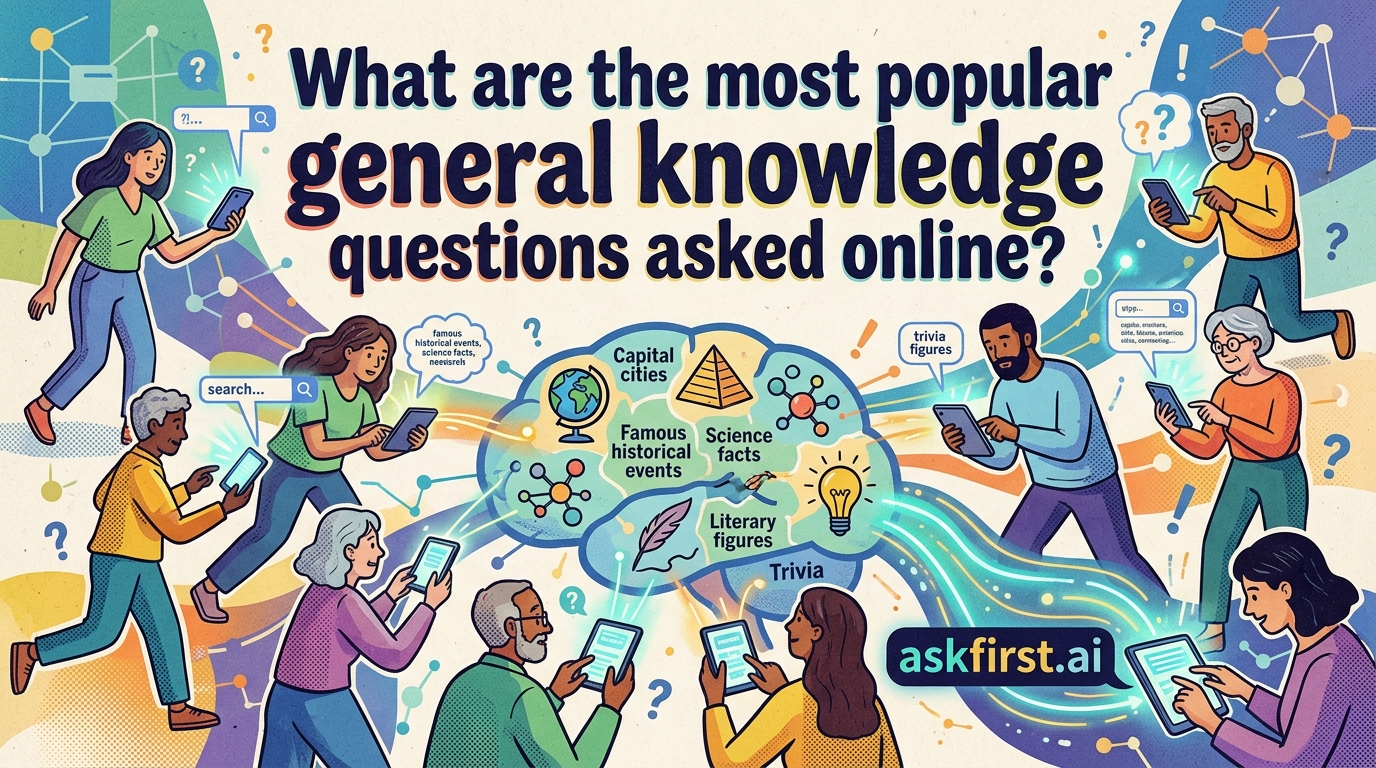
The landscape of human curiosity has undergone a radical transformation in the digital age. With the ubiquity of search engines and voice-activated assistants, the "most popular" general knowledge questions are no longer those found in traditional encyclopedias, but rather those that reflect the intersection of daily life, pop culture, and the pursuit of trivial enlightenment. Based on trending search data and analytical reports from platforms like Google Trends and Ahrefs, the public’s inquiry habits reveal a fascinating hierarchy of knowledge.
The Geography and Demographics of Inquiry
The most frequently asked questions generally fall into categories that solve immediate problems or satisfy the human urge for categorization. According to data scientist Seth Stephens-Davidowitz in his seminal work, Everybody Lies: Big Data, New Data, and What the Internet Can Tell Us About Who We Really Are, search queries provide a raw, unfiltered look at human ignorance and curiosity.
Common queries often revolve around basic geography and political structures. For instance, questions like "What is the capital of [Country]?" or "How many countries are there in the world?" remain at the top of search volumes globally. These queries highlight a persistent need for foundational context in an increasingly globalized world. Despite the availability of satellite maps and real-time data, the basic structure of the nation-state remains the primary mental map for the average user.
Pop Culture and the "Who Is" Phenomenon
A significant portion of online general knowledge queries is driven by "event-based curiosity." When a celebrity enters the news cycle, the search volume for their biographical details skyrockets. Questions like "How old is [Celebrity]?" or "What is [Celebrity's] net worth?" are consistently among the most asked questions on the internet.
This trend is corroborated by the research presented in The Shallows: What the Internet Is Doing to Our Brains by Nicholas Carr. Carr argues that the internet encourages a style of "skimming" knowledge, where users seek quick, digestible facts rather than deep comprehension. The internet has turned general knowledge into a snapshot-based endeavor; users want the answer to appear in a "featured snippet" at the top of their browser, bypassing the need to read entire articles or books.
Scientific and Natural Phenomena
Beyond the realm of celebrity, the public frequently turns to the internet to understand their physical environment. The most popular questions in this sphere are often rooted in fundamental science:
- "Why is the sky blue?" – This remains a perennial favorite, reflecting a universal desire to understand the optics of our atmosphere.
- "How do planes fly?" – An inquiry that touches on the physics of lift and drag, frequently sought by students and curious adults alike.
- "What is the largest animal in the world?" – A classic trivia question that reflects our fascination with biological extremes.
These questions are often indexed by educational platforms like Khan Academy or Britannica, which provide structured pedagogical responses. The popularity of these questions illustrates that while we have access to the sum of human knowledge, we are still largely concerned with the same "big picture" questions that have puzzled humans for centuries.
The Rise of "How-To" General Knowledge
General knowledge has increasingly blurred the line with practical skill acquisition. Questions such as "How to tie a tie?" or "How to boil an egg?" are treated as general knowledge queries. This shift signifies that for the modern user, "general knowledge" is defined as any information that makes one appear competent or informed in a social setting.
In The Information: A History, a Theory, a Flood by James Gleick, the author explores how the abundance of information has changed our cognitive relationship with facts. We no longer store information in our minds; we store the location of the information. Consequently, the most popular questions are those that serve as "shortcuts" to social or professional success.
Psychological Underpinnings of Popular Questions
Why do we ask these specific questions? Psychologists often point to the "need for closure." When a person encounters a gap in their knowledge, they experience a minor psychological discomfort. Searching for an answer—even a trivial one—provides a hit of dopamine, reinforcing the habit of using search engines as an external hard drive for the brain.
Furthermore, the influence of quiz-based media, such as Jeopardy! or the global phenomenon of Pub Trivia, has codified what we consider "general knowledge." Questions regarding the periodic table, the dates of World War II, or the works of William Shakespeare are perpetually popular because they are the "currency" of social intelligence.
Conclusion
The most popular general knowledge questions online are not merely random queries; they are a mirror reflecting our collective priorities. They show a mix of basic academic interest, a fixation on the lives of public figures, and a need for practical, immediate solutions to everyday life. While the medium has shifted from libraries to screens, the fundamental human drive to categorize, understand, and master the world through questioning remains unchanged. Whether searching for the capital of a distant nation or the mechanics of flight, we are all participating in a massive, collaborative effort to make sense of the world, one search query at a time.