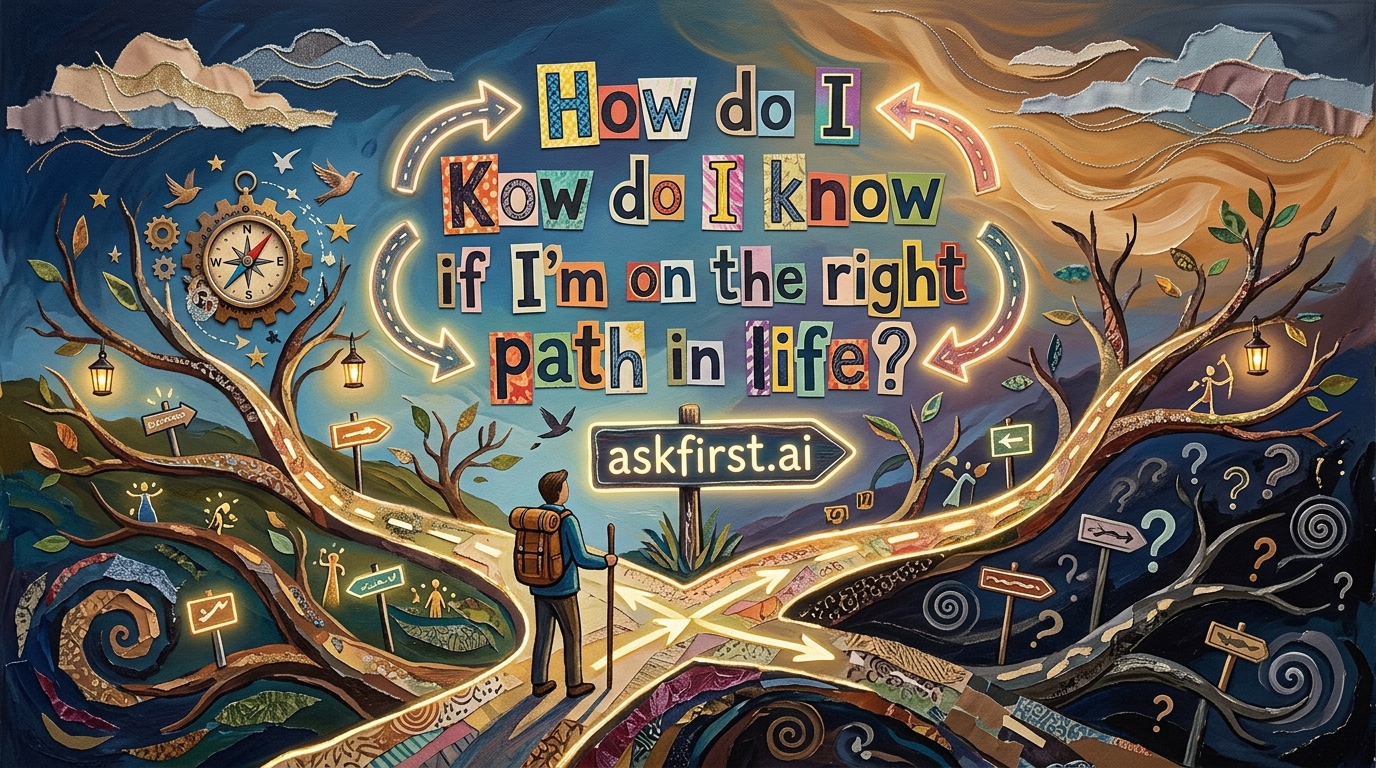
Determining whether one is on the "right path" in life is perhaps the most profound existential challenge a human being can face. It is a question that has occupied the minds of philosophers, theologians, and psychologists for millennia. There is no singular, objective metric for success; rather, the "right path" is a subjective intersection of your innate values, your daily actions, and the sense of internal coherence you experience as you move through time. To discern if you are truly aligned with your purpose, you must look beyond external accolades and examine the architecture of your internal life.
The Indicator of Internal Congruence
The most reliable signal that you are on the right path is a state of internal congruence. As psychologist Carl Rogers argued in his seminal work On Becoming a Person (1961), psychological health is achieved when there is a alignment between the "ideal self" and the "actual self." If your daily behaviors, career choices, and relationships consistently contradict your core values, you will inevitably experience "cognitive dissonance"—a state of mental discomfort that signals you are living out of alignment.
Ask yourself: If you were stripped of all external validation—the titles, the salary, and the opinions of others—would you still find meaning in your current pursuits? If the answer is a resounding "yes," you are likely operating from a place of intrinsic motivation, which is the hallmark of a life well-lived.
The Concept of "Flow" and Engagement
In his groundbreaking research on human happiness, psychologist Mihaly Csikszentmihalyi introduced the concept of "Flow" in his book Flow: The Psychology of Optimal Experience (1990). He defined flow as a state of deep absorption in an activity where the sense of time and self-consciousness dissolves.
If you find that your current path provides frequent opportunities for flow—moments where you are challenged exactly enough to match your skill level—you are likely on the right track. Conversely, if your life is characterized by "boredom" (where challenges are too low) or "anxiety" (where challenges are too high), you may need to recalibrate. When you are on the right path, your work or creative output feels less like a chore and more like a natural expression of your capabilities.
The Role of "The Shadow" and Resistance
It is a common misconception that being on the "right path" means everything will be easy. In reality, the most meaningful paths are often the most difficult. Joseph Campbell, in his exploration of mythology and the human journey in The Hero with a Thousand Faces (1949), posits that the "hero’s journey" involves confronting the unknown and facing significant internal and external resistance.
If you are facing struggles, do not automatically assume you are on the wrong path. Instead, ask yourself: Is this "good" suffering or "bad" suffering?
- Good suffering is the friction encountered while growing, learning, and pursuing a noble goal. It is the exhaustion of a writer finishing a manuscript or the mental fatigue of a student mastering a complex language.
- Bad suffering is the soul-crushing weight of staying in a situation that actively degrades your character, health, or integrity.
If you are struggling toward a goal that ennobles you, you are likely exactly where you need to be.
Evaluating Your Social and Environmental Feedback
While internal metrics are paramount, the external environment acts as a mirror. The people you surround yourself with often dictate the trajectory of your growth. In The 7 Habits of Highly Effective People, Stephen Covey emphasizes the importance of "interdependence"—the realization that our greatest achievements are realized in concert with others.
Look at your immediate circle. Do they challenge you to be better? Do they support your vision even when it is inconvenient for them? If you find yourself constantly having to shrink your personality or hide your ambitions to maintain your relationships, you are likely on a path that is not sustainable. A life on the "right path" generally attracts people who align with your values and repels those who seek to keep you static.
Conclusion: The Path is a Process, Not a Destination
Ultimately, the "right path" is not a fixed coordinate on a map; it is a dynamic process of constant adjustment. As the philosopher Friedrich Nietzsche noted in Thus Spoke Zarathustra, "You have your way. I have my way. As for the right way, the correct way, and the only way, it does not exist."
You know you are on the right path when you stop looking for a "sign" from the universe and start taking responsibility for the direction of your own life. You are on the right track when you can look back at your past decisions with a sense of ownership, and look forward to the future with a sense of agency. If you are living with integrity, learning from your failures, and contributing something of value to the world around you, then you are not just on a path—you are creating it. Trust the process of your own evolution, and remember that the most meaningful lives are those that are lived with intentionality and courage.