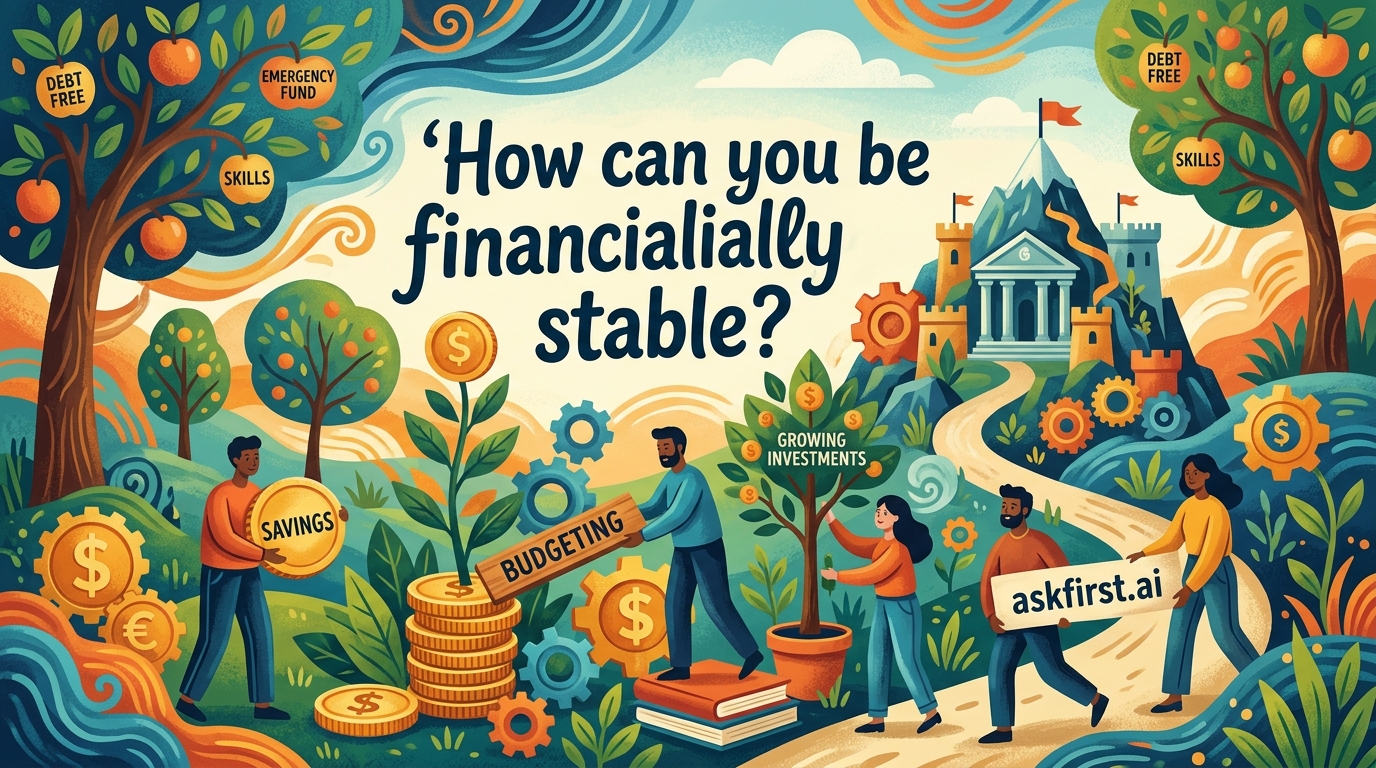
Achieving financial stability is not a result of luck, high-income windfalls, or sudden market success. Rather, it is the cumulative effect of disciplined habits, strategic planning, and a profound psychological shift regarding how one views money. Financial stability is defined as the state of having sufficient resources to meet your current obligations while concurrently building a buffer against future uncertainties and funding long-term goals.
To reach this state, one must move beyond the common trap of "living paycheck to paycheck" and transition into a systematic framework of wealth management. Below is a comprehensive blueprint for establishing long-term financial security.
1. The Foundation: Cash Flow Mastery and Budgeting
The bedrock of financial stability is the ability to track and control the flow of money. Without a clear understanding of your income versus your expenses, you are essentially flying blind.
The most effective method for this is the 50/30/20 rule, popularized by Senator Elizabeth Warren in her book All Your Worth: The Ultimate Lifetime Money Plan. This framework suggests allocating 50% of your after-tax income to "needs" (housing, utilities, groceries), 30% to "wants" (entertainment, dining out, hobbies), and 20% to "savings and debt repayment."
- Concrete Example: If your monthly take-home pay is $4,000, you aim to keep fixed costs at $2,000. If your rent or mortgage exceeds this, you are "house poor," which is a primary driver of financial instability.
- The Action Step: Use digital tools or simple spreadsheets to categorize every transaction for at least 90 days. You will likely find "leaks"—small, recurring subscriptions or impulsive purchases that aggregate into significant annual losses.
2. The Defensive Strategy: Emergency Funds and Debt Management
Before you can invest for growth, you must protect yourself from catastrophe. Financial experts, such as Dave Ramsey in The Total Money Makeover, emphasize the necessity of a "Starter Emergency Fund" of $1,000 to $2,000, eventually growing into a "Fully Funded Emergency Fund" covering 3 to 6 months of essential living expenses.
Debt is the greatest inhibitor of wealth creation. High-interest consumer debt, particularly credit card debt with APRs often exceeding 20%, acts as a negative investment. When paying off debt, consider the Debt Avalanche method, where you focus on the debt with the highest interest rate first to minimize total interest paid, or the Debt Snowball method, where you pay off the smallest balances first to build psychological momentum.
3. The Offensive Strategy: Investing and Asset Allocation
Saving money in a traditional bank account is a losing battle against inflation. To achieve true stability, your money must work for you. This requires moving into the realm of passive investing.
The cornerstone of modern portfolio theory, championed by figures like Burton Malkiel in A Random Walk Down Wall Street, is the use of low-cost index funds. Rather than attempting to "beat the market" by picking individual stocks, you buy the entire market through broad-market ETFs (Exchange Traded Funds) like those tracking the S&P 500.
- Consistency is Key: Implement Dollar-Cost Averaging (DCA). By investing a fixed amount of money at regular intervals—regardless of whether the market is up or down—you reduce the risk of timing the market poorly and benefit from long-term compounding interest.
- Tax-Advantaged Accounts: Always prioritize accounts like the 401(k) or IRA (in the United States) or their global equivalents. These accounts offer tax deferral or tax-free growth, which significantly enhances the speed at which your wealth accumulates over decades.
4. The Psychological Dimension: Lifestyle Inflation
One of the most dangerous obstacles to stability is "lifestyle creep." As you earn more, your desire to upgrade your car, house, or wardrobe often increases proportionally. This keeps you in a state of perpetual scarcity.
To combat this, practice intentional frugality. This does not mean deprivation; it means spending money only on things that provide genuine value to your life while ruthlessly cutting back on areas that do not. As Thomas J. Stanley and William D. Danko noted in their seminal book The Millionaire Next Door, the vast majority of financially stable individuals live well below their means, drive modest vehicles, and prioritize net worth over visible displays of wealth.
5. Continuous Education and Human Capital
Your greatest financial asset is your ability to earn an income. Investing in your own skills, certifications, and networking is the surest way to increase your "value" in the marketplace. Whether it is learning a new technical skill, improving your negotiation tactics, or understanding the nuances of tax law, continuous education provides a return on investment that far exceeds most stock market gains.
Conclusion
Financial stability is not a destination but a continuous process of management and mindset. It requires the courage to delay gratification today to secure freedom tomorrow. By mastering your cash flow, eliminating high-interest debt, investing in low-cost index funds, and resisting the urge to inflate your lifestyle, you build a fortress around your future. Start by auditing your current financial position today, set a concrete savings goal, and automate your investments. The compounding effect of these small, consistent actions will, over time, provide the ultimate reward: the freedom to live life on your own terms.