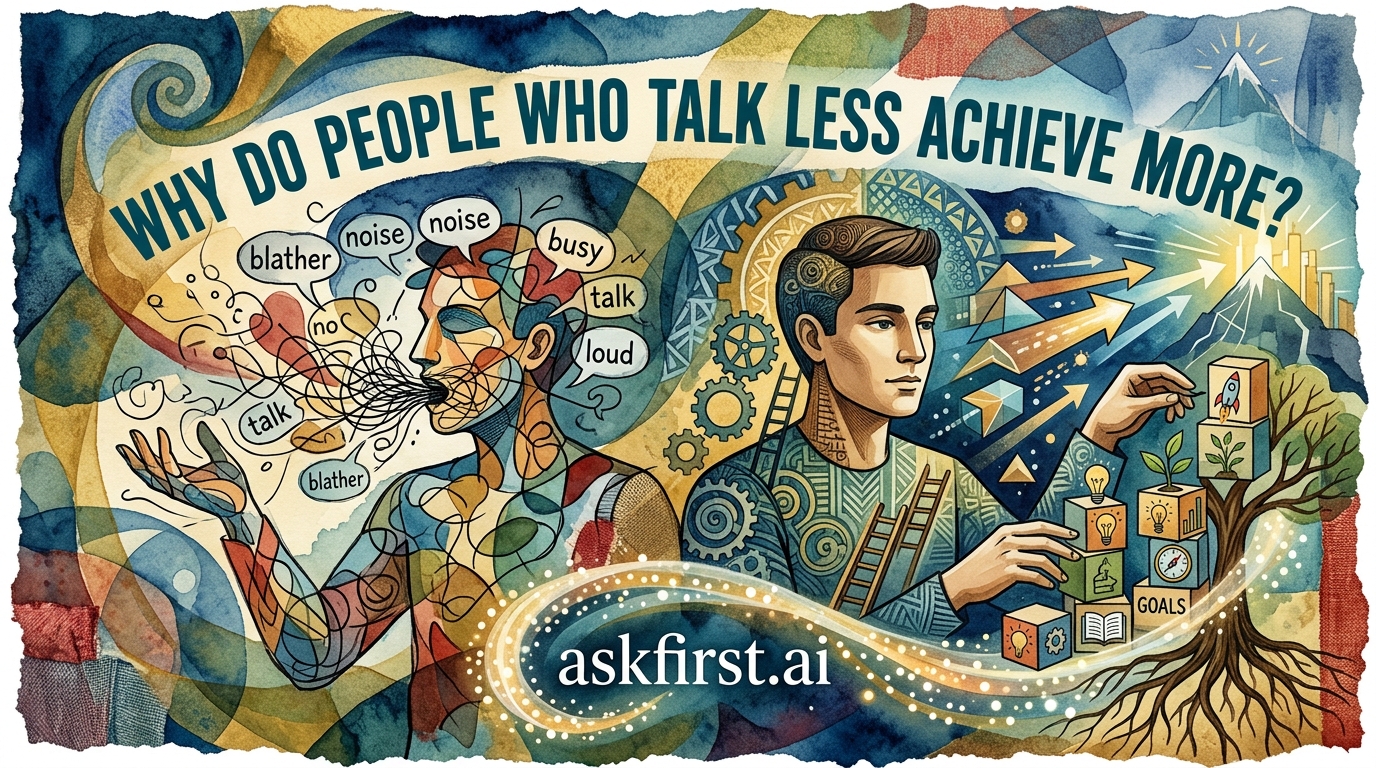
The correlation between speaking less and achieving more is a phenomenon observed across various disciplines, ranging from corporate leadership and high-stakes negotiation to creative innovation and scientific research. While society often equates extroversion and constant communication with competence, the most effective individuals frequently operate on the principle of "strategic silence." This approach is not merely a personality quirk; it is a calculated methodology for maximizing cognitive resources, exerting influence, and maintaining long-term focus.
The Cognitive Advantage: Preservation of Mental Energy
One of the primary reasons "quiet achievers" often outperform their counterparts is the preservation of cognitive bandwidth. Speaking is an energy-intensive process that requires constant synthesis of information, social monitoring, and verbal articulation. When an individual speaks less, they naturally shift into a state of active observation.
By listening more than they speak, these individuals act as data aggregators. They absorb the nuances of a room, identify underlying power dynamics, and detect patterns that others—who are busy articulating their own thoughts—inevitably miss. This information asymmetry gives the quiet observer a significant strategic advantage. When they finally do speak, their contributions are informed by a comprehensive understanding of the landscape, making their input exponentially more valuable and accurate.
The Power of Scarcity and Perceived Value
In the economics of communication, words follow the law of supply and demand. When an individual speaks incessantly, their words become a commodity of low scarcity; they are often ignored or filtered out as background noise. Conversely, individuals who speak infrequently create a sense of anticipation.
When a person who rarely speaks chooses to contribute, the audience—be it colleagues, stakeholders, or peers—is conditioned to pay close attention. Their words carry a higher "weight" because they are perceived as deliberate, curated, and significant. This dynamic fosters authority. People who talk less are often viewed as more thoughtful and composed, which naturally builds trust and respect. In a professional environment, this perceived gravitas can fast-track career progression, as leadership is frequently associated with the ability to remain calm and decisive under pressure.
Cultivating Deep Work and Flow States
High achievement, particularly in complex fields, requires extended periods of "deep work"—a state of distraction-free concentration that pushes cognitive capabilities to their limits. Constant verbal interaction is the antithesis of deep work. It fragments attention and forces the brain to constantly context-switch between social processing and task execution.
People who talk less often do so because they are prioritizing their internal processing over external stimulation. By minimizing unnecessary chatter, they protect their ability to enter "flow states." During these periods, they are able to solve intricate problems, draft complex strategies, or create high-quality output that is simply inaccessible to those who are constantly distracted by the demands of social maintenance. The cumulative effect of these undisturbed hours leads to a higher volume and quality of output over time.
Strategic Emotional Intelligence and De-escalation
Communication is often used as a defensive mechanism to alleviate anxiety or fill uncomfortable silences. High achievers who talk less have typically mastered the art of emotional regulation. They understand that silence is a powerful tool in negotiation and conflict resolution.
In a negotiation, the "first to speak loses" is a common adage for a reason. By remaining silent, a person forces the other party to reveal more information, potentially exposing their own insecurities, bottom lines, or alternative options. Furthermore, in moments of conflict, silence acts as a de-escalation tactic. While others are busy reacting emotionally or defending their positions, the silent observer remains objective. This emotional distance allows them to navigate interpersonal challenges with a level of clarity that is often obscured by the heat of verbal engagement.
Intentionality and Precision
The most successful people tend to be highly intentional. They view language as a tool for precision rather than a vehicle for social signaling. When an individual speaks less, they tend to think more about the structure, clarity, and impact of their message before they deliver it.
This leads to a higher rate of "signal-to-noise" ratio in their communication. Their directives are clearer, their feedback is more constructive, and their vision is easier to follow because it is not diluted by unnecessary filler or contradictory statements. By the time they articulate a goal or a decision, they have already stress-tested it in their minds. This results in fewer misunderstandings, faster execution, and a reputation for reliability.
Conclusion
The path to high achievement is rarely paved with loud proclamations or continuous social noise. Instead, it is built on the foundation of intentional silence, deep observation, and the strategic deployment of one’s voice. By choosing to speak less, individuals reclaim their cognitive energy, increase the weight and authority of their contributions, protect their time for deep work, and navigate the complexities of human interaction with superior emotional intelligence. In a world that often rewards the loudest voice, the quiet achiever remains the one who is actually steering the ship.