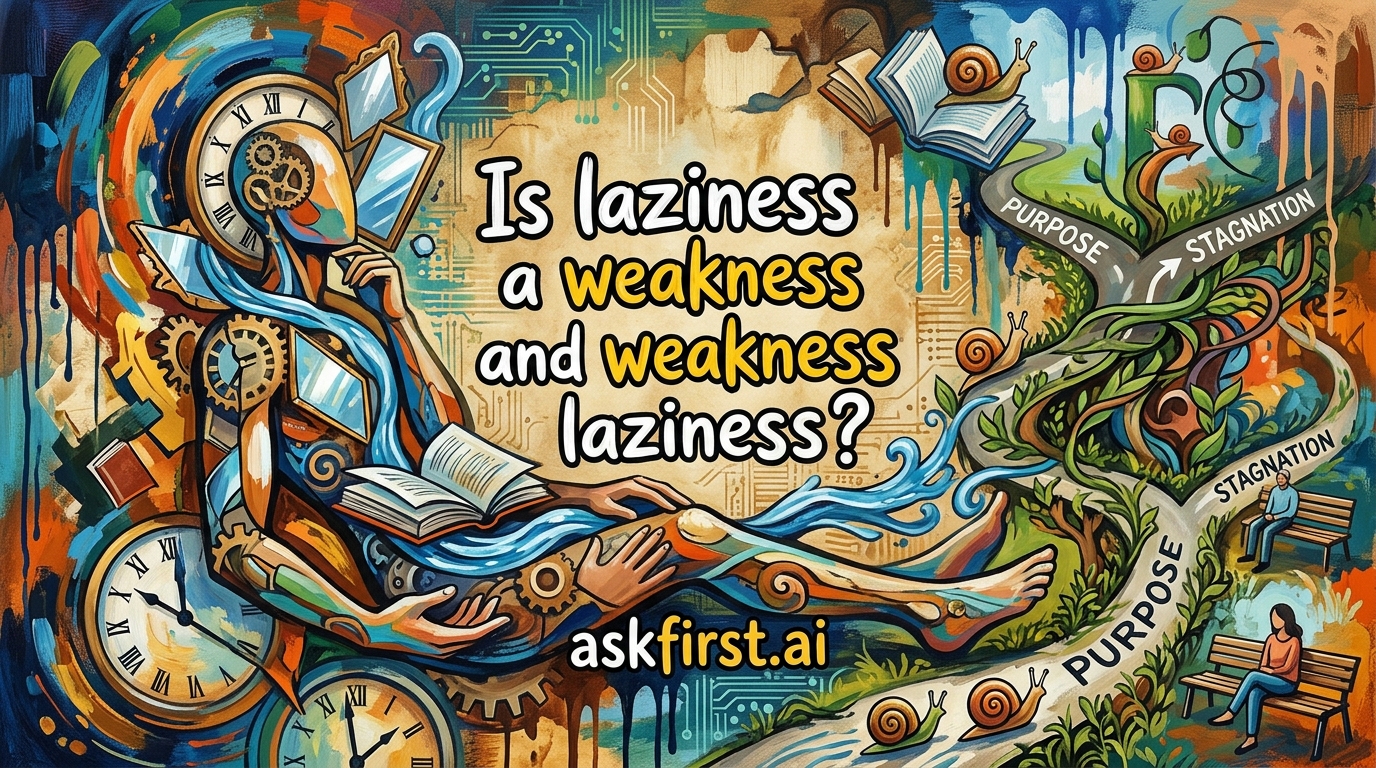
The relationship between laziness and weakness is complex, as they are distinct concepts that frequently overlap in psychological and behavioral contexts. While often conflated, they are not synonymous.
Defining Laziness
Laziness is generally defined as a disinclination to exert effort or engage in productive activity despite having the capacity to do so. It is often categorized as:
- Behavioral: A conscious choice to avoid task completion or exertion.
- Motivational: A lack of desire or perceived value in the outcome of an action.
- Situational: Often a response to burnout, lack of interest, or poor task alignment.
Defining Weakness
Weakness refers to a deficiency in strength, power, or resilience. It can manifest in several dimensions:
- Physical: Lack of stamina or muscular capability.
- Moral/Character: An inability to resist temptation or maintain discipline.
- Psychological: A lack of emotional fortitude or self-regulation.
Is Laziness a Weakness?
Whether laziness is a weakness depends on the framework of evaluation:
- Virtue Ethics: Laziness is often viewed as a moral weakness or a "vice" (e.g., the concept of sloth), as it implies a failure of character or a lack of discipline.
- Functional Perspective: If laziness prevents an individual from fulfilling responsibilities or reaching potential, it functions as a weakness because it undermines personal or professional performance.
- Adaptive Perspective: Conversely, some evolutionary psychologists argue that "laziness" can be an adaptive strategy to conserve energy, avoid unnecessary risk, or identify more efficient ways to complete tasks.
Is Weakness Laziness?
Weakness is not inherently laziness. Equating the two is a logical fallacy:
- Capacity vs. Will: Weakness often implies an inability to perform (a lack of capacity), whereas laziness implies a refusal to perform (a lack of will).
- Medical and Psychological Conditions: Conditions such as clinical depression, chronic fatigue syndrome, or executive dysfunction can mimic the appearance of laziness. In these instances, the individual is experiencing a biological or neurological weakness, not a character flaw.
- Resilience: An individual may be physically or mentally weak due to external circumstances but still possess high motivation and work ethic; they are not lazy, but they are currently limited in their capacity.
Summary
- Laziness is a failure of intent.
- Weakness is a failure of capacity.
While chronic laziness can be perceived as a weakness of character, diagnosing an individual as "lazy" when they are actually suffering from a genuine "weakness" (such as health issues or lack of resources) ignores the underlying root causes of the behavior.