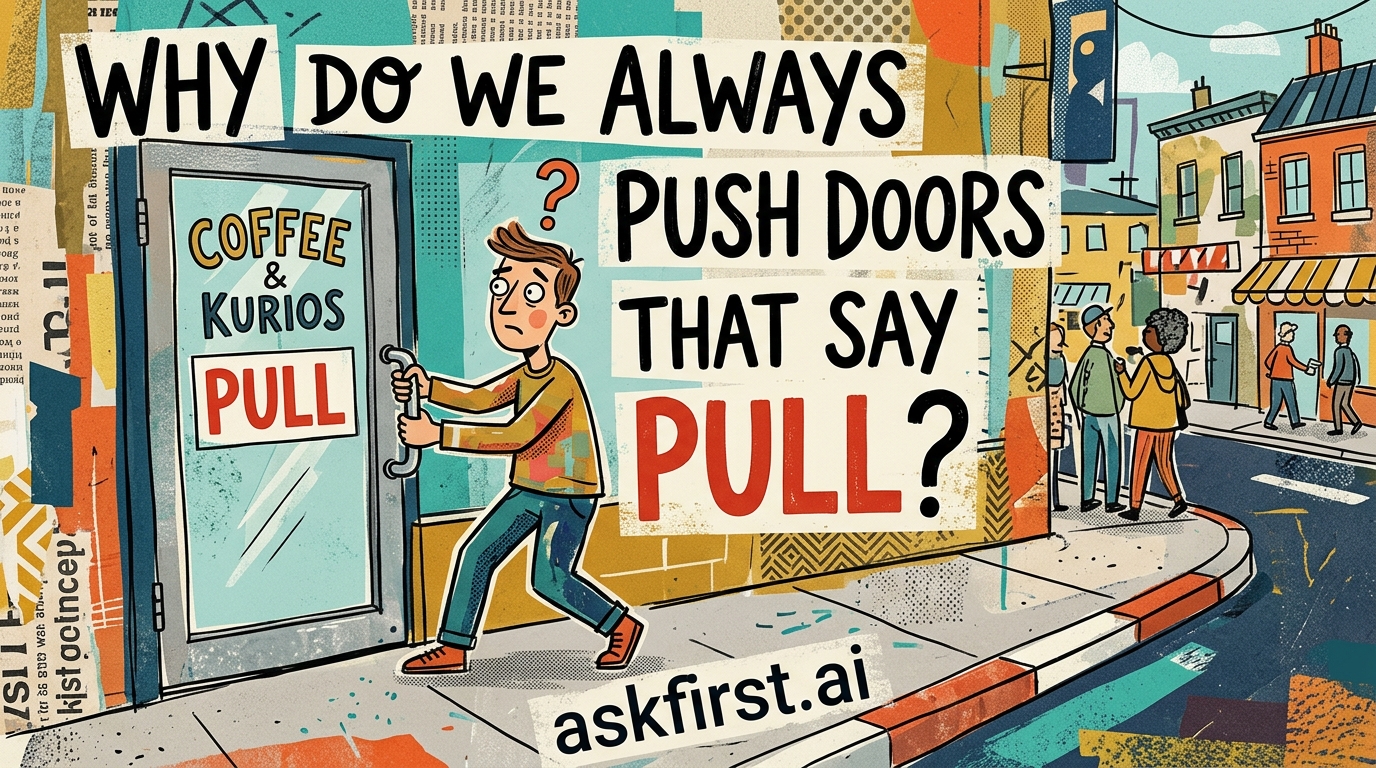
The Psychology of the 'Norman Door'
This phenomenon is fundamentally rooted in design psychology. When a door lacks clear visual cues, human beings rely on instinctive mapping. If a handle is shaped like a vertical bar or a flat plate, the brain subconsciously interprets it as an object to be pushed, regardless of the sign reading 'pull'. This clash between intuitive design and linguistic instruction is known as a 'Norman Door', named after the cognitive scientist Don Norman.
Why This Happens
- Cognitive Load: The human brain prefers to conserve energy by following visual patterns rather than reading text.
- Affordances: Physical shapes imply usage; a vertical bar suggests gripping and pulling, whereas a flat panel invites pushing.
- Behavioral Priming: People often operate on autopilot, focusing on their destination rather than the hardware of the entrance.
How Design Can Fix It
To eliminate this common confusion, effective architectural design focuses on natural mapping. A door that requires pulling should feature a handle that is physically impossible to push, such as a small knob or a concave indentation. When visual affordances match the necessary action, the need for written signs disappears entirely, creating a seamless experience for every user walking through the door.