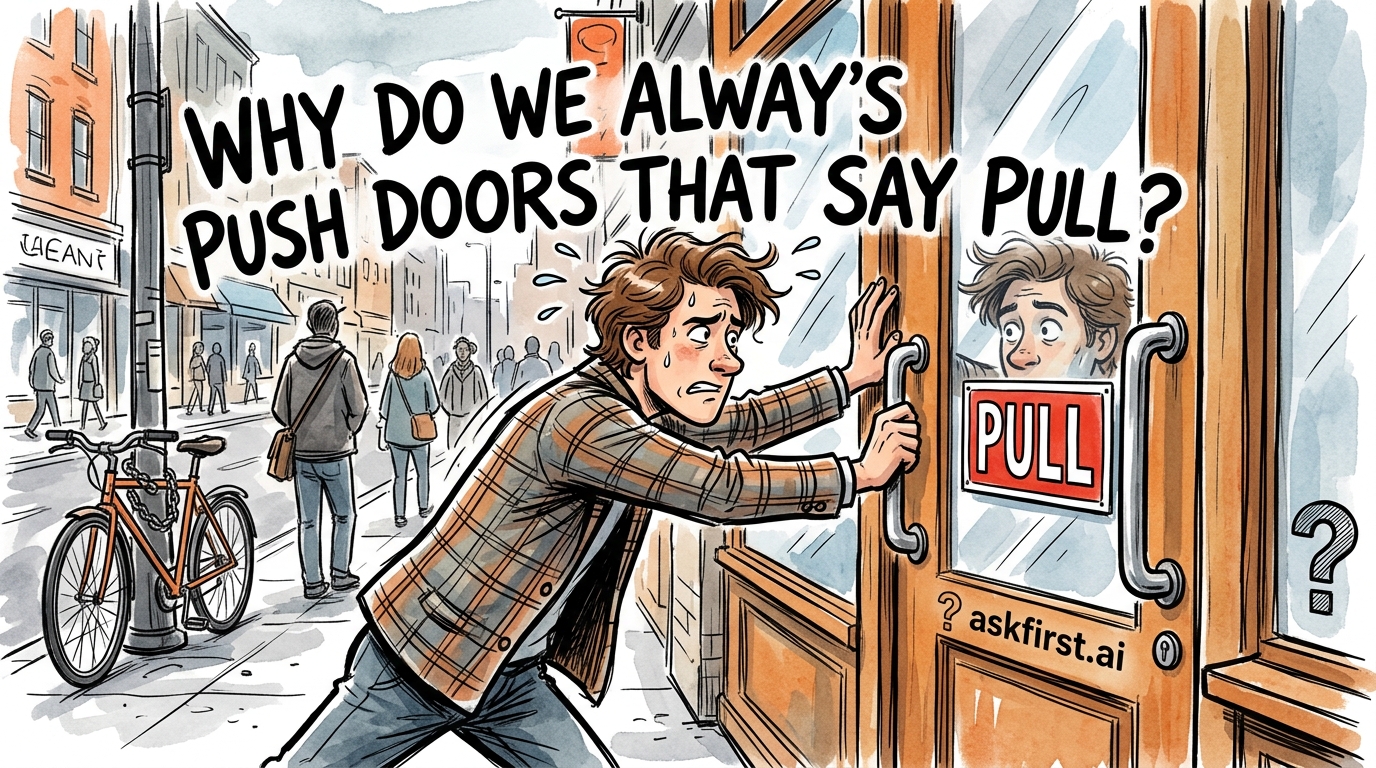
The Psychology of Design Errors
This phenomenon, often called a 'Norman Door', highlights a fundamental disconnect between intuitive human behavior and poor interface design. When a door handle is flat or vertical, the brain automatically interprets it as something to push because push-action is more ergonomic and requires less cognitive load.
Why the Confusion Persists
- Affordance Theory: Objects possess 'affordances' that dictate how they are used. If a door provides a flat plate, humans naturally lean into it to push, regardless of the sign.
- The Power of Habit: People operate on autopilot during routine movements. If the door lacks a clear, tactile indicator that it requires a pull, the brain defaults to the simplest mechanical interaction.
Designing for Success
To eliminate this confusion, architects must utilize Human-Centered Design:
- Visual Cues: A handle that clearly requires a hand to grasp effectively signals a 'pull' action.
- Constraint Mapping: If a door must be pulled, the design should make pushing physically difficult or impossible.
By aligning physical cues with mental models, designers can create environments where every movement feels natural and effortless, proving that the blame often lies with the design, not the user.