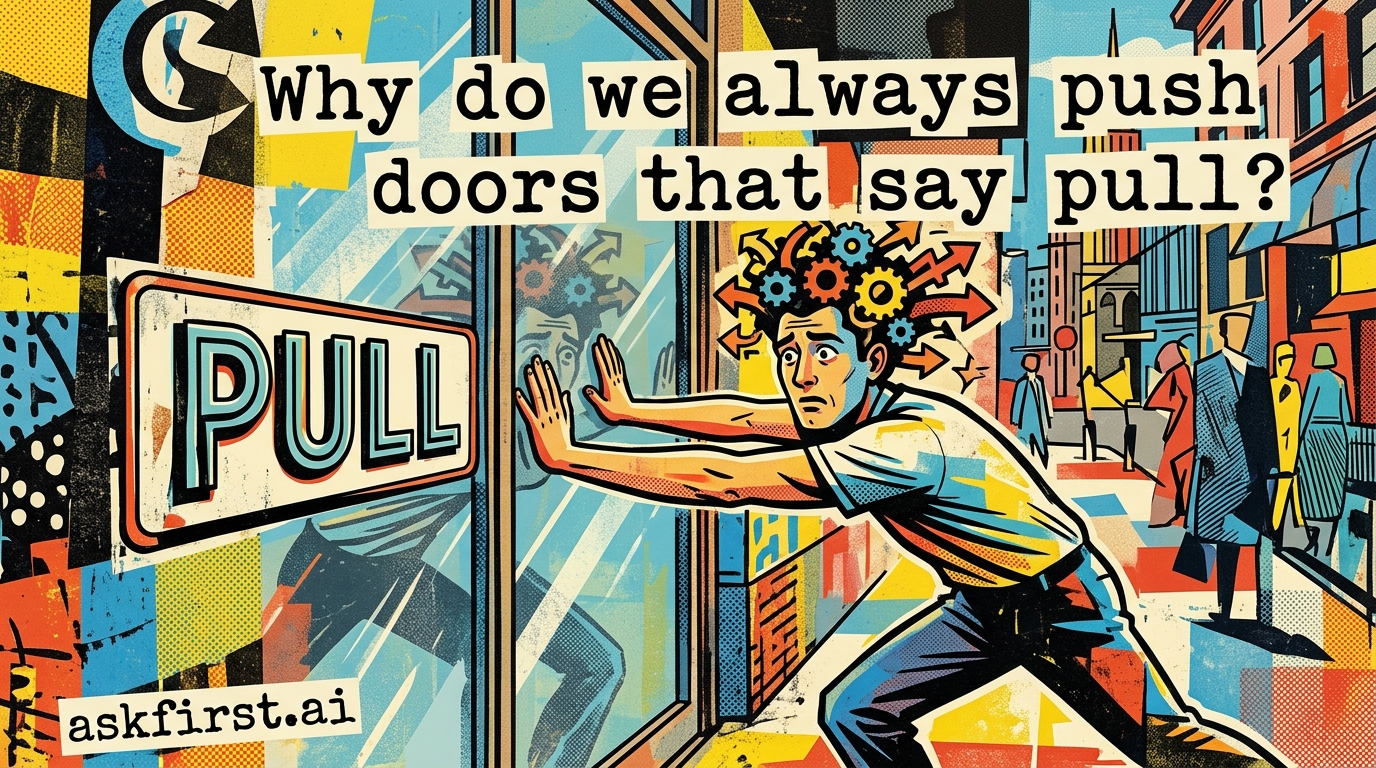
The Psychology of the 'Norman Door'
This universal struggle is known as a Norman Door, named after design expert Don Norman. The phenomenon occurs due to a mismatch between perceived affordance and actual functionality. Humans are cognitively wired to rely on visual cues; when a door features a large, flat plate, the subconscious brain interprets this as an invitation to push, regardless of any instructional text.
Why Instructions Often Fail
- Cognitive Load: The human brain prioritizes intuitive interaction over linguistic processing. We rarely stop to read signs.
- Evolutionary Habit: Our survival instincts prioritize rapid movement. Pausing to analyze a handle’s mechanics interferes with our momentum.
- Design Ambiguity: When the hardware design (a flat push plate) contradicts the label (a 'pull' sticker), the physical form almost always wins the psychological battle.
Overcoming Design Flaws
To bridge this gap, modern industrial design emphasizes natural mapping. Ideally, a door requiring a pull motion should feature a vertical handle that physically cannot be pushed. By aligning the object’s physical form with the required human action, designers eliminate the need for confusing instructional labels entirely, leading to a seamless, frustration-free interaction for every user.