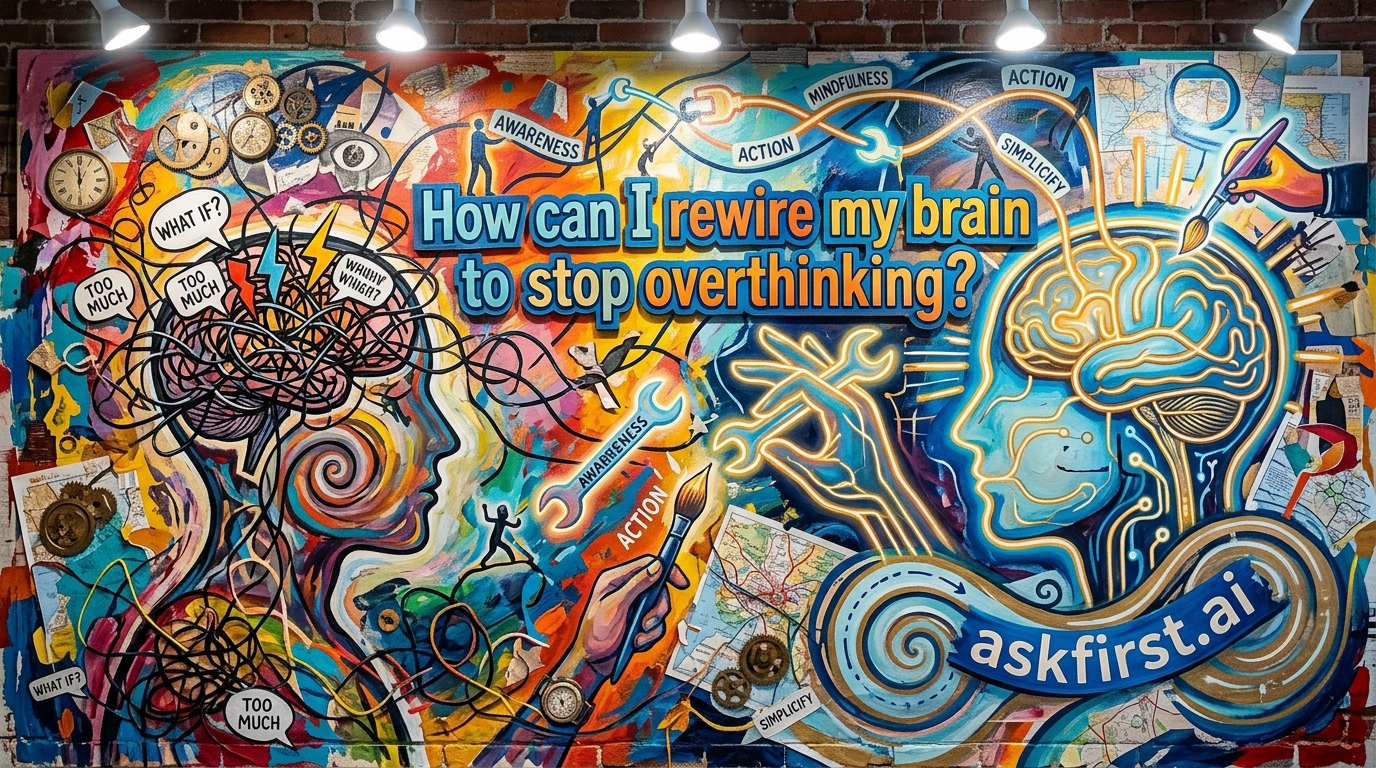
Rewiring the brain to reduce overthinking involves utilizing neuroplasticity—the brain's ability to reorganize itself by forming new neural connections. To shift away from habitual rumination, you must weaken the neural pathways associated with anxiety and strengthen those associated with present-moment awareness.
1. Implement Cognitive Reframing
Overthinking often stems from "cognitive distortions," such as catastrophizing or black-and-white thinking.
- Identify the trigger: Recognize when a thought loop begins. Label it explicitly: "I am currently overthinking this situation."
- Challenge the evidence: Ask yourself, "Is this thought based on fact or feeling?" and "What is the most likely outcome, rather than the worst-case scenario?"
- Set time limits: Practice "worry scheduling." Allocate 15 minutes per day to address your concerns. If a thought arises outside this window, write it down and defer it to your scheduled time.
2. Practice Mindfulness Meditation
Consistent meditation physically alters the brain, specifically by shrinking the amygdala (the brain's "fight or flight" center) and thickening the prefrontal cortex (responsible for executive function and emotional regulation).
- Focus on the breath: When the mind wanders, gently bring your focus back to the sensation of breathing. This strengthens the neural "muscle" of attention control.
- Observe without judgment: Treat thoughts like passing cars or clouds. Acknowledge them, but do not attach to them or attempt to solve them immediately.
3. Engage in "Flow" Activities
Overthinking typically occurs when the brain is in the Default Mode Network (DMN), a state of self-referential thought. Engaging in complex, absorbing tasks shifts the brain out of the DMN and into the task-positive network.
- Physical movement: High-intensity exercise or rhythmic activities like running, swimming, or dancing force the brain to prioritize sensory input over internal monologue.
- Creative hobbies: Activities that require fine motor skills and deep focus—such as painting, coding, or playing an instrument—occupy the cognitive resources that would otherwise be used for rumination.
4. Behavioral Activation
Overthinking is frequently a defense mechanism against taking action. Breaking the cycle requires replacing rumination with decisive movement.
- The Five-Minute Rule: If a task feels overwhelming, commit to working on it for only five minutes. Often, the anxiety associated with starting is greater than the task itself.
- Decision hierarchies: Prioritize decisions based on impact. For low-stakes choices, implement a "one-minute rule" to prevent analysis paralysis.
5. Physiological Regulation
The brain and body exist in a feedback loop. If your nervous system is in a state of high arousal, your brain will interpret this as a need to overthink to find a solution.
- Vagus nerve stimulation: Use deep, slow diaphragmatic breathing (e.g., the 4-7-8 technique) to activate the parasympathetic nervous system, which signals to the brain that there is no immediate threat.
- Sleep hygiene: Sleep deprivation impairs the prefrontal cortex, making it significantly harder to inhibit intrusive thoughts. Prioritize consistent sleep cycles to maintain emotional regulation.
Note: If overthinking is accompanied by severe anxiety, panic attacks, or an inability to function in daily life, consulting a mental health professional for Cognitive Behavioral Therapy (CBT) is the clinical gold standard for restructuring these neural patterns.