The Legal Reality of Lunar Property Rights
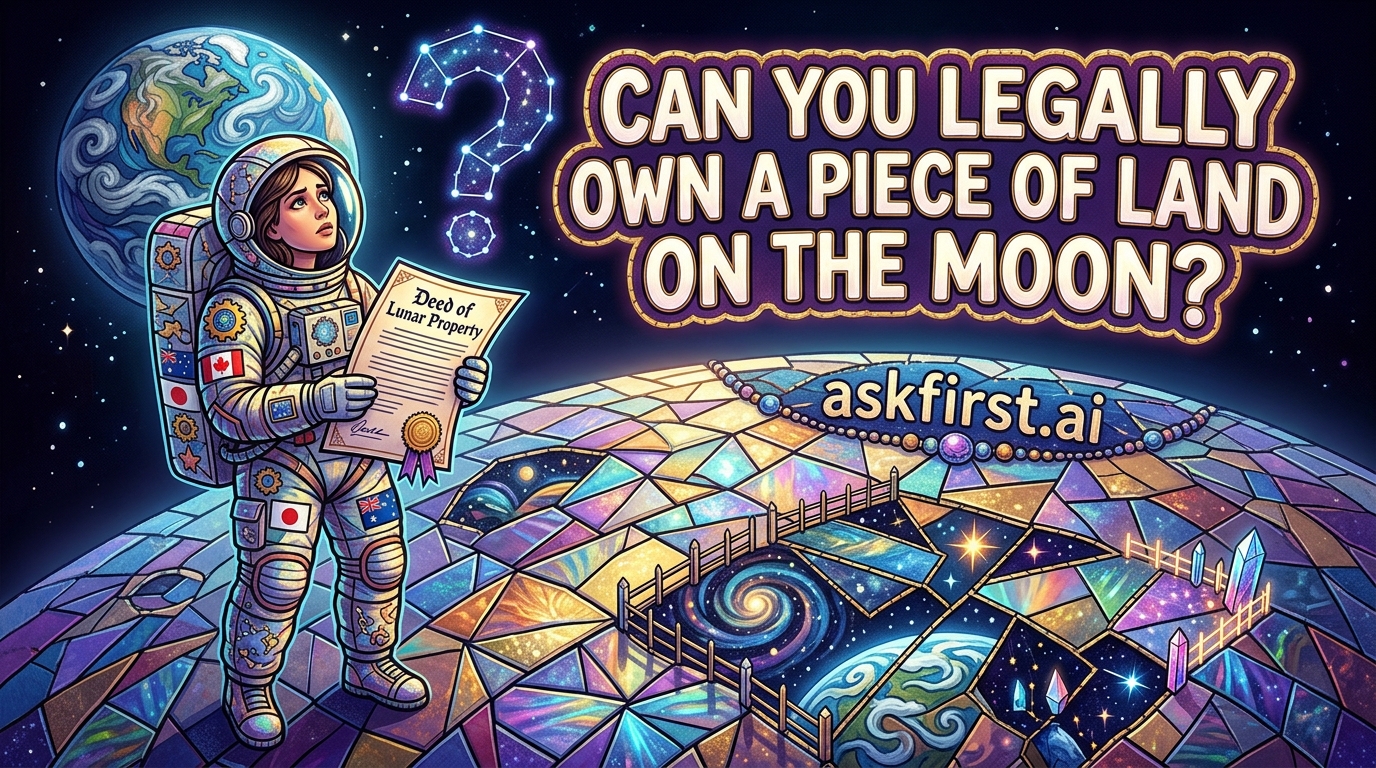
For decades, advertisements have appeared offering individuals the chance to purchase "deeds" to lunar craters, mountain ranges, or vast lunar plains. These novelty certificates, often printed on high-quality parchment, suggest that ownership of extraterrestrial real estate is a reality. However, from the perspective of international law, the answer remains a firm and legally grounded "no." The concept of private ownership regarding celestial bodies is strictly prohibited by a complex framework of treaties that prevent individuals or nations from claiming sovereignty over the Moon.
The Outer Space Treaty of 1967
The cornerstone of space law is the Treaty on Principles Governing the Activities of States in the Exploration and Use of Outer Space, including the Moon and Other Celestial Bodies, commonly known as the Outer Space Treaty (OST). Signed in 1967 by major global powers including the United States, the Soviet Union, and the United Kingdom, it serves as the "Magna Carta" of space law. Article II of the treaty explicitly states: "Outer space, including the moon and other celestial bodies, is not subject to national appropriation by claim of sovereignty, by means of use or occupation, or by any other means."
Because the treaty binds nations to ensure that their citizens and non-governmental entities (such as private corporations) do not violate these principles, the prohibition extends beyond just governments. If a nation cannot claim territory on the moon, its legal system cannot recognize or enforce a claim made by one of its citizens. Therefore, any deed issued by a private company is legally unenforceable in any court on Earth.
Why Novelty Deeds Are Not Property Titles
It is vital to distinguish between a commercial product sold as a gift and a legally binding land title. When someone buys a "Moon Deed" today, they are purchasing a novelty item—much like a star-naming certificate. These companies are effectively selling a souvenir rather than an interest in real estate. Because there is no legal registry office on the Moon, and no government entity capable of enforcing property rights under current international agreements, these certificates hold zero weight under property law. In fact, most of these companies include fine print disclaimers acknowledging that the purchase is for entertainment purposes only.
The Moon Agreement and Its Controversies
Following the success of the Outer Space Treaty, the international community attempted to further regulate celestial resources via the 1979 Moon Agreement. This treaty went a step further, proposing that the Moon and its resources be considered "the common heritage of mankind." It sought to establish an international regime to govern the exploitation of resources if and when that became feasible. However, the Moon Agreement saw very limited ratification. Major spacefaring nations, including the United States, Russia, and China, have not signed it, viewing it as potentially restrictive to future commercial exploration and mining operations.
The Future of Commercial Space Activities
While personal ownership of lunar soil is currently impossible, the landscape of space law is shifting as we move toward the era of deep-space mining and lunar base construction. Newer developments, such as the U.S. Commercial Space Launch Competitiveness Act of 2015 and the international Artemis Accords, address the extraction of resources rather than the ownership of the land itself. These frameworks suggest that while one cannot own the moon, they might eventually be permitted to own the resources (such as water ice or rare earth minerals) they extract from it.
This distinction is crucial: legal experts argue that "extraction" does not equate to "territorial appropriation." Much like fishing in international waters where the ocean is not owned by the fisherman, mining lunar resources might one day be governed by international regulatory bodies without implying that the mining entity owns the crater where the minerals were found.
Summary of Current Standing
To summarize the legal reality for any prospective lunar landowner:
- No Sovereignty: No nation may claim territory on the moon.
- Private Claims Denied: No private individual or company can hold a legally binding deed to lunar land under the current international framework.
- Novelty vs. Legal: Any document sold to you currently is a decorative souvenir, not a property title.
- Resource Exploitation: The law is evolving to distinguish between owning the land and harvesting the resources located upon it.
As humanity looks toward long-term habitation on the Moon, the laws will undoubtedly evolve. Future treaties may eventually provide frameworks for land management and safety zones around lunar bases, but these will likely resemble leasehold agreements or usage rights rather than traditional "fee simple" ownership. Until such international consensus is reached, the moon remains, by law, the province of all mankind, belonging to no single person or nation.