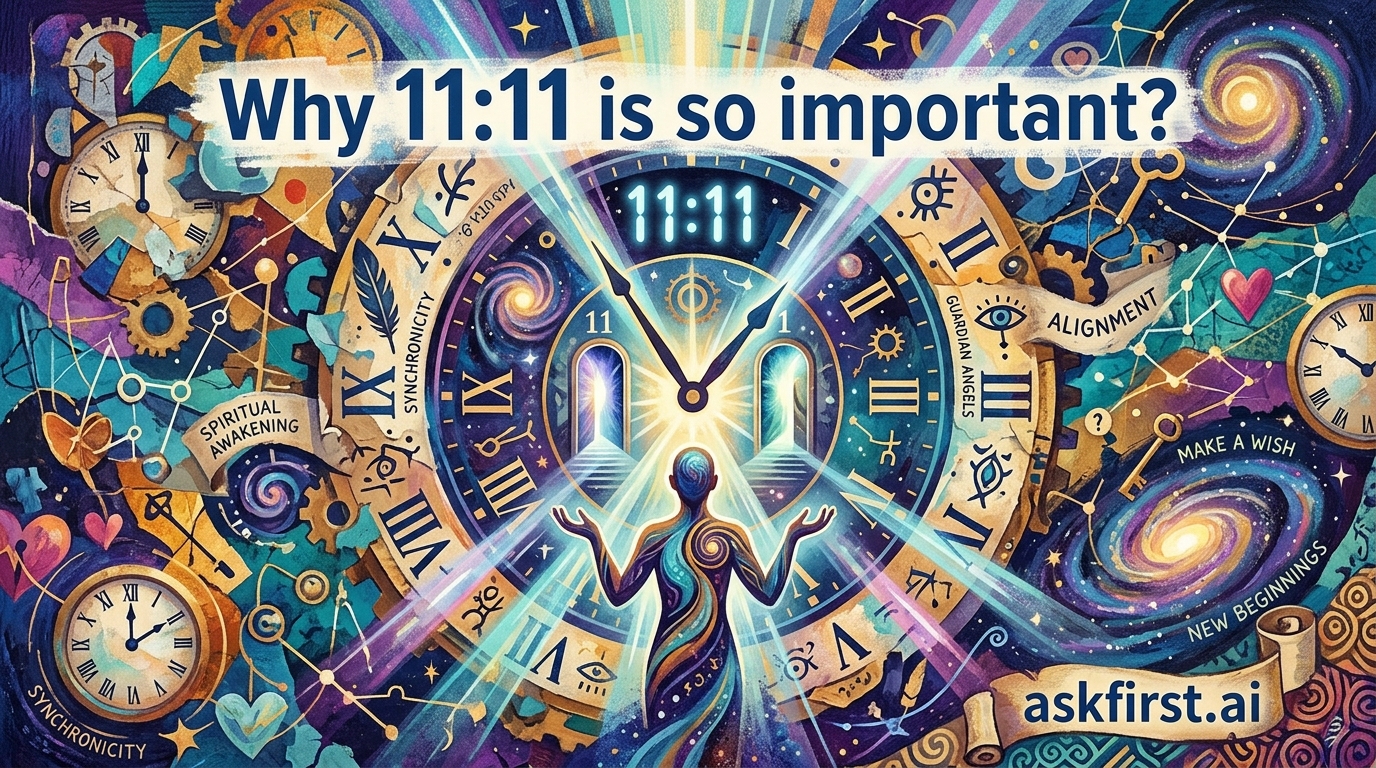
The phenomenon of "11:11" transcends simple chronometry, evolving into a profound cultural, psychological, and spiritual touchstone for millions of people worldwide. Whether viewed as a synchronistic occurrence, a manifestation of the collective unconscious, or a simple trick of cognitive bias, the recurring sight of 11:11 on digital clocks has become one of the most recognizable modern-day "signs." To understand why this specific sequence holds such weight, we must examine the intersection of numerology, psychology, and the evolution of digital culture.
The Psychological Perspective: Pattern Recognition and Confirmation Bias
From a purely scientific standpoint, the significance of 11:11 is largely attributed to the Baader-Meinhof phenomenon, also known as the Frequency Illusion. As explained by linguist Arnold Zwicky, who coined the term in 2006, this occurs when an individual notices a specific piece of information—in this case, the time 11:11—and subsequently perceives it everywhere. Because our brains are hardwired for pattern recognition, once we assign "meaning" to a number, the brain begins to filter out the thousands of other moments in a day to highlight that specific sequence.
In his seminal work The Undiscovered Self, Carl Jung explored the concept of synchronicity, defining it as an "acausal connecting principle." Jung argued that events that are meaningfully related, yet lack a direct cause-and-effect link, serve as windows into the collective unconscious. For many, 11:11 acts as a "synchronistic trigger." When you glance at the clock at exactly 11:11, it interrupts your internal monologue, providing a split-second of mindfulness. It is not necessarily the number itself that holds power, but the psychological "pause" it mandates, forcing a momentary alignment between the observer and the present moment.
Numerology and the Archetype of the Master Number
In the field of numerology, which has been studied since the time of Pythagoras, the number 11 is classified as a "Master Number." Unlike single-digit numbers, Master Numbers (11, 22, and 33) are believed to possess higher vibrational frequencies and spiritual potential.
According to authors like Dan Millman, author of The Life You Were Born to Live, the number 11 represents intuition, spiritual insight, and enlightenment. It is often described as the "Messenger," acting as a bridge between the subconscious and the conscious mind. When the number is doubled to 11:11, numerologists interpret this as a "portal" or a "gateway." The binary nature of the ones—standing side-by-side—is seen as a symbol of duality being reconciled. In many esoteric traditions, 11:11 is interpreted as an invitation to align one's personal intent with the cosmic order, often serving as a prompt to make a wish or set a clear intention.
The Evolution of 11:11 in Digital Culture
The rise of 11:11 as a global phenomenon is inextricably linked to the digital age. Before the ubiquity of digital clocks, people relied on analog timepieces. Analog clocks make it difficult to "catch" 11:11, as the hands are constantly moving and do not display a static, digit-based sequence. The shift to digital displays on smartphones, microwave ovens, and computer screens created a standardized, global visual language.
This cultural shift was accelerated by the internet. In the late 1990s and early 2000s, forums and early social media platforms began to aggregate reports of people seeing 11:11. This created a "meme-like" effect where the repetition of the experience validated the individual’s belief. As noted by folklorist Jan Harold Brunvand in his studies on urban legends, the digital age allows for the rapid spread of "folk beliefs." 11:11 transitioned from a private quirk to a shared cultural experience, effectively creating a modern, secular ritual where millions of people pause for a second to "make a wish."
Practical Implications: Mindfulness in a Fast-Paced World
Regardless of whether one believes in mystical numerology or psychological phenomena, the act of acknowledging 11:11 serves a very practical purpose: it acts as an anchor for mindfulness. In a society characterized by chronic distraction and information overload, 11:11 serves as a self-imposed "check-in."
When you notice the time, you are forced to stop what you are doing, acknowledge your current state, and perhaps breathe or reset your focus. This is similar to the practice of "mindful grounding" used in cognitive behavioral therapy (CBT). By assigning meaning to the time, you are effectively training your brain to pause, reflect, and re-center. In this sense, the importance of 11:11 is entirely self-determined; it is a tool for self-reflection that you have programmed into your own daily routine.
Conclusion
The importance of 11:11 is a fascinating mosaic of science, mysticism, and sociology. While skeptics rightly point to the Frequency Illusion as a logical explanation, the persistence of the phenomenon highlights a human need for meaning, connection, and rhythm in an increasingly chaotic world. Whether it is a "gateway" to the spiritual realm or a simple cognitive feedback loop, the act of noticing 11:11 remains a powerful, universal experience. By transforming a mundane glance at a clock into a moment of intentionality, individuals reclaim their time and impose a sense of order upon the flow of their daily lives. Ultimately, 11:11 is as important as you choose to make it, serving as a mirror that reflects the significance you assign to the passage of your own life.