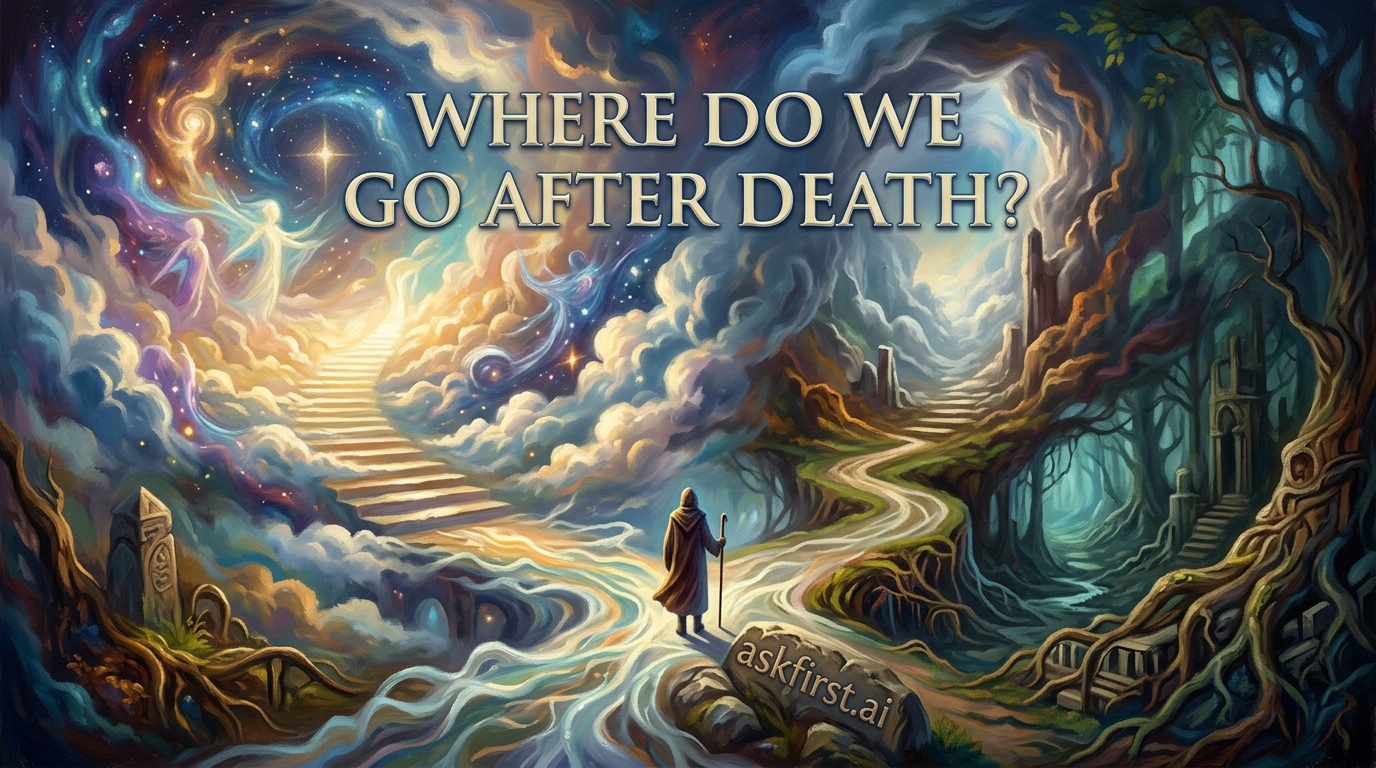
The question of what happens after death is perhaps the most profound inquiry in the history of human consciousness. It sits at the intersection of biological reality, philosophical speculation, religious doctrine, and, increasingly, the frontier of quantum physics. Because there is no empirical, peer-reviewed data that confirms a singular "destination" for human consciousness, we must examine this through the lenses of the major frameworks that have attempted to map the afterlife.
The Biological and Materialist Perspective
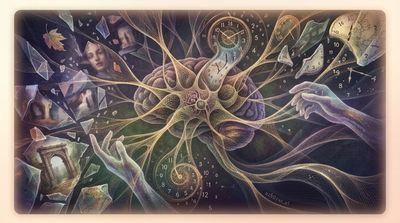
From the standpoint of strict materialism, as championed by thinkers like Daniel Dennett in his seminal work Consciousness Explained, death is the absolute termination of the self. In this view, the mind is an emergent property of the brain’s complex neural architecture. When the biological systems—the heart, the lungs, and ultimately the cerebral cortex—cease to function, the "software" of the mind ceases to run.
Under this framework, there is no "where" to go. The atoms that compose the human body undergo a process of decomposition, returning to the carbon cycle of the Earth. As the physicist Lawrence Krauss argues in A Universe from Nothing, we are effectively "star stuff," and upon death, we simply return to the fundamental energy states of the universe. This perspective posits that the illusion of the "I" is merely a temporary configuration of matter, and death is the dissolution of that configuration.
The Religious and Metaphysical Architectures
Conversely, the vast majority of human history has been defined by the belief that death is a transition rather than an end. These traditions provide highly structured maps of the "afterlife."
- The Abrahamic Traditions: In Christianity, Islam, and Judaism, the afterlife is largely conceived as a state of judgment and subsequent dwelling in the presence of the Divine (Heaven/Jannah) or separation from it (Hell/Jahannam). The focus here is on the soul—a non-material essence—that persists beyond the decay of the body.
- The Dharmic Traditions: Hinduism and Buddhism view death through the lens of Samsara, the cycle of birth, death, and rebirth. As described in the Bhagavad Gita, the soul (Atman) is eternal and merely sheds the body like an old garment. The destination is determined by Karma—the sum of one's actions—and the ultimate goal is Moksha or Nirvana, a state of liberation from the cycle of existence altogether.
- The Tibetan Book of the Dead (Bardo Thodol): This ancient text offers a detailed cartography of the Bardo, an intermediate state between death and rebirth. It describes the consciousness encountering various visions and lights, suggesting that the "destination" is a reflection of the individual's mental state at the moment of passing.
The Consciousness-Centric and Quantum Hypothesis
In contemporary discourse, some researchers are pushing back against pure materialism by exploring the possibility that consciousness is not a byproduct of the brain, but a fundamental feature of the universe.
Dr. Robert Lanza, in his book Biocentrism, argues that space and time are tools of the mind, not external realities. He suggests that because consciousness creates the universe, it cannot be destroyed by the death of the biological vessel. If space and time are subjective, the "afterlife" might not be a distant location, but a shift in the way consciousness experiences reality.
Similarly, the "Orch-OR" theory, proposed by physicist Sir Roger Penrose and anesthesiologist Stuart Hameroff, suggests that consciousness originates from quantum vibrations within the brain’s microtubules. They posit that when the body dies, this quantum information is not destroyed but is released back into the fabric of the universe. While this does not prove a "heaven," it provides a scientific framework for how the "self" might persist in a non-localized state.
Near-Death Experiences (NDEs) as Empirical Data
While subjective, the reports of those who have experienced clinical death and resuscitation provide a fascinating, if debated, dataset. In Proof of Heaven, neurosurgeon Dr. Eben Alexander details his own NDE, describing a transition into a realm of immense connectivity and love.
Critics, such as Dr. Sam Parnia, director of critical care and resuscitation research at NYU Langone Health, suggest that these experiences are the result of the brain’s final attempt to make sense of hypoxia and neurochemical release (such as DMT). However, the consistency of these reports—the sensation of floating, moving through a tunnel, and encountering deceased loved ones—suggests that if there is an afterlife, it may be characterized by a shift in perception where the constraints of linear time and individual ego dissolve.
Conclusion: The Uncharted Frontier
Ultimately, the question of where we go remains the ultimate "undiscovered country." If we synthesize the available perspectives, we find that the answer depends on the definition of the "self." If the self is the ego, it likely dissipates. If the self is consciousness itself, it may be that we never truly "go" anywhere; rather, we return to a state of being that is fundamental to the architecture of reality.
Whether one views death as a return to the stars, a journey through the Bardo, or a simple cessation of existence, the mystery continues to drive human inquiry. As we advance in our understanding of quantum mechanics and neuroscience, the boundary between the "physical" and the "spiritual" continues to blur, suggesting that the destination of death may be as complex and multifaceted as the life that precedes it.