The Paradox of the Perpetual Mind: Defining and Achieving Inner Peace
The human mind is a relentless engine of cognition. From the moment we wake until we drift into the fragmented landscapes of sleep, our internal monologue rarely ceases. This phenomenon, often referred to by psychologists as the "default mode network" (DMN), keeps us in a near-constant state of planning, ruminating, or analyzing. Because the biological nature of the brain is to process information, the question of when a person truly experiences inner peace is one of the most profound inquiries in the history of philosophy, psychology, and contemplative practice.
The Misconception of "Stopping" the Mind
A common error in the pursuit of tranquility is the belief that inner peace requires the total cessation of thought. If you approach meditation or mindfulness with the goal of "turning off" the brain, you are setting yourself up for failure. As neuroscientist Dr. Judson Brewer explains in his book Unwinding Anxiety, the brain is designed to solve problems; it is a prediction machine. Attempting to silence it is like trying to stop the heart from beating or the lungs from breathing.
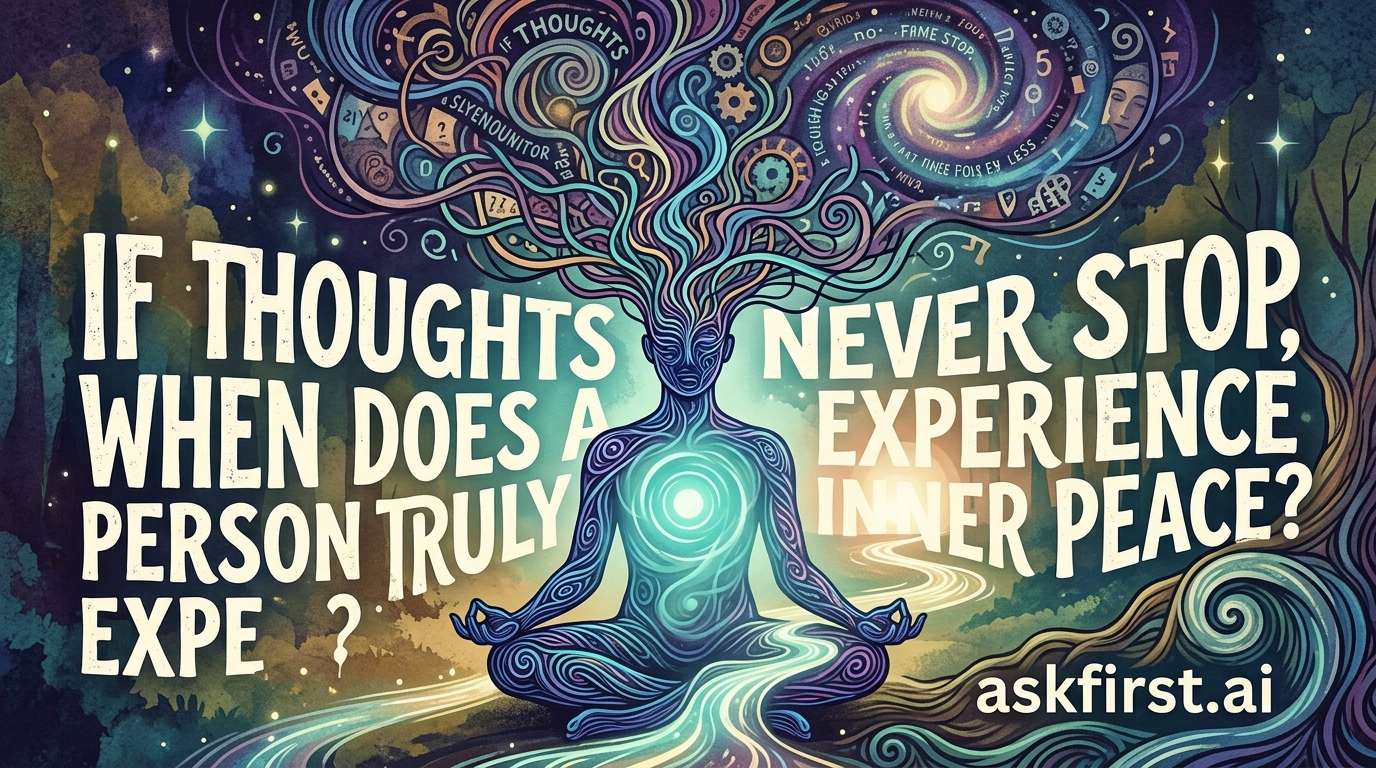
True inner peace is not found by stopping the flow of thoughts, but by changing our relationship to them. It is the transition from being a prisoner of your thoughts to becoming a witness of them. In the influential text The Power of Now, Eckhart Tolle argues that peace arrives when you realize that you are not the voice in your head, but the consciousness that observes that voice. When you stop identifying with every passing thought as an objective truth, the emotional "hook" of those thoughts weakens, creating a gap of silence amidst the noise.
The Role of "Flow States" and Absorption
One of the most concrete ways humans experience inner peace is through the psychological state known as "Flow," a concept popularized by the Hungarian-American psychologist Mihaly Csikszentmihalyi in his seminal work Flow: The Psychology of Optimal Experience. When you are deeply engaged in a task that matches your skill level—be it painting, coding, playing a complex musical piece, or mountain climbing—the self-reflective, narrative-driven part of the brain often goes quiet.
In this state, the "monkey mind" is bypassed because your cognitive resources are entirely consumed by the present moment. You aren't "thinking" about being at peace; you are simply being. This illustrates that inner peace is often a byproduct of intense, purposeful action rather than passive contemplation. It is the experience of the ego dissolving into the activity, leaving behind a profound sense of clarity and stillness.
The Biological Basis: Autonomic Regulation
From a physiological perspective, inner peace is often the experience of the parasympathetic nervous system taking dominance. When we are constantly thinking, we are often trapped in a low-grade "fight or flight" response, fueled by cortisol and adrenaline. According to Dr. Bessel van der Kolk in his groundbreaking book The Body Keeps the Score, we cannot "think" our way out of a dysregulated nervous system.
We experience inner peace when the body feels safe enough to move into a state of "rest and digest." This is why techniques like rhythmic breathing (as studied by James Nestor in Breath: The New Science of a Lost Art) or cold-water immersion are so effective. By altering our physical state, we send a signal to the brain that the perceived threats—which our thoughts often exaggerate—are not real. Peace, therefore, is not just a mental state; it is a physiological achievement.
The Practice of Non-Judgmental Awareness
The ancient traditions of Zen Buddhism and Stoicism offer a pragmatic framework for this. Marcus Aurelius, in his Meditations, repeatedly emphasizes that we have power over our minds, not over external events. He posits that our distress comes not from the thoughts themselves, but from the judgments we attach to them.
To experience peace while thoughts are still present, you must cultivate "metacognition"—the ability to think about your thinking. When a stressful thought arises, instead of engaging with it, you label it: "This is a thought about the future." By categorizing the thought, you create a psychological distance. You observe the thought as if it were a car passing by on the street. You acknowledge its presence, but you do not step into the road to chase it. This is the essence of mindfulness as taught by Jon Kabat-Zinn in Full Catastrophe Living.
Conclusion: Peace as a Dynamic Process
Ultimately, inner peace is not a destination or a permanent state of silence. It is a dynamic, recurring choice. It is the ability to remain anchored in the present moment even while the storm of cognition continues to swirl around you. You experience it in the moments you choose to observe rather than react, to breathe rather than brace, and to accept the transient nature of your mental activity.
Just as the ocean is calm at its depths even when waves are crashing on the surface, your inner peace exists beneath the surface of your thoughts. It is always there, waiting for you to stop identifying with the waves and recognize the vast, still water that holds them. You do not need to silence the mind to find peace; you simply need to widen your perspective until the noise of the mind is no longer the center of your universe.