The Persistence of Essence: Unveiling What Remains
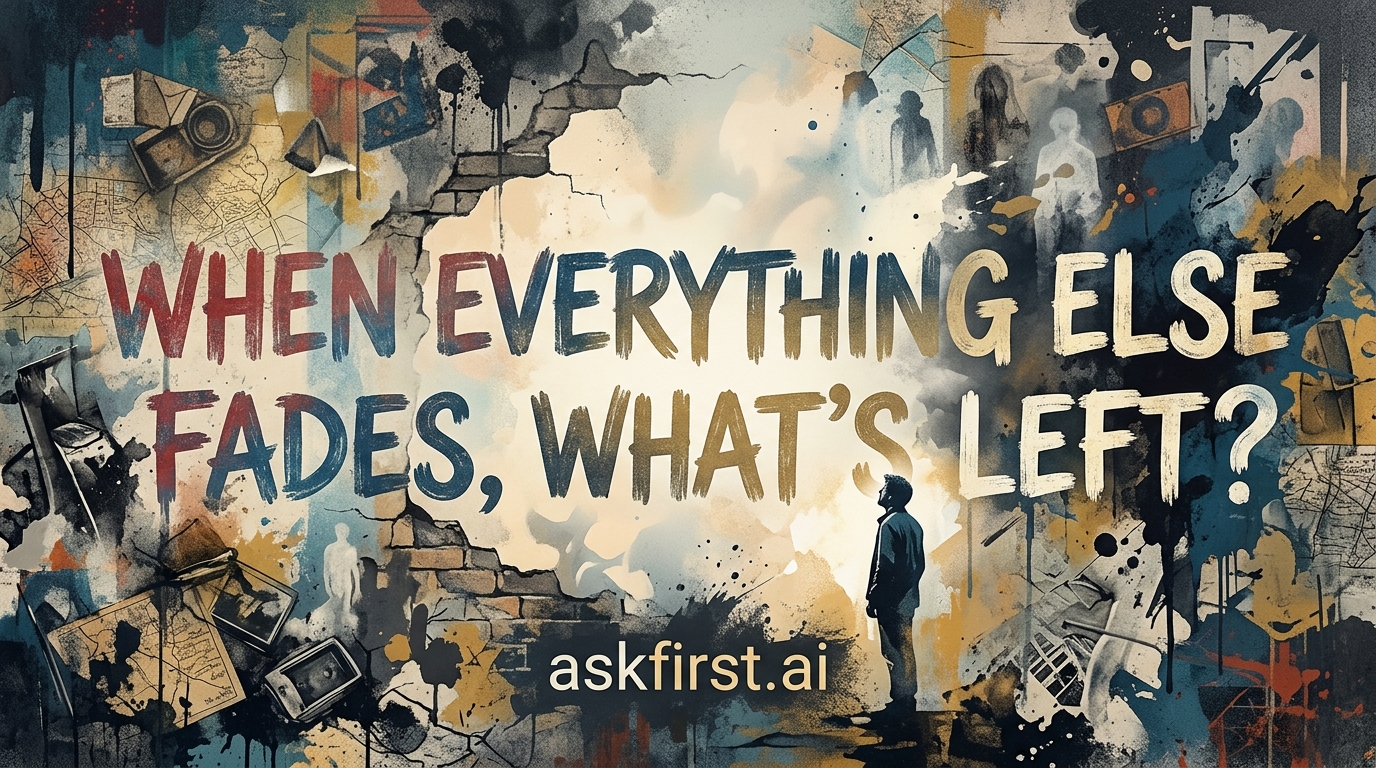
When the noise of daily life—the professional ambitions, the digital cacophony, the material acquisitions, and the ego-driven narratives—gradually recedes, we are confronted with the fundamental question of human existence: What remains? This inquiry has occupied the minds of philosophers, theologians, and physicists for millennia. To understand what persists when everything else fades, we must peel back the layers of the constructed self to reveal the bedrock of reality.
The Philosophical Perspective: The "Atman" and the "Tabula Rasa"
In the ancient Vedic traditions of India, specifically within the Upanishads, the answer is defined as Atman—the eternal, unchanging core of the individual. The sages argued that while our bodies age and our memories flicker, there is a "witness consciousness" that remains untouched by the passage of time. This is not a personality or a set of beliefs, but the pure capacity to be aware.
Contrast this with the Western philosophical tradition, such as John Locke’s An Essay Concerning Human Understanding. Locke famously posited the tabula rasa (blank slate), suggesting we are products of experience. However, when we strip away those experiences, modern existentialists like Jean-Paul Sartre would argue that what remains is "radical freedom." In Being and Nothingness, Sartre posits that human consciousness is a "nothingness" that creates its own meaning. When external markers fade, we are left with the sheer, terrifying, and beautiful responsibility of existence itself—the raw potential to choose who we are in the next moment.
The Biological Imperative: The Continuity of Life
From a biological standpoint, when the individual ego fades, what remains is the continuity of the species. Richard Dawkins, in his seminal work The Selfish Gene, shifts the focus from the individual to the genetic sequence. He argues that we are essentially "survival machines" for our genes. Even when an individual life concludes, the biological instruction set—the blueprints of life that have survived for billions of years—persists.
This is not merely a clinical observation; it is a profound realization of interconnectedness. We are part of a continuous chain of life that stretches back to the first single-celled organisms. When our personal narratives fade, the biological legacy remains, encoded in the DNA of our descendants and the collective biosphere. We are a temporary manifestation of an ancient, ongoing process.
The Physical Reality: Energy and Information
If we look toward modern physics, the answer takes a more abstract, yet mathematically rigorous form. According to the First Law of Thermodynamics, energy cannot be created or destroyed, only transformed. When the structures of our physical bodies dissolve, the energy that animated them does not vanish; it reintegrates into the universe.
Furthermore, in the realm of information theory, as explored by thinkers like Leonard Susskind in The Black Hole War, there is a hypothesis known as the "Holographic Principle." This suggests that the information about every particle in the universe is encoded on its boundary. In this view, nothing is ever truly lost. Even the complex patterns of our thoughts and experiences are, in some sense, etched into the fabric of spacetime. When the "everything else" of our daily experience fades, the fundamental information of our existence remains as a permanent, albeit transformed, part of the cosmic record.
The Psychological Bedrock: The Capacity for Connection
On a more humanistic level, when we strip away the titles, the wealth, and the social status, what remains is the capacity for love and connection. Viktor Frankl, a psychiatrist and Holocaust survivor, documented this in Man’s Search for Meaning. In the depths of the concentration camps, where all external markers of identity had been forcibly removed, Frankl discovered that the ability to find meaning—through love, through work, or through an attitude of courage—was the final, indestructible human freedom.
Even when the world is stripped away, the capacity to care for another, to perceive beauty, and to hold onto a sense of purpose persists. This "human spark" is not dependent on circumstances; it is an inherent property of consciousness. It is the ability to say "yes" to life, even when life offers nothing but suffering.
Conclusion: The Unfading Core
When everything else fades, we are left with a composite of these truths: the witness consciousness that observes existence, the biological thread that links us to all life, the conserved energy and information that we contribute to the universe, and the indestructible capacity for meaning.
We are not merely the sum of our possessions or our social roles. We are the process of the universe experiencing itself. Whether viewed through the lens of ancient spirituality or modern science, the conclusion remains remarkably consistent: there is a core of reality—call it consciousness, energy, or love—that is persistent. It is the foundation upon which the fragile, changing world is built. Recognizing this is not a cause for despair, but for profound liberation. When we realize that what is essential cannot be lost, we are finally free to live with authenticity and grace.