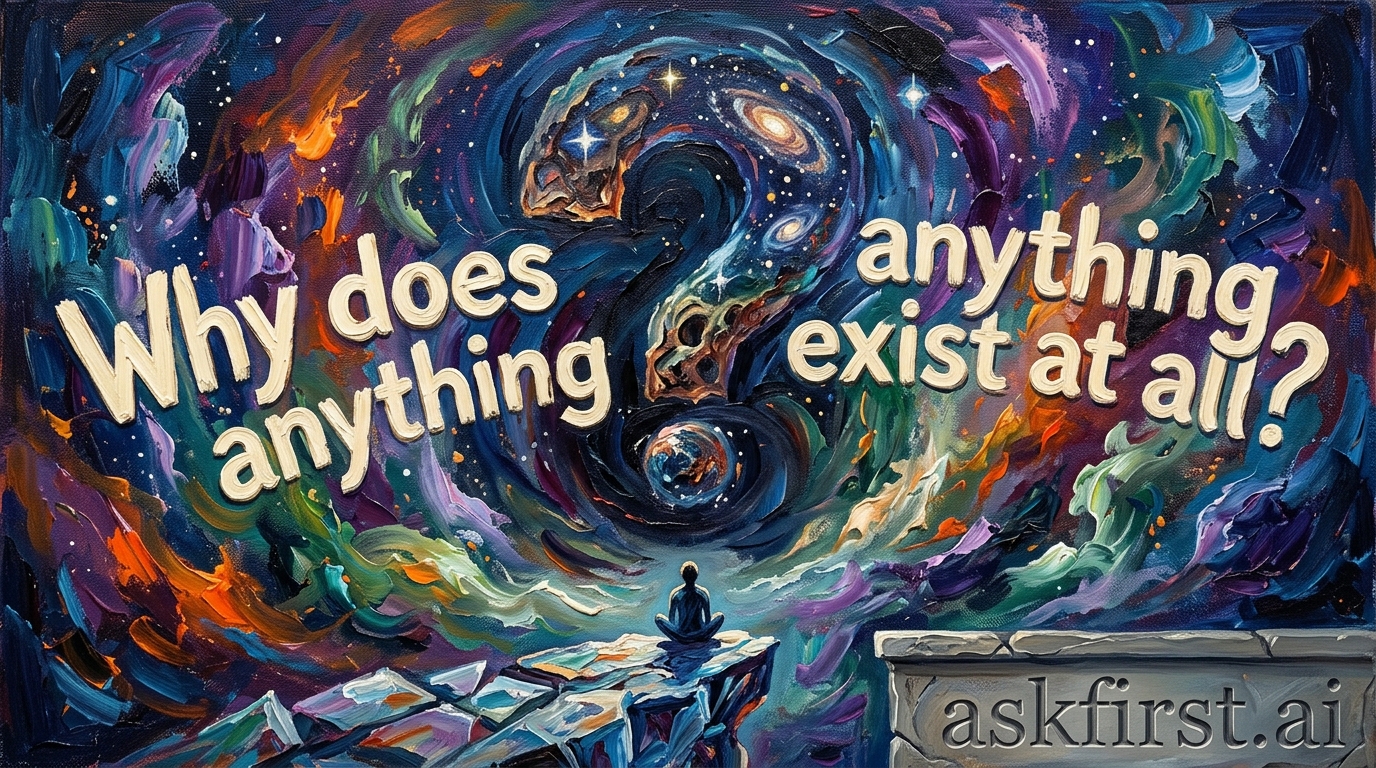
The question of why anything exists at all—often phrased as Gottfried Wilhelm Leibniz’s famous inquiry, "Why is there something rather than nothing?"—is perhaps the deepest mystery in philosophy, physics, and metaphysics. Because it sits at the edge of human knowledge, there is no single consensus, but rather several compelling frameworks:
The Principle of Sufficient Reason: Leibniz argued that for every fact, there must be a reason why it is so and not otherwise. In this view, the existence of the universe must have an explanation, which leads many to posit a "Necessary Being" (God or a fundamental logical structure) whose nature is to exist, thereby grounding the existence of everything else.
The Anthropic Principle: This perspective suggests that we shouldn't be surprised that the universe exists, because if it didn't, we wouldn't be here to ask the question. In a multiverse scenario, there could be an infinite number of "nothings" or failed universes, but we necessarily find ourselves in one that supports life.
Quantum Vacuum Fluctuations: From a modern physics standpoint, "nothing" is not necessarily empty. Quantum field theory suggests that even in a vacuum, particles pop in and out of existence. Some physicists, like Lawrence Krauss, argue that "nothing" is unstable, and that the laws of physics are such that a universe can arise from quantum fluctuations without requiring a prior cause.
Mathematical Platonism: Some thinkers, such as Max Tegmark, propose the Mathematical Universe Hypothesis. This suggests that mathematics is not just a tool to describe reality, but that reality is mathematics. In this view, all mathematical structures exist, and our physical universe is simply one of these structures that happens to be complex enough to contain self-aware observers.
The Limits of Language: Finally, many philosophers—notably those in the tradition of Ludwig Wittgenstein—argue that the question itself might be meaningless. Our language and logic are evolved to describe things within the universe (cause and effect, time, space). Attempting to use these tools to explain the existence of the universe as a whole may be a category error, akin to asking what is "north of the North Pole."
In summary, we remain in a state of profound intellectual wonder. Whether the universe is a mathematical inevitability, a quantum accident, or a metaphysical necessity remains one of the greatest open questions in the history of thought.