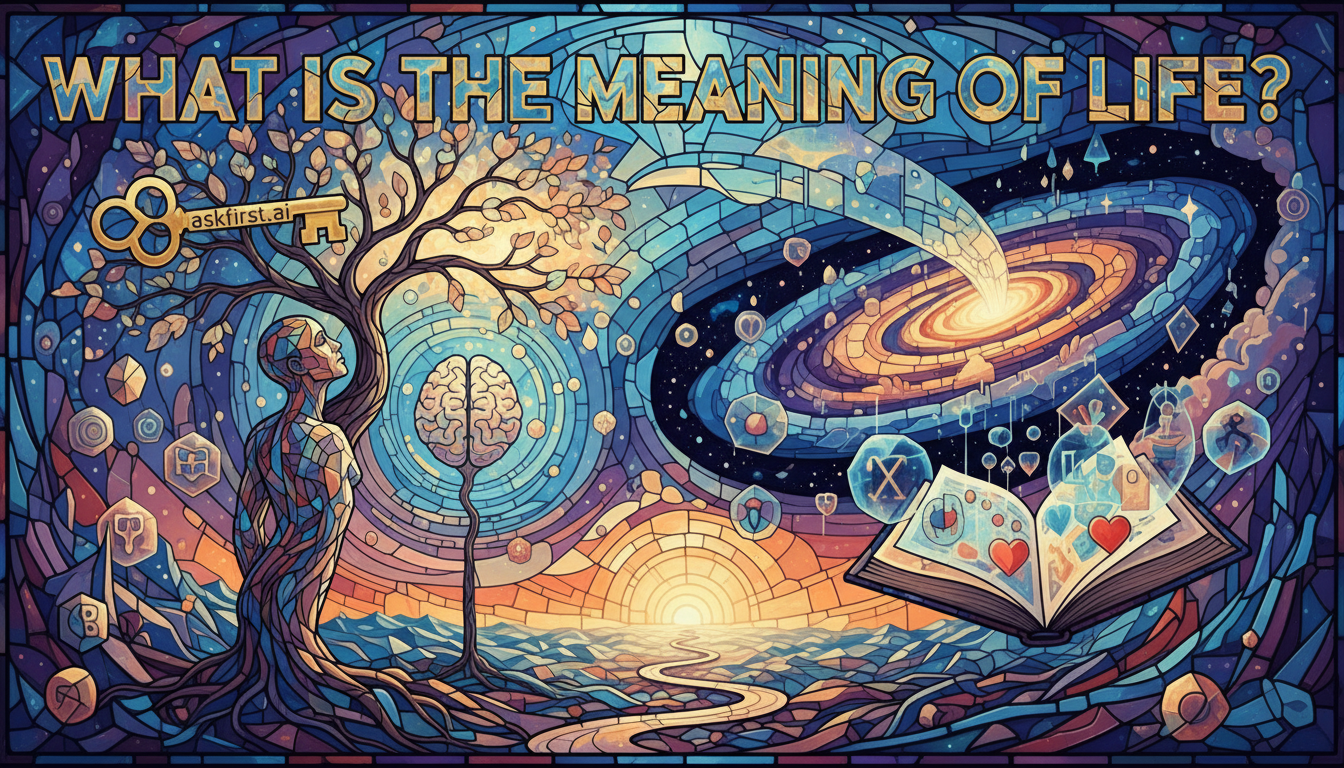
The question regarding the "meaning of life" is perhaps the most profound inquiry in human history. It has occupied the minds of theologians, philosophers, scientists, and artists for millennia. Because there is no single, empirically verifiable answer, the pursuit of this meaning is categorized into several distinct frameworks: the biological, the philosophical, the existential, and the psychological.
The Biological Perspective: Continuity and Propagation
From a purely evolutionary and biological standpoint, the "meaning" of life is objective and functional. Life exists to persist. According to the principles of evolutionary biology, every living organism is a vessel for genetic information. The primary objective is the survival of the species, achieved through adaptation, resource acquisition, and successful reproduction.
In this context, the meaning of life is the continuation of the chain of life. We are the beneficiaries of billions of years of successful genetic transmission. Our existence is a testament to the resilience of our ancestors. By passing on our genetic code or contributing to the collective knowledge and survival of our species, we fulfill a biological imperative that predates human consciousness.
Philosophical Frameworks: Virtue and Hedonism
Philosophers have long debated whether meaning is discovered or created. Throughout antiquity, two major schools of thought emerged:
- Virtue Ethics (Aristotelianism): Aristotle argued that the meaning of life is Eudaimonia, often translated as "flourishing" or "living well." He posited that humans have a specific function—reason—and that by exercising our rational faculties and living in accordance with virtue, we achieve our highest potential. For Aristotle, meaning is found in excellence and the fulfillment of one’s character.
- Hedonism and Epicureanism: Conversely, others argue that life’s meaning is derived from the pursuit of pleasure and the avoidance of pain. While often misunderstood as mere indulgence, the Epicurean tradition emphasizes the pursuit of ataraxia—a state of serene tranquility and freedom from fear. Here, the meaning of life is the cultivation of a peaceful, content existence.
The Existentialist Turn: Radical Freedom
In the 19th and 20th centuries, thinkers like Jean-Paul Sartre and Albert Camus shifted the narrative. Existentialism posits that "existence precedes essence." This means that humans are born into the world without a pre-defined purpose or "blueprint."
Sartre famously argued that because there is no divine architect or biological destiny that dictates our specific path, we are "condemned to be free." This radical freedom is both a burden and a gift. It implies that you are the sole author of your life’s meaning. If the universe provides no inherent map, you must draw your own. Camus, in The Myth of Sisyphus, explored the "absurd"—the conflict between the human search for meaning and the silent, meaningless universe. He concluded that we should embrace the absurdity and continue to live with passion and rebellion, finding joy in the struggle itself.
The Psychological Dimension: Purpose and Connection
Modern psychology, particularly the work of Viktor Frankl, offers a practical application to this age-old question. A psychiatrist and Holocaust survivor, Frankl wrote Man’s Search for Meaning, in which he argued that the primary human drive is not pleasure (as Freud suggested) or power (as Adler suggested), but the will to meaning.
Frankl identified three primary ways to find meaning in one's life:
- Creating a work or doing a deed: Contributing to the world through labor, art, or service.
- Experiencing something or encountering someone: Finding meaning through love, connection, and the appreciation of beauty or nature.
- The attitude we take toward unavoidable suffering: Even in circumstances where we cannot change our situation, we retain the freedom to choose our attitude. Finding meaning in suffering is, according to Frankl, the ultimate test of the human spirit.
Synthesizing the Search
To synthesize these views, we can conclude that the meaning of life is not a static object to be found hidden under a rock or written in the stars. It is a dynamic process of engagement.
Meaning is found in the intersection of three factors:
- Contribution: How you impact the world beyond yourself.
- Connection: The depth of your relationships with other sentient beings.
- Self-Actualization: The pursuit of your own growth, intellectual curiosity, and moral integrity.
Ultimately, the meaning of life is whatever you determine it to be. It is the narrative thread you weave through your experiences. Whether you find meaning in raising a family, solving complex scientific problems, creating art, or simply observing the beauty of a sunrise, your life gains significance through the weight of your own values. You are the architect of your own purpose, and the fact that the universe is vast and indifferent is not a cause for despair, but a blank canvas upon which you are free to paint your own definition of a life well-lived.