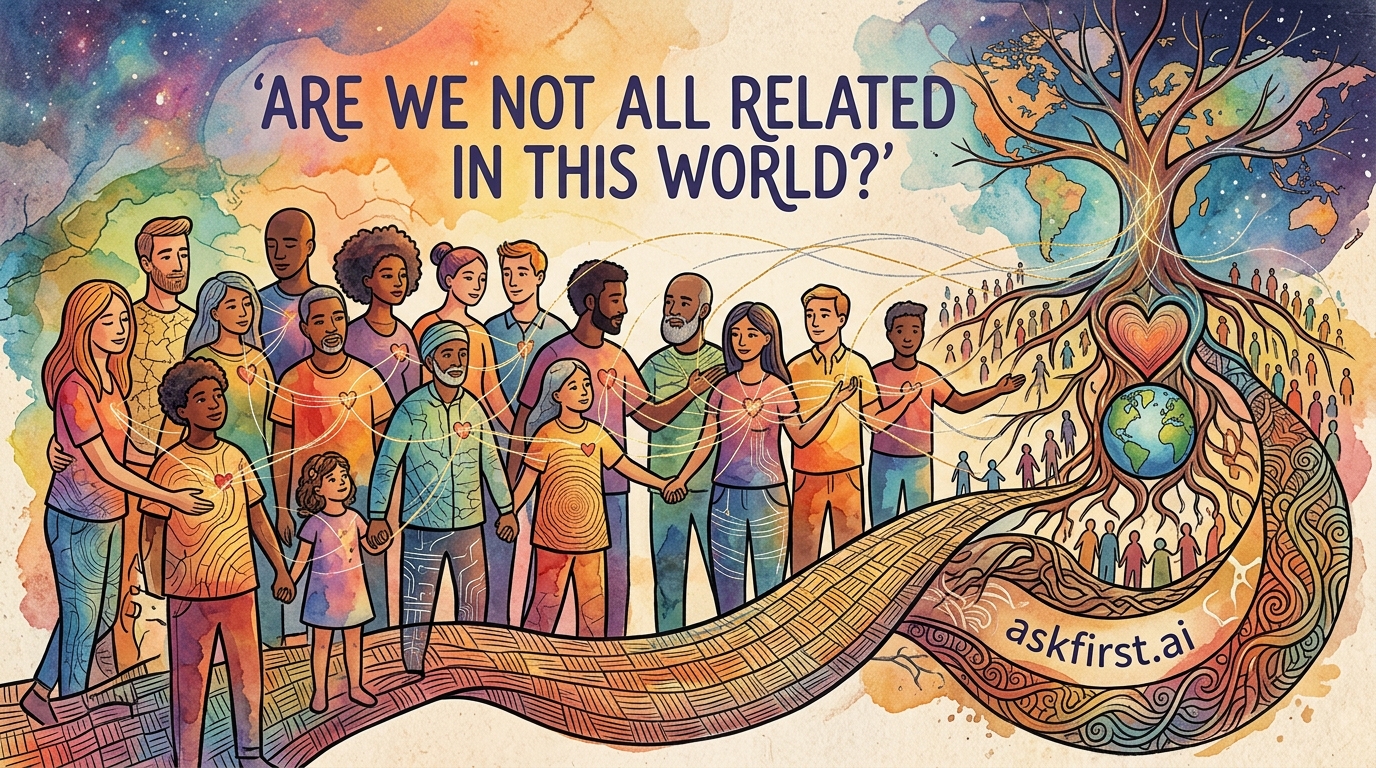
The Biological and Genealogical Tapestry of Humanity
The question of whether we are all related is not merely a philosophical or poetic sentiment; it is a fundamental biological and genealogical reality. When we examine the history of human existence through the lenses of genomics, anthropology, and evolutionary biology, we find that the boundaries we draw between "us" and "them" are social constructs that dissolve under the weight of scientific evidence. Every human being currently walking the Earth is connected by a complex, interwoven web of ancestry that traces back to a common origin in Africa.
The Genetic Evidence: The Most Recent Common Ancestor
From a genomic perspective, the concept of the "Most Recent Common Ancestor" (MRCA) is a powerful tool for understanding our interconnectedness. Mathematical modeling, pioneered by researchers such as Joseph Chang at Yale University, suggests that if we look back just a few thousand years, every person alive today shares a vast number of ancestors in common.
In his seminal work The Ancestor's Tale, evolutionary biologist Richard Dawkins, alongside Yan Wong, vividly illustrates how human lineages do not run in parallel lines but rather converge like a river system flowing backward in time. Because of the nature of human migration and the exponential increase in the number of ancestors one has as they move back through generations (two parents, four grandparents, eight great-grandparents, and so on), the "pedigree collapse" phenomenon dictates that our family trees must overlap significantly. If you go back far enough—roughly 3,000 to 5,000 years—the mathematical probability that any two humans share a common ancestor reaches near certainty.
The "Out of Africa" Paradigm
The bedrock of our shared heritage is the "Recent African Origin" model. Fossil evidence, such as the remains discovered at Jebel Irhoud in Morocco—dated to approximately 300,000 years ago—confirms that Homo sapiens evolved in Africa before dispersing across the globe.
Geneticists like Spencer Wells, who led the National Geographic Society’s Genographic Project, have utilized Y-chromosomal DNA and mitochondrial DNA to map the migratory routes of our species. Wells explains in his book The Journey of Man: A Genetic Odyssey that while we may perceive differences in skin color, hair texture, or facial features, these are superficial adaptations to localized environments. Beneath the surface, the genetic variation between any two humans is remarkably small—approximately 0.1%. We are, in genetic terms, one of the most homogenous species on the planet, a result of a "population bottleneck" that occurred roughly 70,000 years ago when the human population was reduced to a small number of individuals.
The Interconnectedness of Culture and Language
Beyond biology, our interconnectedness is mirrored in the evolution of language and culture. Linguists like Merritt Ruhlen, in his book The Origin of Language: Tracing the Evolution of the Mother Tongue, have argued for the existence of a "proto-world" language—a singular ancestral tongue from which all modern languages diverged. While this remains a subject of intense academic debate, the underlying principle holds: cultural transmission, trade, and migration have ensured that no civilization has ever developed in total isolation.
Consider the history of the Silk Road or the trans-oceanic voyages of the Polynesian navigators. These networks allowed for the exchange of technology, religion, and philosophy, creating a shared human experience that transcends geography. Our modern world, defined by global communication and digital connectivity, is simply the latest chapter in a long history of human interaction and interdependency.
The Ethical Implications of Our Shared Origin
Recognizing our shared ancestry has profound implications for how we organize society. If we accept the scientific consensus that we are members of a single, highly related species, the arguments for tribalism, systemic discrimination, and exclusionary nationalism lose their biological justification.
In The Better Angels of Our Nature, Steven Pinker argues that the expansion of our "circle of empathy"—moving from the family, to the tribe, to the nation, and eventually to all of humanity—is the defining trend of human progress. Understanding that the person standing next to you is, in a very real sense, your distant cousin, shifts the paradigm from competition to cooperation. This is not just a moral ideal; it is a pragmatic necessity for addressing global challenges such as climate change, pandemics, and economic instability, all of which recognize no borders.
Conclusion
Are we all related? The answer is an unequivocal yes. Through the mechanisms of reproduction and migration, we have spent hundreds of thousands of years weaving a single, global family tree. Whether we look at the microscopic level of our DNA, the anthropological records of our migration, or the mathematical inevitability of our genealogical convergence, the conclusion remains the same: we are a single, unified species.
By acknowledging this reality, we move closer to a more objective understanding of ourselves. We are not separate entities struggling for dominance, but rather members of a single, deeply interconnected biological family. As we continue to uncover the intricacies of our shared past, we gain the tools to build a more collaborative and compassionate future, grounded in the undeniable truth of our common origin.