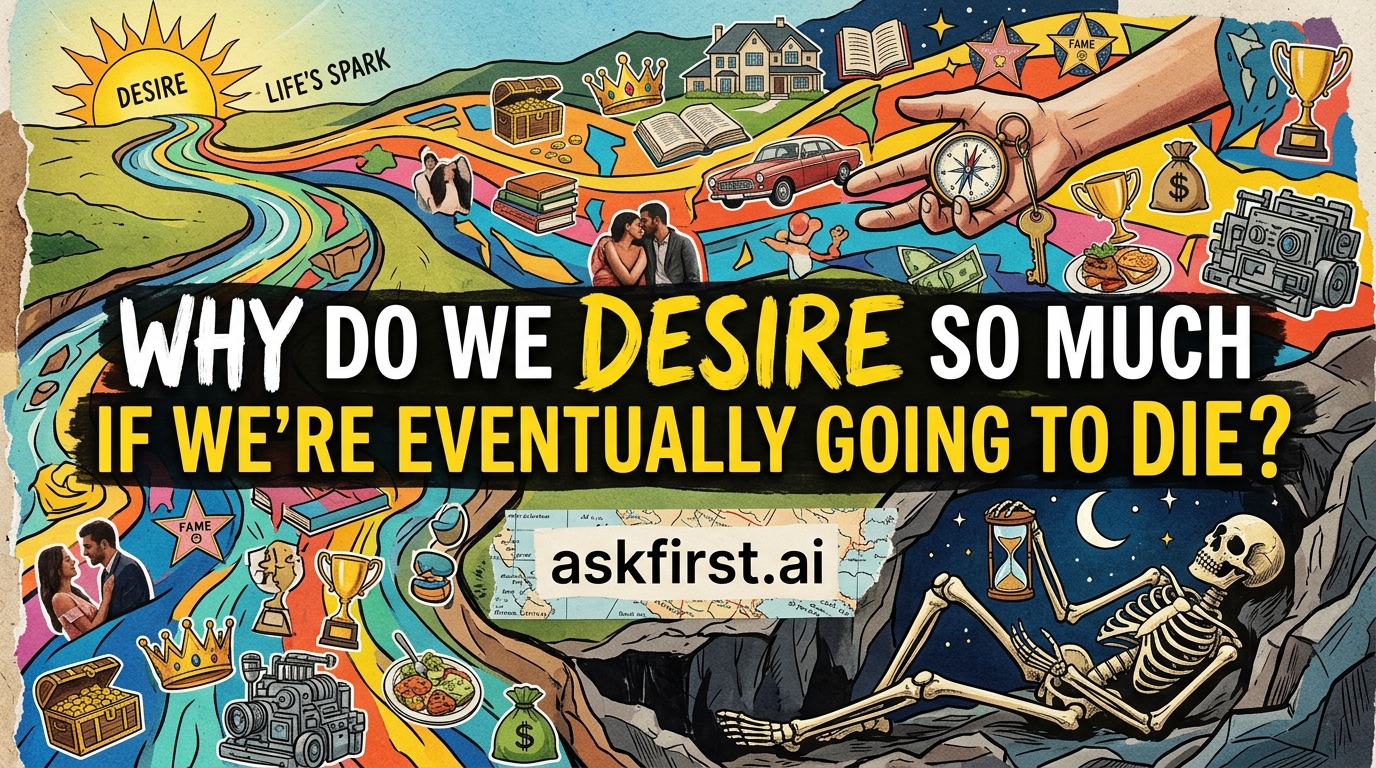
The human condition is defined by a profound, recurring paradox: we are creatures possessed of infinite ambition, yet we operate within the rigid constraints of a finite lifespan. This tension between our relentless desire to acquire, achieve, and experience, and the looming reality of mortality, is the central theme of philosophical inquiry across human history. To understand why we persist in desiring despite the certainty of death, we must examine the biological, psychological, and existential dimensions of the human experience.
The Biological Imperative: Evolution as the Architect of Desire
From a strictly evolutionary standpoint, desire is not a bug in our cognitive software; it is the primary engine of survival. As Richard Dawkins argues in The Selfish Gene, our biological systems are programmed to prioritize gene propagation and resource accumulation. We desire because our ancestors who lacked desire—those who did not strive for food, status, or reproductive success—did not survive long enough to pass on their traits.
Even though we are now conscious of our mortality, our neurobiology remains governed by the dopamine reward circuits that evolved in the Pleistocene era. When we set a goal, work toward it, and achieve it, our brains release neurotransmitters that reinforce the behavior. We are, in a sense, biologically compelled to act as though we have all the time in the world because our survival mechanisms do not possess an "off switch" for the reality of death. We desire because we are the descendants of the most successfully dissatisfied organisms in history.
The Existential Drive: Building a Legacy Against Oblivion
Beyond biology, there is the existential project of self-transcendence. Ernest Becker, in his Pulitzer Prize-winning masterpiece The Denial of Death, posits that human civilization is essentially a massive, symbolic defense mechanism against the terror of our own mortality. Becker argues that because we are the only species aware of our inevitable end, we seek to "heroize" ourselves by creating cultural works, accumulating wealth, or seeking fame.
We desire so much because we are attempting to project our identities into a future where we no longer exist. Whether it is writing a book, building a company, or raising a family, these acts are attempts to leave a "residue" of the self. We desire status and achievement not just for the immediate gratification, but because they serve as anchors in the stream of time, providing the illusion that we have made an impact that will outlast our physical bodies. In this sense, desire is a shield against the existential void.
The Hedonic Treadmill and the Psychology of Becoming
Psychologically, humans are governed by what researchers Brickman and Campbell termed the "Hedonic Treadmill." This concept suggests that we possess a baseline level of happiness to which we eventually return, regardless of our successes or failures. We desire because the act of "becoming" is more cognitively stimulating than the state of "being."
Consider the life of a mountain climber. Reaching the summit is a fleeting moment of satisfaction, but the desire that drives the climber is found in the grueling weeks of preparation and the ascent itself. The philosopher Arthur Schopenhauer, in The World as Will and Representation, suggested that human life swings like a pendulum between pain and boredom. We desire to escape the boredom of stasis, and we fear the pain of loss. By constantly desiring, we fill the emptiness of our existence with purpose, effectively distracting ourselves from the silent ticking of the clock.
The Meaning of the Finite
Perhaps the most compelling argument for why we desire despite death is that mortality is the very condition that gives our desires value. If we were immortal, nothing would ever be urgent. If we had infinite time to learn every language, visit every country, and master every craft, the choice to do any one of those things would lose its weight.
In Being and Time, Martin Heidegger argues that human existence is defined by "Being-towards-death." He suggests that recognizing our mortality is what allows us to live authentically. When we accept that our time is limited, our desires become focused, passionate, and meaningful. The scarcity of time is what creates the value of the experience. We desire because the very act of wanting something—and working to achieve it before our time runs out—is what defines us as human. It is the friction between our infinite capacity to imagine and our finite capacity to execute that creates the sparks of human culture, art, and innovation.
Conclusion
We desire in the face of death because we are not merely passive observers of our lives; we are active participants in a narrative that we are writing in real-time. Our desires are the ink with which we record our presence in the universe. While the biological drive for survival, the existential need to deny death, and the psychological pursuit of novelty all play their parts, the ultimate reason we desire is that it is the most vital expression of life itself. To stop desiring would be to surrender to the void before it arrives. Instead, we embrace the tension, understanding that while we may be destined for an end, the intensity of our pursuit is what makes the journey profound.